Assessing academic integrity patterns among pre-service teachers using AI-based plagiarism detection

Downloads
Abstract
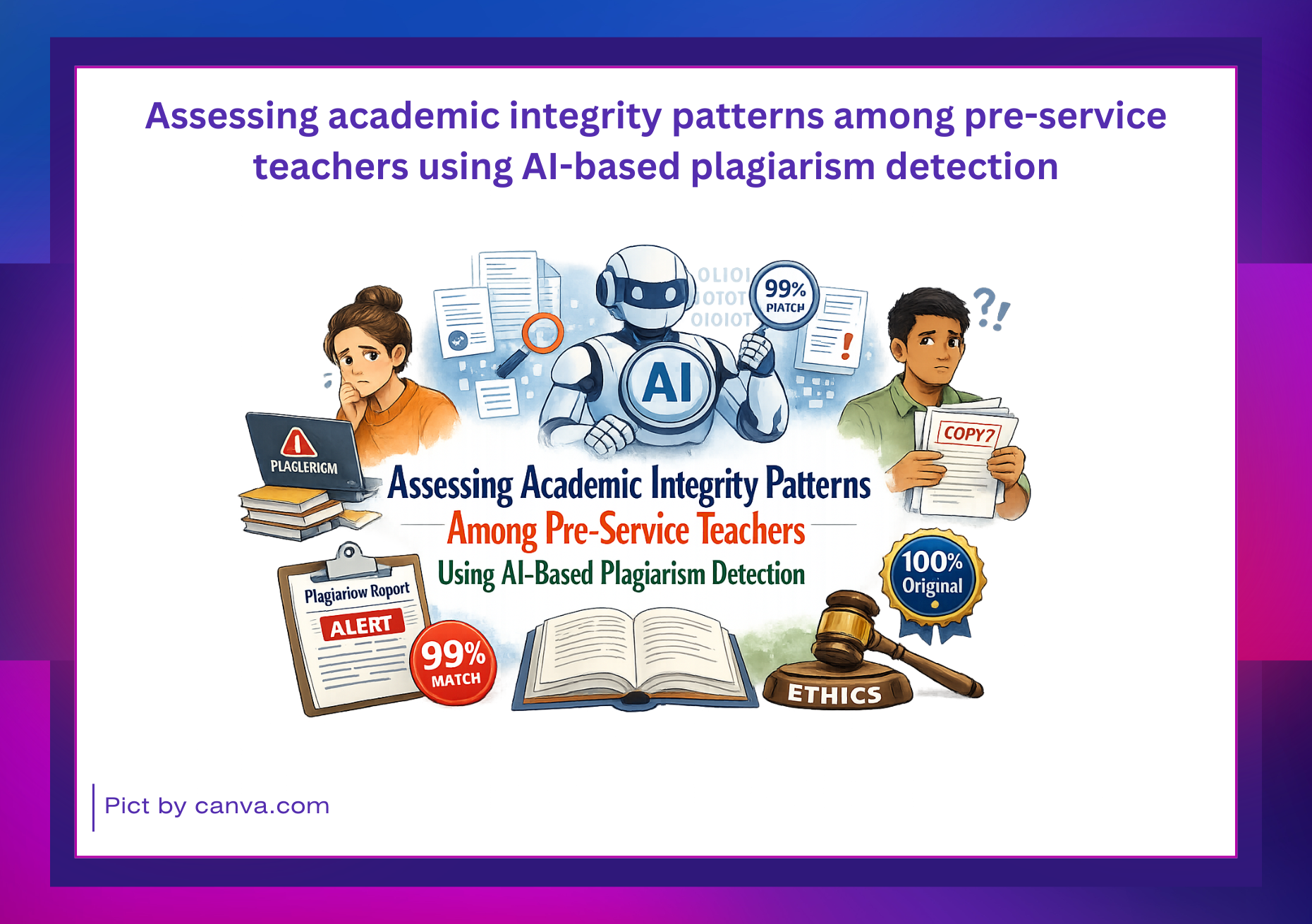
Background: The advent of artificial intelligence has intensified concerns about academic dishonesty among students, particularly in written outputs. Plagiarism, a common form of misconduct, involves using others’ ideas without proper attribution.
Objectives: This study aimed to determine the degree and patterns of academic integrity in the pre-service teachers’ book reviews.
Methods: Employing a descriptive research design through document analysis, the study used purposive sampling to collect 40 book reviews, applying set inclusion and exclusion criteria. An AI-based plagiarism detection tool, Grammarly, was used to identify instances of plagiarism and assess the level of academic integrity reflected in the outputs. Descriptive statistical methods were applied to examine plagiarism levels across different sections of the book reviews.
Results: Results showed that the majority of pre-service teachers demonstrated a very high level of academic integrity in their book reviews, scoring 97% or interpreted as students committing 3% plagiarism. Furthermore, sectional analysis showed that the introduction and conclusion exhibited higher integrity, while the body contained the most instances of plagiarism. This suggests that students struggled more with sections requiring critical thinking, original insights, and proper citation. Most plagiarism cases were linked to failure to cite sources and unintentional misuse of references.
Conclusions: Teacher Education Institutions integrate AI-supported evaluation tools and plagiarism detection systems into instruction and assessment. Embedding academic integrity modules and discussions on AI ethics is also encouraged. Future research should involve larger and more diverse samples and utilize multiple AI detection tools to enhance the reliability and validity of findings through cross-verification.
Adams, M. (2007). In the profession: re-viewing the academic book review. Journal of English Linguistics, 35(2), 202–205. https://doi.org/10.1177/0075424207302347
Anney, V. N., & Mosha, M. A. (2015). Student's Plagiarisms in Higher Learning Institutions in the Era of Improved Internet Access: Case Study of Developing Countries. Journal of Education and Practice, 6(13), 203-216. https://eric.ed.gov/?id=EJ1080502
Baran, L., & Jonason, P. K. (2020). Academic dishonesty among university students: The roles of the psychopathy, motivation, and self-efficacy. PLoS ONE, 15(8), e0238141. https://doi.org/10.1371/journal.pone.0238141
Batane, T. (2010). Turning to Turnitin to fight plagiarism among university students. Journal of Educational Technology & Society, 13(2), 1-12. https://www.learntechlib.org/p/75346/
Bautista, R. M., & Pentang, J. T. (2022). Ctrl C+ Ctrl V: Plagiarism and knowledge on referencing and citation among pre-service teachers. International Journal of Multidisciplinary: Applied Business and Education Research, 3(2), 245-257. http://dx.doi.org/10.11594/ijmaber.03.02.10
Bolívar, A. (2025). El lugar de la ética profesional en la formación universitaria. Revista mexicana de investigación educativa, 10(24), 93-123. https://www.scielo.org.mx/pdf/rmie/v10n24/1405-6666-rmie-10-24-93.pdf
Cambridge Dictionary. (2022). Honesty. Retrieved from https://dictionary.cambridge.org/us/dictionary/english/honesty
Clarke, O., Chan, W. Y. D., Bukuru, S., Logan, J., & Wong, R. (2023). Assessing knowledge of and attitudes towards plagiarism and ability to recognize plagiaristic writing among university students in Rwanda. Higher Education, 85(2), 247-263. https://doi.org/10.1007/s10734-022-00830-y
Devika, S., & Sheela, P. (2020). Perception of prospective teachers on academic integrity. In Innovations in the designing and marketing of information services (pp. 135-147). IGI Global. https://doi.org/10.4018/978-1-7998-1482-5.ch010
Dong, Y., & Shi, L. (2021). Using Grammarly to support students’ source-based writing practices. Assessing Writing, 50, 100564. https://doi.org/10.1016/j.asw.2021.100564
Edwards, D., & Mercer, N. (2013). Common knowledge (Routledge revivals): The development of understanding in the classroom. Routledge.
Espinosaa, C. D., & Toquero, C. M. D. (2018). Academic Integrity: Influence on the Research Skills of the Pre-Service Teachers. International Journal of Education Excellent, 4(2), 15-28. https://doi.org/10.18562/IJEE.036
Garg, R. (2016). Methodology for research I. Indian journal of anaesthesia, 60(9), 640-645. https://doi.org/10.4103/0019-5049.190619
Gömbeyaz, K. (2019). A guide for book reviews. ULUM, 2(1), 169-174. https://doi.org/10.5281/zenodo.3358594
International Center for Academic Integrity. (2022). Fundamental values of academic integrity. Retrieved from https://academicintegrity.org/resources/fundamentalvalues
Lee, A. D., Green, B. N., Johnson, C. D., & Nyquist, J. (2010). How to write a scholarly book review for publication in a peer-reviewed journal: a review of the literature. Journal of Chiropractic Education, 24(1), 57-69. https://doi.org/10.7899/1042-5055-24.1.57
Maryon, T., Dubre, V., Elliott, K., Escareno, J., Fagan, M. H., Standridge, E., & Lieneck, C. (2022). COVID-19 academic integrity violations and trends: A rapid review. Education Sciences, 12(12), 901. https://doi.org/10.3390/educsci12120901
Ng, Y. M., & Yip, C. W. (2019). A 3-step teaching approach for a blended learning of ‘understanding and avoiding unintentional plagiarism’. Nurse education in practice, 41, 102643. https://doi.org/10.1016/j.nepr.2019.102643
Perdana, I., & Farida, M. (2019). Online grammar checkers and their use for EFL writing. Journal of English Teaching, Applied Linguistics and Literatures (JETALL), 2(2), 67-76. https://doi.org/10.20527/jetall.v2i2.7332
Selemani, A., Chawinga, W. D., & Dube, G. (2018). Why do postgraduate students commit plagiarism? An empirical study. International Journal for Educational Integrity, 14(1), 7. https://doi.org/10.1007/s40979-018-0029-6
Shapoval, R. V., Nastyuk, V. Y., Inshyn, M. I., & Posashkov, A. A. (2021). Academic honesty: Current status and ways of improvement. Justicia, 26(39), 37-46. https://doi.org/10.17081/just.26.39.4818
Turner, K. L., Adams, J. D., & Eaton, S. E. (2022). Academic integrity, STEM education, and COVID-19: A call to action. Cultural Studies of Science Education, 17(2), 331–339. https://doi.org/10.1007/s11422-021-10090-4
Waltzer, T., & Dahl, A. (2021). Students’ perceptions and evaluations of plagiarism: Effects of text and context. Journal of Moral Education, 50(4), 436-451. https://doi.org/10.1080/03057240.2020.1787961
Wheeler, D., & Anderson, D. (2010). Dealing with plagiarism in a complex information society. Education, Business and Society: Contemporary Middle Eastern Issues, 3(3), 166–177. https://doi.org/10.1108/17537981011070082
Yazici, S., Yildiz Durak, H., Aksu Dünya, B., & Şentürk, B. (2023). Online versus face-to-face cheating: The prevalence of cheating behaviours during the pandemic compared to the pre-pandemic among Turkish university students. Journal of Computer Assisted Learning, 39(1), 231–254. https://doi.org/10.1111/jcal.12743
Zaman, N. A. B., Yatin, S. F. M., Saad, N. S., Rashid, S. N., Kamis, Y., Abd Kadir, I. K., & Dollah, W. A. K. W. (2020). Plagiarism and academic integrity. International Journal of Academic Research in Business and Social Sciences, 10(11), 1138–1149. http://dx.doi.org/10.6007/IJARBSS/v10-i11/8189
Copyright (c) 2026 Irish Arroyo, Sittie Nor Aisha Rusiana, Daniere Maryje Tabada, Kim Silva, Carla Marie Rubio, Esmeraldo Sarad, Cathy Mae Toquero

This work is licensed under a Creative Commons Attribution-ShareAlike 4.0 International License.