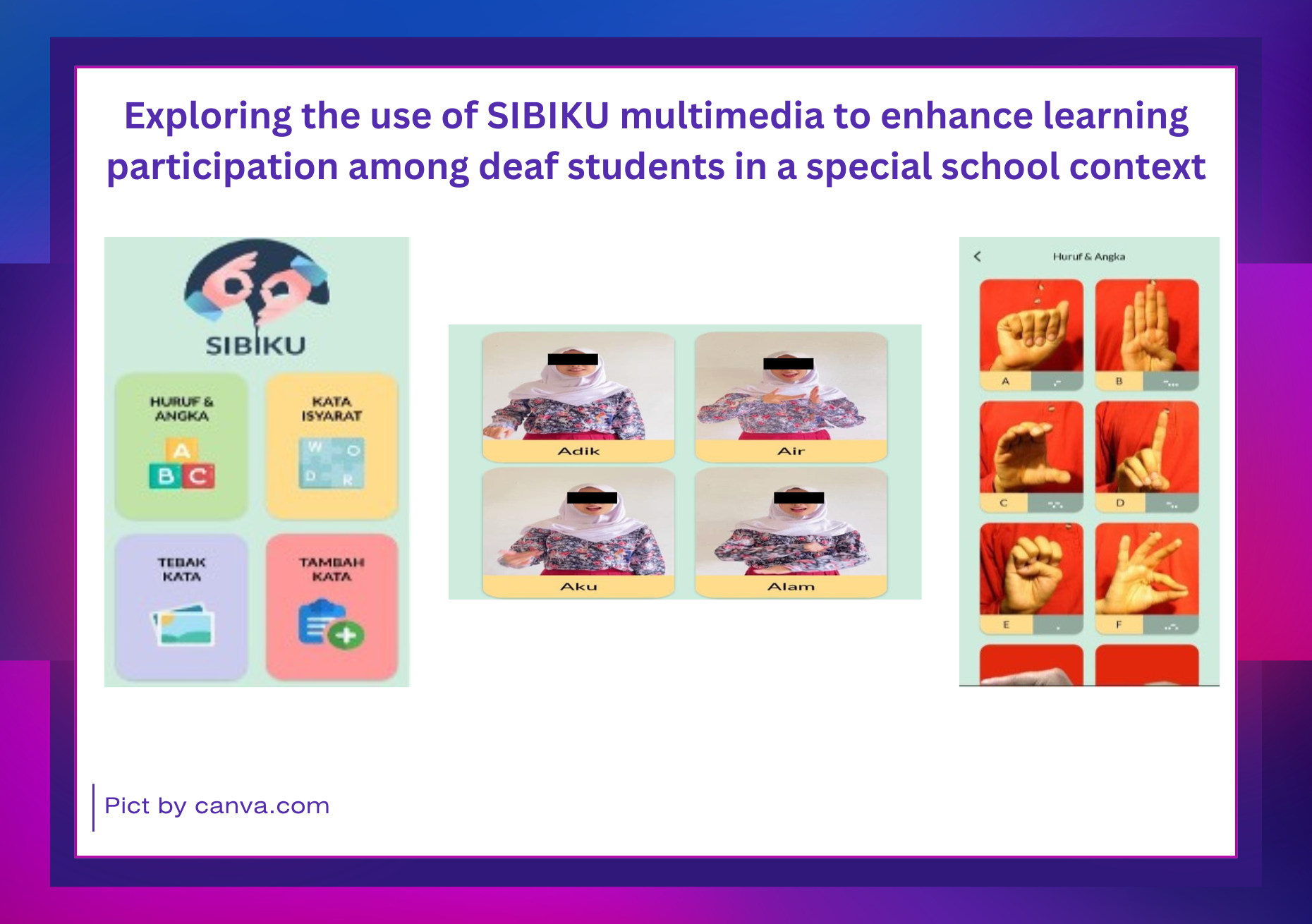
Exploring the use of SIBIKU multimedia to enhance learning participation among deaf students in a special school context

Downloads
Abstract
Background: Observations at SLB C YPALB Perwari Kuningan indicate low motivation and limited participation among deaf students during learning activities. Interactive multimedia such as SIBIKU is expected to address these challenges.
Objectives: This study aims to (1) examine the implementation of SIBIKU multimedia in learning, (2) analyze students’ responses, and (3) evaluate changes in students’ learning participation and vocabulary acquisition.
Methods: This study employed a descriptive qualitative design with a field-based approach. Participants were selected using purposive sampling, consisting of one teacher and deaf students involved in computer learning activities. Data were collected through participatory observation, semi-structured interviews, and documentation. The main instrument was the researcher, supported by observation and interview guidelines. Data were analyzed using thematic analysis following Miles and Huberman’s model, including data reduction, data display, and conclusion drawing, with triangulation to ensure validity.
Results: The findings show that SIBIKU multimedia enhances student participation, as indicated by (1) increased attention to learning media, (2) active imitation of sign language movements, (3) higher frequency of student interaction and turn-taking, and (4) greater engagement in learning tasks such as word-guessing activities. Students also demonstrated improved motivation and more independent learning behavior.
Conclusions: SIBIKU multimedia provides a visually rich, interactive learning environment that effectively increases participation and engagement among deaf students, making it a promising tool for inclusive education.Al-Azawei, A., Serenelli, F., & Lundqvist, K. (2016). Universal Design for Learning (UDL): A content analysis of peer reviewed journals from 2012 to 2015. Journal of the Scholarship of Teaching and Learning, 16(3), 39-56. https://doi.org/10.14434/josotl.v16i3.19295
Bonfield, C. A., Salter, M., Longmuir, A., Benson, M., & Adachi, C. (2020). Transformation or evolution?: Education 4.0, teaching and learning in the digital age. Higher education pedagogies, 5(1), 223-246. https://doi.org/10.1080/23752696.2020.1816847
Budiyanto, Kabri, K., Harapan, E. ., & Purwanto, M. B. (2024). 21st Century English Learning: a Revolution in Skills, Critical Thinking, Creativity, and Visual Communication. Asian Journal of Applied Education (AJAE), 3(1), 43–54. https://doi.org/10.55927/ajae.v3i1.7841
Clanton Harpine, E. (2024). Creating an intrinsically motivating learning environment: Promoting student engagement and intrinsic motivation. In Service Learning in Higher Education: From Pedagogy to Practice (pp. 59-76). Cham: Springer Nature Switzerland. https://doi.org/10.1007/978-3-031-51378-7_5
Debevc, M., Kosec, P., & Holzinger, A. (2011). Improving multimodal web accessibility for deaf people: sign language interpreter module. Multimedia Tools and Applications, 54(1), 181-199. https://doi.org/10.1007/s11042-010-0529-8
Imlawi, J. (2021). Students’ engagement in E-learning applications: The impact of sound’s elements. Education and Information Technologies, 26(5), 6227-6239. https://doi.org/10.1007/s10639-021-10605-0
Indriani, F., AlQisan, N. H., & Okfitri, N. N. (2021, September). Innovative learning era industrial revolution 4.0 in optimizing 21st century competence elementary school students. In Proceedings of the Second Asia Pacific International Conference on Industrial Engineering and Operations Management (pp. 3147-3157). https://ieomsociety.org/proceedings/2021indonesia/570.pdf
Jayasekara, R. (2024, October). Enhancing the learning experience in e-learning platforms-Activity based learning approach with multimedia. In AIP Conference Proceedings (Vol. 3220, No. 1, p. 030031). AIP Publishing LLC. https://doi.org/10.1063/5.0234893
Jervis, M. G., & Drake, M. A. (2014). The use of qualitative research methods in quantitative science: A review. Journal of Sensory Studies, 29(4), 234-247. https://doi.org/10.1111/joss.12101
Kumar, N. (2025). Special Education: Tailored Approaches for Students with Disabilities. IJSAT-International Journal on Science and Technology, 16(4), 1-7. https://doi.org/10.71097/IJSAT.v16.i4.8947
Liaw, S. S., & Huang, H. M. (2013). Perceived satisfaction, perceived usefulness and interactive learning environments as predictors to self-regulation in e-learning environments. Computers & education, 60(1), 14-24. https://doi.org/10.1016/j.compedu.2012.07.015
Mayer, R. E. (2002). Multimedia learning. In Psychology of learning and motivation (Vol. 41, pp. 85-139). Academic Press. https://doi.org/10.1017/CBO9780511811678
Machumu, H., & Zhu, C. (2017). The relationship between student conceptions of constructivist learning and their engagement in constructivist based blended learning environments. International Journal of Learning Technology, 12(3), 253-272. https://doi.org/10.1504/IJLT.2017.088408
Moreno, R., & Mayer, R. (2007). Interactive multimodal learning environments: Special issue on interactive learning environments: Contemporary issues and trends. Educational psychology review, 19(3), 309-326. https://doi.org/10.1007/s10648-007-9047-2
Ryan, R. M., & Deci, E. L. (2024). Self-determination theory. In Encyclopedia of quality of life and well-being research (pp. 6229-6235). Cham: Springer International Publishing. https://doi.org/10.1007/978-3-031-17299-1_2630
Saxena, R. R., Voss, W., & Mahmood, S. (2024). Empowering Learners Globally: A User Interface and User Experience Design Case Study Describing the Development of a Mobile Application That Bridges the Educational Divide Through Accessible Instructional Resources. Authorea Preprints. https://doi.org/10.36227/techrxiv.172175659.90097054/v1
Scifo, L., Fulantelli, G., & Vivas, A. J. (2025). Special EducationAL Needs in Preschools: Types, Characteristics, and Needed Adaptations. In Physical Education in Early Childhood (pp. 359-372). Routledge. https://doi.org/10.4324/9781003615675
Sun, J. C. Y., & Hsieh, P. H. (2018). Application of a gamified interactive response system to enhance the intrinsic and extrinsic motivation, student engagement, and attention of English learners. Journal of Educational Technology & Society, 21(3), 104-116. https://www.learntechlib.org/p/190822/
Tohani, E., & Aulia, I. (2022). Effects of 21st century learning on the development of critical thinking, creativity, communication, and collaboration skills. Journal of Nonformal Education, 8(1), 46-53. https://doi.org/10.15294/jne.v8i1.33334
Yusuf, M., Adriyanto, F., Priyono, P., & Rahman, A. (2022, December). Pedagogical problem faced by teachers in communication and language learning for deaf students in special schools. In 3rd Progress in Social Science, Humanities and Education Research Symposium (PSSHERS 2021) (pp. 15-27). Atlantis Press. https://doi.org/10.2991/978-2-494069-33-6_3
Zydney, J. M., & Warner, Z. (2016). Mobile apps for science learning: Review of research. Computers & Education, 94, 1-17. https://doi.org/10.1016/j.compedu.2015.11.001
Copyright (c) 2026 Nurina Ayuningtyas, Ahmad Fajri Lutfi

This work is licensed under a Creative Commons Attribution-ShareAlike 4.0 International License.