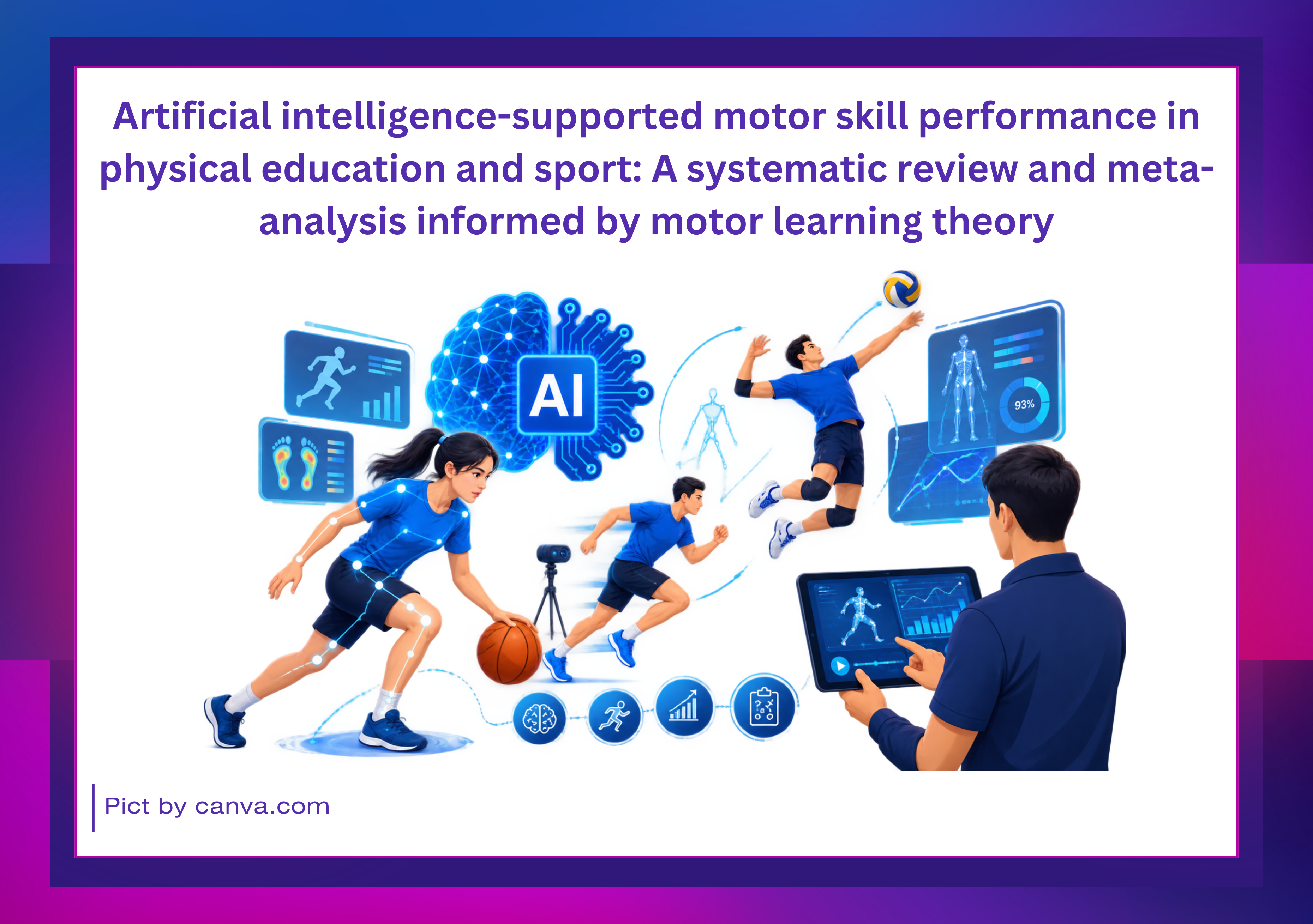
Artificial intelligence-supported motor skill performance in physical education and sport: A systematic review and meta-analysis informed by motor learning theory

Downloads
Background: Artificial Intelligence (AI) has increasingly been integrated into physical education (PE) to support motor learning through technologies such as computer vision, motion tracking, intelligent tutoring systems, virtual reality, and generative AI. However, evidence regarding its effectiveness remains fragmented across different intervention types and learning contexts.
Objectives: This study aimed to evaluate the effects of AI-supported interventions on motor skill performance in physical education and sport settings and to synthesize complementary learning-related outcomes.
Methods: A systematic review and meta-analysis were conducted in accordance with PRISMA 2020. Scopus, PubMed, and ProQuest were searched through 22 June 2026. Eligible studies evaluated AI-supported, adaptive, or intelligent interventions in physical education, sport, or motor skill-learning contexts and reported learner-level motor performance; complementary learning-related outcomes were synthesized narratively. Risk of bias was assessed using RoB 2 and ROBINS-I, and standardized mean differences (SMDs) with 95% confidence intervals (CIs) were synthesized using a random-effects model.
Results: Fifteen studies were included in the qualitative synthesis; six contributed to the meta-analysis and nine were synthesized narratively. The pooled estimate favored the designated AI-supported experimental conditions over their comparators (SMD = 3.15, 95% CI 1.86–4.44; p < .001; I² = 98%). Given the small evidence base, very high heterogeneity, and variable risk of bias, the magnitude of this pooled effect is uncertain. Qualitative findings concerned short-term motor skill performance and complementary outcomes such as engagement, motivation, learning interest, and self-directed learning.
Conclusions: AI-supported interventions may improve short-term motor skill performance in some physical education and sport contexts and may support complementary learning-related outcomes. However, the evidence is preliminary and highly heterogeneous, and immediate post-intervention performance should not be interpreted as definitive evidence of durable motor learning, retention, or transfer. AI should be considered a complementary pedagogical tool rather than a replacement for teacher or coach expertise.
Downloads
Ashwin, T. S., Prakash, V., & Rajendran, R. (2023). A systematic review of intelligent tutoring systems based on Gross body movement detected using computer vision. Computers and Education: Artificial Intelligence, 4, 100125. https://doi.org/10.1016/j.caeai.2023.100125
Calderón, A., Meroño, L., & MacPhail, A. (2020). A student-centred digital technology approach: The relationship between intrinsic motivation, learning climate and academic achievement of physical education pre-service teachers. European Physical Education Review, 26(1), 241–262. https://doi.org/10.1177/1356336X19850852
Chen, W. (2025). Integrating deep learning and wearable technology for real-time, scalable and objective physical education assessment. International Journal of Information and Communication Technology, 26(10), 42–60. https://doi.org/10.1504/IJICT.2025.146096
Dyer, J. F., Stapleton, P., & Rodger, M. W. M. (2015). Sonification as Concurrent Augmented Feedback for Motor Skill Learning and the Importance of Mapping Design. The Open Psychology Journal, 8(1), 192–202. https://doi.org/10.2174/1874350101508010192
Gao, T., & Chen, X. (2025). Implementing machine learning algorithms to optimize sprint performance and biomechanical analysis of track and field athletes. Journal of Computational Methods in Sciences and Engineering, 25(5), 4849–4861. https://doi.org/10.1177/14727978251337990
Halkiopoulos, C., & Gkintoni, E. (2024). Leveraging AI in E-Learning: Personalized Learning and Adaptive Assessment through Cognitive Neuropsychology—A Systematic Analysis. Electronics, 13(18), 3762. https://doi.org/10.3390/electronics13183762
Han, X. (2025). The Influence of AI-Powered Personalized Feedback Systems on Motor Skill Development and Self-Efficacy in PE Learning among University Students in Heilojiang, China. Uniglobal Journal of Social Sciences and Humanities, 4(2), 97–107. https://doi.org/10.53797/ujssh.v4i2.12.2025
Harris, D., Donaldson, R., Bray, M., Arthur, T., Wilson, M., & Vine, S. (2024). Attention computing for enhanced visuomotor skill performance: Testing the effectiveness of gaze-adaptive cues in virtual reality golf putting. Multimedia Tools and Applications, 83(21), 60861–60879. https://doi.org/10.1007/s11042-023-17973-4
Hsia, L.-H., Lin, Y.-N., Lin, C.-H., & Hwang, G.-J. (2025). Effectiveness of gamified intelligent tutoring in physical education through the lens of self-determination theory. Computers & Education, 227, 105212. https://doi.org/10.1016/j.compedu.2024.105212
Huang, Y.-H., Hsia, L.-H., & Hwang, G.-J. (2026). A gamified AI movement assessment and feedback approach for university students in physical education: Effects on movement skills, learning engagement, and behavioral patterns. Education and Information Technologies, 31(9), 2657–2677. https://doi.org/10.1007/s10639-026-13911-7
Kakish, K. (2024). Leveraging AI to Enhance Adaptive Learning: Personalized and Efficient Education Delivery. In B. J. Reithel (Ed.), Proceedings of the Information Systems Education Conference, ISECON (pp. 143–151). Foundation for Information Technology Education. https://www.scopus.com/inward/record.uri?eid=2-s2.0-85218418267&partnerID=40&md5=881be538a00ae89690392cce633b2302
Lauber, B., & Keller, M. (2014). Improving motor performance: Selected aspects of augmented feedback in exercise and health. European Journal of Sport Science, 14(1), 36–43. https://doi.org/10.1080/17461391.2012.725104
Lee, H. S., & Lee, J. (2021). Applying Artificial Intelligence in Physical Education and Future Perspectives. Sustainability, 13(1), 351. https://doi.org/10.3390/su13010351
Ma, J., Ma, L., Qi, S., Zhang, B., & Ruan, W. (2025). A practical study of artificial intelligence-based real-time feedback in online physical education teaching. Smart Learning Environments, 12(1), 52. https://doi.org/10.1186/s40561-025-00411-3
Maberah, S., Kan’An, A., El-Sayed, N., Alahmari, M., Abdelmabood, M., Kholif, M., Jdaitawi, M., Alfrehat, R., Miri, O., Almutairy, G., & AlShehri, E. (2025). Students’ Attitudes and Perceived Usefulness of Artificial Intelligence (AI) Tools in Physical Education. International Journal of Information and Education Technology, 15(4), 767–773. https://doi.org/10.18178/ijiet.2025.15.4.2282
Magill, R., & Anderson, D. I. (2010). Motor learning and control. McGraw-Hill Publishing New York.
McGuinness, L. A., & Higgins, J. P. T. (2021). Risk‐of‐bias VISualization (robvis): An R package and Shiny web app for visualizing risk‐of‐bias assessments. Research Synthesis Methods, 12(1), 55–61. https://doi.org/10.1002/jrsm.1411
Miller, J. C., Miranda, J. P. P., & Tolentino, J. C. G. (2024). Artificial Intelligence in Physical Education (pp. 37–60). https://doi.org/10.4018/979-8-3693-3952-7.ch002
Page, M. J., McKenzie, J. E., Bossuyt, P. M., Boutron, I., Hoffmann, T. C., Mulrow, C. D., Shamseer, L., Tetzlaff, J. M., Akl, E. A., Brennan, S. E., Chou, R., Glanville, J., Grimshaw, J. M., Hróbjartsson, A., Lalu, M. M., Li, T., Loder, E. W., Mayo-Wilson, E., McDonald, S., … Moher, D. (2021). The PRISMA 2020 statement: an updated guideline for reporting systematic reviews. BMJ, n71. https://doi.org/10.1136/bmj.n71
Pullen, P., & Seffens, W. (2018). Machine learning gesture analysis of yoga for exergame development. IET Cyber-Physical Systems: Theory & Applications, 3(2), 106–110. https://doi.org/10.1049/iet-cps.2017.0027
Qiu, Y. (2024). The Impact of LLM Hallucinations on Motor Skill Learning: A Case Study in Badminton. IEEE Access, 12, 139669–139682. https://doi.org/10.1109/ACCESS.2024.3444783
Rakha, A. H. (2026). Digital feedback via free ChatGPT within the reciprocal teaching style: improving fundamental handball skills and students’ attitudes among university beginners. Frontiers in Sports and Active Living, 8. https://doi.org/10.3389/fspor.2026.1772502
Rauter, G., Gerig, N., Sigrist, R., Riener, R., & Wolf, P. (2019). When a robot teaches humans: Automated feedback selection accelerates motor learning. Science Robotics, 4(27). https://doi.org/10.1126/scirobotics.aav1560
Reddy Basani, D. K., Lakshmi Gudivaka, R., Grandhi, S. H., Ramanjaneyulu Gudivaka, B., Gudivaka, R. K., & Kamruzzaman, M. M. (2025). AI-Powered Motion Analysis in Physical Education: GANs and Bayesian Approaches. 2025 4th OPJU International Technology Conference (OTCON) on Smart Computing for Innovation and Advancement in Industry 5.0, 1–6. https://doi.org/10.1109/OTCON65728.2025.11071118
Romano, G., Schneider, J., Di Mitri, D., & Drachsler, H. (2025). Through the Telescope: A Systematic Review of Intelligent Tutoring Systems and Their Applications in Psychomotor Skill Learning. International Journal of Artificial Intelligence in Education, 35(5), 2756–2796. https://doi.org/10.1007/s40593-025-00526-1
Sajja, R., Sermet, Y., Cikmaz, M., Cwiertny, D., & Demir, I. (2024). Artificial Intelligence-Enabled Intelligent Assistant for Personalized and Adaptive Learning in Higher Education. Information, 15(10), 596. https://doi.org/10.3390/info15100596
Sari, H. E., Tumanggor, B., & Efron, D. (2024). Improving Educational Outcomes Through Adaptive Learning Systems using AI. International Transactions on Artificial Intelligence (ITALIC), 3(1), 21–31. https://doi.org/10.33050/italic.v3i1.647
Schmidt, R. A., Lee, T. D., Winstein, C., Wulf, G., & Zelaznik, H. N. (2018). Motor control and learning: A behavioral emphasis. Human kinetics.
Stanney, K. M., Archer, J., Skinner, A., Horner, C., Hughes, C., Brawand, N. P., Martin, E., Sanchez, S., Moralez, L., Fidopiastis, C. M., & Perez, R. S. (2022). Performance gains from adaptive eXtended Reality training fueled by artificial intelligence. The Journal of Defense Modeling and Simulation: Applications, Methodology, Technology, 19(2), 195–218. https://doi.org/10.1177/15485129211064809
Sterne, J. A. C., Savović, J., Page, M. J., Elbers, R. G., Blencowe, N. S., Boutron, I., Cates, C. J., Cheng, H.-Y., Corbett, M. S., Eldridge, S. M., Emberson, J. R., Hernán, M. A., Hopewell, S., Hróbjartsson, A., Junqueira, D. R., Jüni, P., Kirkham, J. J., Lasserson, T., Li, T., … Higgins, J. P. T. (2019). RoB 2: a revised tool for assessing risk of bias in randomised trials. BMJ, l4898. https://doi.org/10.1136/bmj.l4898
Sterne, J. A., Hernán, M. A., Reeves, B. C., Savović, J., Berkman, N. D., Viswanathan, M., Henry, D., Altman, D. G., Ansari, M. T., Boutron, I., Carpenter, J. R., Chan, A.-W., Churchill, R., Deeks, J. J., Hróbjartsson, A., Kirkham, J., Jüni, P., Loke, Y. K., Pigott, T. D., … Higgins, J. P. (2016). ROBINS-I: a tool for assessing risk of bias in non-randomised studies of interventions. BMJ, i4919. https://doi.org/10.1136/bmj.i4919
Takita, H., Hashiura, K., Hatada, Y., Kodama, D., Narumi, T., Tanikawa, T., & Hirose, M. (2025). Do We Still Need Human Instructors? Investigating Automated Methods for Motor Skill Learning in Virtual Co-Embodiment. IEEE Transactions on Visualization and Computer Graphics, 31(5), 2455–2463. https://doi.org/10.1109/TVCG.2025.3549540
Tang, Y. (2024). Research on the Application of Virtual Reality Technology in Motor Skills Training. Applied Mathematics and Nonlinear Sciences, 9(1). https://doi.org/10.2478/amns-2024-1646
Vandevoorde, K., Vollenkemper, L., Schwan, C., Kohlhase, M., & Schenck, W. (2022). Using Artificial Intelligence for Assistance Systems to Bring Motor Learning Principles into Real World Motor Tasks. Sensors, 22(7), 2481. https://doi.org/10.3390/s22072481
Wang, Y., & Wang, X. (2024). Artificial intelligence in physical education: comprehensive review and future teacher training strategies. Frontiers in Public Health, 12. https://doi.org/10.3389/fpubh.2024.1484848
Wojcik, K. (2020). Pattern Recognition Methods as a Tool to Build an Automatic System for Learning Coordinated Human Motions. IEEE Access, 8, 141407–141421. https://doi.org/10.1109/ACCESS.2020.3013283
Wójcik, K., & Piekarczyk, M. (2020). Machine Learning Methodology in a System Applying the Adaptive Strategy for Teaching Human Motions. Sensors, 20(1), 314. https://doi.org/10.3390/s20010314
Wu, J. (2025). Design and Development of Artificial Intelligence Dynamic Physical Education Teaching Resources in Human-Computer Interaction Mode. Journal of Educational Computing Research, 63(5), 1219–1248. https://doi.org/10.1177/07356331251337991
Wulf, G., & Lewthwaite, R. (2016). Optimizing performance through intrinsic motivation and attention for learning: The OPTIMAL theory of motor learning. Psychonomic Bulletin & Review, 23(5), 1382–1414. https://doi.org/10.3758/s13423-015-0999-9
Xiao, Z., & Guo, W. (2026). Research on the innovative integration of scenario creation and generative artificial intelligence in college physical fitness classes. Multidisciplinary Science Journal, 8(8), 2026549. https://doi.org/10.31893/multiscience.2026549
Yan, X., Luo, Z., & Wu, L. (2024). Research on the Application of Intelligent Sports Tracking System in Improving the Teaching Effect of University Physical Education. Applied Mathematics and Nonlinear Sciences, 9(1). https://doi.org/10.2478/amns-2024-1516
Yang, Q. (2024). A Study of Using VRTECH Virtual Reality Technology in Physical Education Teaching to Improve Students’ Learning Interests. Applied Mathematics and Nonlinear Sciences, 9(1). https://doi.org/10.2478/amns-2024-2576
Yekollu, R. K., Bhimraj Ghuge, T., Sunil Biradar, S., Haldikar, S. V., & Farook Mohideen Abdul Kader, O. (2024). AI-Driven Personalized Learning Paths: Enhancing Education Through Adaptive Systems. 507–517. https://doi.org/10.1007/978-981-97-3191-6_38
Zhang, J. (2025). Leveraging Artificial Intelligence for Enhanced Physical Education in Universities. International Journal of Web-Based Learning and Teaching Technologies, 20(1), 1–15. https://doi.org/10.4018/IJWLTT.393622
Zhao, J., Sitthiworachart, J., & Ratanaolarn, T. (2025). The Impact of AI-integrated Sport Blended Learning on Primary School Students’ Sports Skills and Attitudes. The Open Sports Sciences Journal, 18(1). https://doi.org/10.2174/011875399X397619250721071324
Zhao, X. (2025). AI-Driven Tai Chi mastery using deep learning framework for movement assessment and personalized training. Scientific Reports, 15(1), 31700. https://doi.org/10.1038/s41598-025-17187-8
Copyright (c) 2026 Yulingga Nanda Hanief, Vera Septi Sistiasih, Ferdinando Cereda, Spyridon Plakias

This work is licensed under a Creative Commons Attribution-ShareAlike 4.0 International License.