Vol. 1 No. 1 (2025): Journal of Artificial Intelligence in Education & Learning Innovation
This issue has been available online since July 1st, 2025. All articles in this issue were authored/co-authored by 19 authors from Ghana, Malaysia, Indonesia, and the Philippines.
Published:
2025-10-08
Articles
-

Enhancing basketball technique learning using I-spring application: A study in high school physical education
Hadi Saputro1, Rama Kurniawan2, Surya Adi Saputra3, Usman Wahyudi41. State University of Malang , ID2. State University of Malang , ID3. State University of Malang , ID4. State University of Malang , IDAbstractBackground: High school students feel less able to master the subject of Physical Education, Sports, and Health (PJOK) Basketball material in a relatively short meeting, so it needs innovative learning.
Objectives: This research was conducted to develop learning media for basketball game material based on the I-Spring application to facilitate students' learning.
Methods: This research uses the Research and Development (R&D) method using the ADDIE model, which refers to Lee and Owens. Data collection was done through direct observation and questionnaire distribution. The research subjects were the students of Senior High School 1 Gondanglegi, Malang Regency, Indonesia, which amounted to 866 students. The data analysis method used is descriptive qualitative using Likert scale calculation.
Results: The observation results showed that 95.5% of students had participated in basketball learning in class or on the field, 71.2% of students had difficulty learning the basic techniques of basketball games, and 92.4 students needed application-based learning media to understand more deeply and be able to practice basic basketball techniques. Small group trials on 10 students obtained results of 85.2% and 86.4% for large group trials with 30 students.
Conclusions: The developed product is feasible for PJOK learning, especially basketball material at State Senior High School 1 Gondanglegi. Future studies are encouraged to expand the material coverage and evaluate long-term learning outcomes using the developed application.
APA Citation StyleSaputro, H. , Kurniawan, R. , Saputra, S. A. , & Wahyudi, U. (2025). Enhancing basketball technique learning using I-spring application: A study in high school physical education. Journal of Artificial Intelligence in Education & Learning Innovation, 1(1), 1-14. https://doi.org/10.56003/jaieli.v1i1.522 -
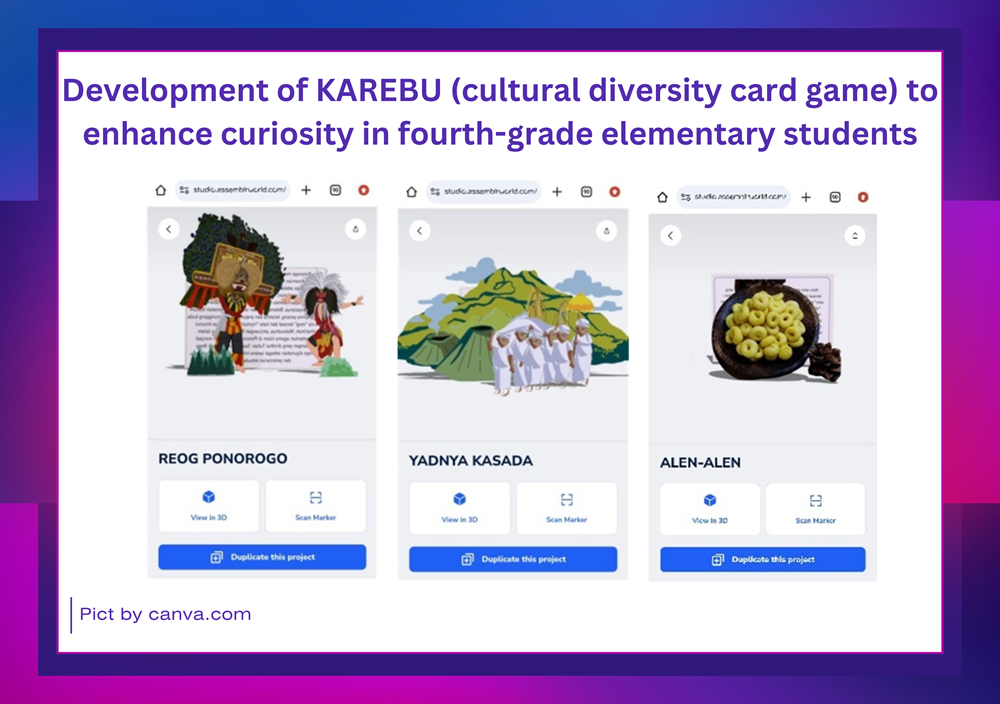
Development of KAREBU (cultural diversity card game) to enhance curiosity in fourth-grade elementary students
Etyka Rina Mahanani1, Erif Ahdhianto2, Yohannes Kurniawan Barus31. State University of Malang , ID2. State University of Malang , ID3. State University of Malang , IDAbstractBackground: Learning media is one of the important components of education.
Objectives: The purpose of this research and development was to develop the KAREBU (Cultural Diversity Card) learning media to strengthen the curiosity character of fourth-grade students in the subject of Natural and Social Sciences with local cultural diversity material that is valid, practical, and effective.
Methods: Using the ADDIE model (Analysis, Design, Development, Implementation, Evaluation), this study developed KAREBU cards integrated with augmented reality (AR) technology. This research instrument is in the form of interviews, observations, and questionnaires given to instrument experts, material experts, media experts, and users, including teachers and students. Data collection stages were carried out through observation, interviews, needs questionnaires, validation questionnaires, practicality questionnaires, and curiosity questionnaires before and after using the media.
Results: The results showed that the KAREBU learning media met the valid, practical, and effective criteria. KAREBU media received a validity score from material experts of 3.72 with a valid category, a score from media experts of 4.91 with a very valid category, and a score from users of 4.73 with a very valid category. The KAREBU learning media received a practicality score from teachers of 4.49 with a convenient category and a practicality score from students of 98.5% with a convenient category. The level of media effectiveness in strengthening students' curiosity was obtained from the results of the questionnaire before and after using the media, which was calculated using the N-Gain Score test with a value of 0.76 and high effectiveness criteria.
Conclusions: Therefore, it was concluded that the KAREBU learning media effectively strengthens students' curiosity. Further studies could explore the long-term impacts of KAREBU on cross-cultural empathy.
APA Citation StyleMahanani, E. R. , Ahdhianto, E. , & Barus, Y. K. (2025). Development of KAREBU (cultural diversity card game) to enhance curiosity in fourth-grade elementary students. Journal of Artificial Intelligence in Education & Learning Innovation, 1(1), 15-31. https://doi.org/10.56003/jaieli.v1i1.526 -
Academic goals and learning strategies of pre-service teachers during emergency online learning in the Philippines
Swen Joshryll Acebes1, Jaizel Malitante2, Nikki Tuble3, Rowena Bongolto41. Mindanao State University - General Santos , PH2. Mindanao State University - General Santos , PH3. Mindanao State University - General Santos , PH4. Mindanao State University - General Santos , PHAbstractBackground: The COVID-19 pandemic has lasted an extended period, during which many students have reported being adversely affected by the escalating global crisis.
Objectives: This study examined the academic goals, learning barriers, facilitative strategies, and ways forward of pre-service teachers during emergency online learning.
Methods: This qualitative case study employed content analysis to examine data gathered through focus group discussions. To explore the implications of survey findings and gain deeper insights into students' perspectives on remote learning, the researchers conducted Focus Group Discussions (FGDs) with twelve purposively selected pre-service teachers via Google Meet. The discussion transcripts were analyzed to construct a compelling narrative, supported by literature and prior research, to explain emerging themes.
Results: Among the twelve participants, ten reported experiencing psychosocial stress, eight cited recurring technical issues, and seven mentioned financial constraints as significant learning barriers. Despite these challenges, the participants remained motivated to complete their coursework, viewing academic achievement as a stepping stone toward improving their socio-economic conditions. They employed various strategies, including scheduling, note-taking, goal-setting, optimistic thinking, parental scaffolding, and systematic planning, to adapt to online learning. To ensure credibility, the researchers used member checking, peer debriefing, and FGD and survey data triangulation.
Conclusions: These findings highlight the resilience and adaptability of pre-service teachers in navigating the challenges of emergency online learning, underscoring the need for supportive institutional policies and resources. Future research may consider comparing student experiences in public and private institutions or examining the long-term impact of emergency remote learning on teaching efficacy. Pedagogical and academic implications are further discussed.
APA Citation StyleAcebes, S. J. , Malitante, J. , Tuble, N. , & Bongolto, R. (2025). Academic goals and learning strategies of pre-service teachers during emergency online learning in the Philippines. Journal of Artificial Intelligence in Education & Learning Innovation, 1(1), 32-49. https://doi.org/10.56003/jaieli.v1i1.569 -
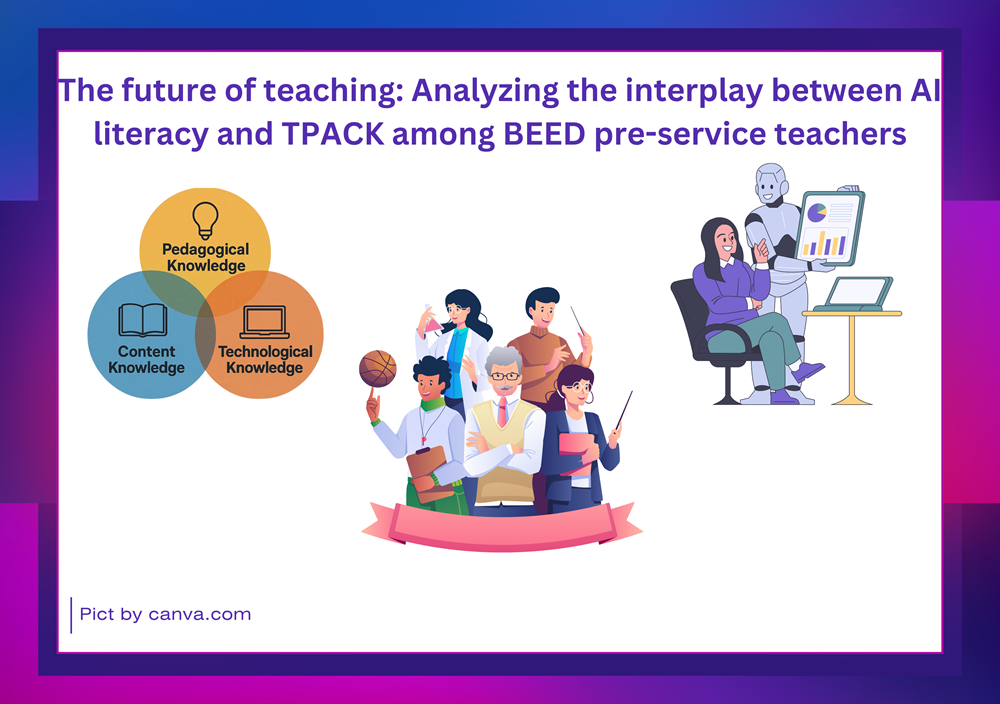
The future of teaching: Analyzing the interplay between AI literacy and TPACK among BEED pre-service teachers
Karl Alvin Aglibot1, Chelsea Lorraine Rito2, Larence Villalon3, Nelvin Gampal 41. Mindanao State University - General Santos , PH2. Mindanao State University – General Santos , PH3. Mindanao State University – General Santos , PH4. Mindanao State University – General Santos , PHAbstractBackground: As artificial intelligence (AI) continues transforming the educational landscape, pre-service teachers must develop theoretical understanding and practical skills in AI integration.
Objectives: This study explored the relationship between AI literacy and TPACK among 139 BEED pre-service teachers.
Methods: Using descriptive statistics, Spearman's correlation, and multiple linear regression analysis, the study investigated how components of AI literacy relate to TPACK.
Results: Results revealed that the pre-service teachers demonstrated high levels of AI literacy, particularly in ethical awareness and intrinsic motivation. Pre-service teachers expressed strong interest in AI's educational potential and a commitment to its responsible use. While their foundational AI knowledge was high, many reported moderate self-efficacy and lacked confidence in executing AI-related tasks. Gaps were also noted in applying AI concepts to real-world teaching scenarios and designing AI-driven solutions. Furthermore, the results showed high TPACK proficiency, with strength in pedagogical and technological knowledge, though weaknesses were observed in content areas like mathematics and technical troubleshooting. A moderate positive correlation (Spearman's ρ = 0.48, p < 0.05) between AI literacy and TPACK indicates a meaningful association. Regression analysis revealed that AI literacy components explained 25.5% of the variance in TPACK. Cognitive learning emerged as the only significant predictor.
Conclusions: The findings underscore the need for teacher education programs to provide hands-on, cognitive-focused AI training. Hence, enhancing pre-service teachers' cognitive and practical skills is essential to thoroughly preparing them for AI-enhanced teaching environments' demands.
APA Citation StyleAglibot, K. A. , Rito, C. L. , Villalon, L. , & Gampal , N. (2025). The future of teaching: Analyzing the interplay between AI literacy and TPACK among BEED pre-service teachers. Journal of Artificial Intelligence in Education & Learning Innovation, 1(1), 50-65. https://doi.org/10.56003/jaieli.v1i1.570 -
Factors influencing teachers’ attrition in public basic schools in Techiman Municipality, Ghana: An embedded mixed methods study
Joseph Kyeremeh1, Dickson Adom2, Michael Ato Essuman3, Lim Seon Pek41. Kwame Nkrumah University of Science and Technology , GH2. Kwame Nkrumah University of Science and Technology , GH3. Kwame Nkrumah University of Science and Technology , GH4. INTI International University , MYAbstractBackground: The high teacher attrition rate in public primary schools in Techiman, Ghana, has become a serious problem that directly impacts the quality of education and the achievement of national education development goals.
Objectives: The study investigated factors that influence teachers' attrition in the Techiman Municipality.
Methods: One hundred ninety-seven teachers were sampled for the study using convenience and simple random sampling techniques. This study utilized the embedded mixed methods design with descriptive survey and phenomenology as research methods to collect quantitative and qualitative datasets using questionnaires and interviews as data collection tools. The qualitative data were analyzed using thematic analysis, while the quantitative data were analyzed using descriptive and inferential statistics using the SPSS software.
Results: It was found that teachers perceived salary as the major employer-related factor in teachers' attrition (relative importance index (RII) = 0.85). team member-related factors, such as the willingness of teachers to pursue another career outside education, were perceived as the primary factor of attrition (RII = 0.78). In contrast, an external-related factor, such as better opportunities in some other occupations, was ranked the first major contributor to teachers' attrition (RII = 0.88). The overall assessment of the factors of attrition based on the relative importance index revealed that Employer-related factors are the major contributor to teachers' attrition (RII = 0.70).
Conclusions: The study recommends that the Ghana government find innovative ways of increasing teachers' salaries as a source of motivation and offer them other incentive packages to aid in retaining them in the service.
APA Citation StyleKyeremeh, J. , Adom, D. , Essuman, M. A. , & Pek, L. S. (2025). Factors influencing teachers’ attrition in public basic schools in Techiman Municipality, Ghana: An embedded mixed methods study. Journal of Artificial Intelligence in Education & Learning Innovation, 1(1), 66-88. https://doi.org/10.56003/jaieli.v1i1.578