Search
Search Results
##search.searchResults.foundPlural##
-

Analysis of dominant physical factors in volleyball skills: confirmatory analysis of the Bahana Muda volleyball team
Mahesa Dwi Chandra11. State University of Malang , ID2026-01-05|page 111-121AbstractBackground: Physical condition is an important determinant of volleyball skill performance, but few studies have empirically tested the structure of its dominant factors using a confirmatory approach.
Objectives: This study aims to identify the dominant physical condition factors that influence the playing skills of Bahana Muda Club volleyball athletes using Confirmatory Factor Analysis (CFA).
Methods: This study used a quantitative descriptive design. The sample consisted of 20 male volleyball athletes from the Bahana Muda Club who were selected through purposive sampling. The physical condition variables measured included speed (30-meter run), endurance (beep test), arm muscle strength (push-ups), abdominal muscle strength (sit-ups), leg muscle power (vertical jump), and agility (shuttle run). The analysis was conducted through an initial exploratory analysis and continued with CFA using IBM SPSS AMOS version 26. The goodness-of-fit model was evaluated using the CFI, TLI, and RMSEA indices.
Results: The CFA results show that leg muscle power (λ = 0.791), arm muscle strength (λ = 0.742), endurance (λ = 0.732), and agility (λ = 0.606) have significant factor loadings on volleyball skills (p < 0.05), while abdominal muscle speed and strength did not show significant contributions. The CFA model showed good data fit (CFI = 0.986; TLI = 0.978; RMSEA = 0.050).
Conclusions: Leg muscle power, arm muscle strength, endurance, and agility are the dominant physical factors in volleyball skills. Training programs should prioritize these components, and further research should involve larger samples and cross-clubs.APA Citation StyleChandra, M. D. (2026). Analysis of dominant physical factors in volleyball skills: confirmatory analysis of the Bahana Muda volleyball team. Sport, Exercise, and Injury, 111-121. https://doi.org/10.56003/sei.v1i2.642 -

Injury patterns and risk factors in high school futsal: An observational study
Rafif Jendra Atmaja11. State University of Malang , ID2025-06-17|page 1-14AbstractBackground: Sports injuries at an early age are crucial and must be given attention.
Objectives: This study aims to analyze injury patterns, causative factors, and prevention strategies specific to high school futsal players.
Methods: The research method used was descriptive quantitative with a cross-sectional study approach. The population in this study were male students of State Senior High School 1 Ponorogo who participated in class meeting activities, with purposive sampling technique found 24 samples. Data collected by questionnaire included information on the type of injury, location of injury, causative factors, injury treatment and type of rehabilitation.
Results: The results showed that the most common injuries were cuts/abrasions (29%) and bruises (23%), most common in the lower extremities, namely knees (23%) and ankles (20%), the most common cause of injury was physical contact (54%), most injuries occurred during the second half (67%), the most common first aid given was cold compresses (51%) and the most common rehabilitation/therapy was massage (25%) and physiotherapy (21%).
Conclusions: The findings can be concluded that the most dominant type of injury experienced by students is abrasion, especially in the knee area. In addition, the main causative factors of injury are fatigue, infrastructure, and collisions between players. The results of this study indicate the urgency of implementing injury prevention programs and the importance of conducting post-injury rehabilitation, in an effort to minimize the risk of injury to support the sustainability of students' careers in sports.
APA Citation StyleAtmaja, R. J. (2025). Injury patterns and risk factors in high school futsal: An observational study. Sport, Exercise, and Injury, 1-14. https://doi.org/10.56003/sei.v1i1.513 -
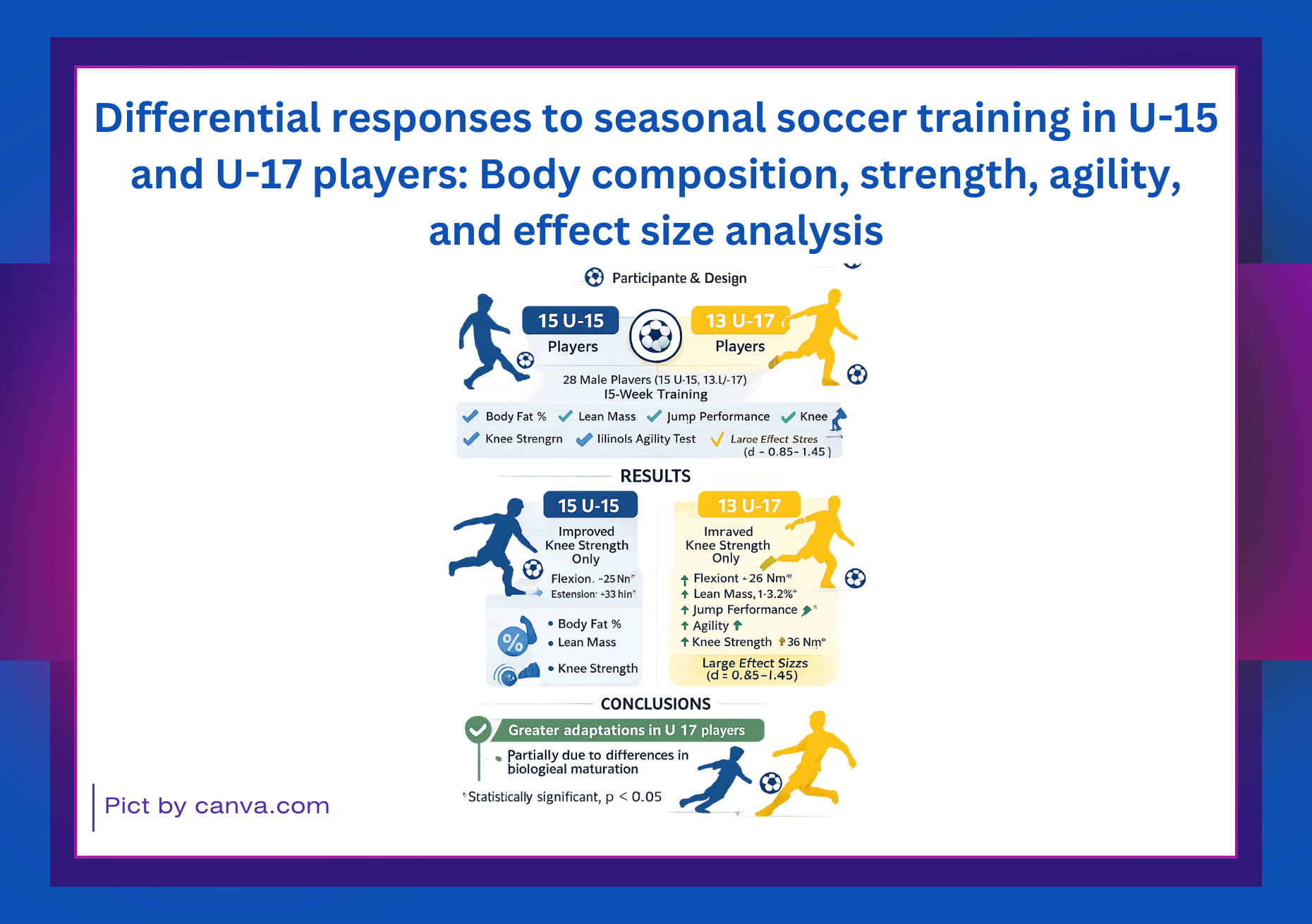
Differential responses to seasonal soccer training in U-15 and U-17 players: Body composition, strength, agility, and effect size analysis
Rick Stoop1, Georgios Georgiadis2, Iván González-García31. Football Club Utrecht, Herculesplein 241, 3584 AA Utrecht , NL2. Department of Nutrition and Movement Sciences, NUTRIM School of Nutrition and Translational Research in Metabolism, Maastricht University , NL3. Faculty of Health Sciences, Universidad Isabel I, Burgos , ES2026-06-09|page 48-63AbstractBackground: Training programs during adolescence play a crucial role in optimizing body composition and physical performance in youth soccer players. However, differences in training adaptations between age groups, particularly in agility performance, remain insufficiently explored.
Objectives: This study aimed to examine the effects of a seasonal soccer training program on body composition, strength, and agility in U-15 and U-17 soccer players.
Methods: A pre–post experimental design was applied to 28 male youth soccer players (U-15: n = 15; U-17: n = 13) competing in a football league in the Netherlands. Participants completed a 16-week training program consisting of technical, conditioning, tactical, and mental components. Body composition (height, body mass, lean mass, fat mass), jump performance (SJ, CMJ, CMJmax), isokinetic strength (knee flexion and extension peak torque), and agility (Illinois Agility Test) were assessed before and after the intervention. Data were analyzed using repeated-measures analysis of variance (ANOVA) and effect sizes were calculated using Cohen’s d.
Results: In the U-15 group, significant improvements were observed only in knee flexion (70.2 ± 15.8 vs. 95.4 ± 23.5 Nm, p = 0.006, d = 1.25) and extension peak torque (75.1 ± 20.4 vs. 96.8 ± 18.9 Nm, p = 0.012, d = 1.10). In contrast, U-17 players demonstrated significant increases in lean mass (50.2 ± 3.1% vs. 53.4 ± 2.3%, p = 0.021), reductions in fat mass (11.0 ± 2.9% vs. 8.7 ± 2.5%, p = 0.037), improvements in agility performance (16.2 ± 0.7 vs. 15.4 ± 0.65 s, p = 0.008, d = 1.18), and knee flexion peak torque (78.4 ± 26.5 vs. 118.3 ± 28.7 Nm, p = 0.003, d = 1.45), together with significant gains in jump performance (p < 0.05). Most significant changes in the U-17 group were accompanied by large effect sizes (d = 0.85–1.45).
Conclusions: The training program elicited greater physiological and performance adaptations in U-17 compared to U-15 players. The greater adaptations observed in the U-17 group may be partially influenced by differences in biological maturation; however, maturity status was not directly assessed in the present study.
APA Citation StyleStoop, R. , Georgiadis, G. , & González-García, I. (2026). Differential responses to seasonal soccer training in U-15 and U-17 players: Body composition, strength, agility, and effect size analysis. Sport, Exercise, and Injury, 48-63. https://doi.org/10.56003/sei.v2i1.735 -
Injury pattern and risk factors in grassroots football: A study of 10-year-old athletes
Leo Ferdinand1, Yulingga Nanda Hanief2, Randy M. Manimtim31. State University of Malang , ID2. State University of Malang , ID3. Batangas State University TNEU , PH2025-06-17|page 27-39AbstractBackground: Young football players, especially in grassroots competitions, are highly susceptible to injury due to physical contact, fatigue, and underdeveloped motor skills, making injury prevention a critical aspect of early childhood sports.
Objectives: This study aims to analyze the types, causes, and needs for injury prevention in 10-year-old football players.
Methods: A descriptive quantitative design was used with the survey method. Data was collected through a structured questionnaire distributed to players injured during the competition. A purposive sampling technique was applied with inclusion criteria: (1) players injured during the match and (2) willing to participate. The final sample consisted of 25 athletes.
Results: A total of 25 injury incidents were recorded. The most common type of injury was contusion, reaching 13 cases (52%), followed by muscle cramps (20%) and sprains (8%). Most injuries (64%) occurred in the lower extremities, especially the knee and thigh. Injuries predominantly occurred in the second half of matches (60%), with 88% caused by physical contact with an opponent. In the absence of medical personnel, coaches often found themselves in the role of first responders, a challenging position that requires adequate training and support. Many players continued to play despite their injuries, indicating a need for improved injury management.
Conclusions: The study concluded that football injuries in children generally occur in the lower extremities, with bruising being the most dominant type. Player-to-player collisions caused most injuries, and many players could continue the match. This shows the importance of prevention, education, and follow-up for developing the sport of football.
APA Citation StyleFerdinand, L. , Hanief, Y. N. , & Manimtim, R. M. (2025). Injury pattern and risk factors in grassroots football: A study of 10-year-old athletes. Sport, Exercise, and Injury, 27-39. https://doi.org/10.56003/sei.v1i1.512

1 - 4 of 4 items