Search
Search Results
##search.searchResults.foundPlural##
-

Analysis of dominant physical factors in volleyball skills: confirmatory analysis of the Bahana Muda volleyball team
Mahesa Dwi Chandra11. State University of Malang , ID2026-01-05|page 111-121AbstractBackground: Physical condition is an important determinant of volleyball skill performance, but few studies have empirically tested the structure of its dominant factors using a confirmatory approach.
Objectives: This study aims to identify the dominant physical condition factors that influence the playing skills of Bahana Muda Club volleyball athletes using Confirmatory Factor Analysis (CFA).
Methods: This study used a quantitative descriptive design. The sample consisted of 20 male volleyball athletes from the Bahana Muda Club who were selected through purposive sampling. The physical condition variables measured included speed (30-meter run), endurance (beep test), arm muscle strength (push-ups), abdominal muscle strength (sit-ups), leg muscle power (vertical jump), and agility (shuttle run). The analysis was conducted through an initial exploratory analysis and continued with CFA using IBM SPSS AMOS version 26. The goodness-of-fit model was evaluated using the CFI, TLI, and RMSEA indices.
Results: The CFA results show that leg muscle power (λ = 0.791), arm muscle strength (λ = 0.742), endurance (λ = 0.732), and agility (λ = 0.606) have significant factor loadings on volleyball skills (p < 0.05), while abdominal muscle speed and strength did not show significant contributions. The CFA model showed good data fit (CFI = 0.986; TLI = 0.978; RMSEA = 0.050).
Conclusions: Leg muscle power, arm muscle strength, endurance, and agility are the dominant physical factors in volleyball skills. Training programs should prioritize these components, and further research should involve larger samples and cross-clubs.APA Citation StyleChandra, M. D. (2026). Analysis of dominant physical factors in volleyball skills: confirmatory analysis of the Bahana Muda volleyball team. Sport, Exercise, and Injury, 111-121. https://doi.org/10.56003/sei.v1i2.642 -
Gender differences in bilateral and ipsilateral lower limb strength asymmetry among football players
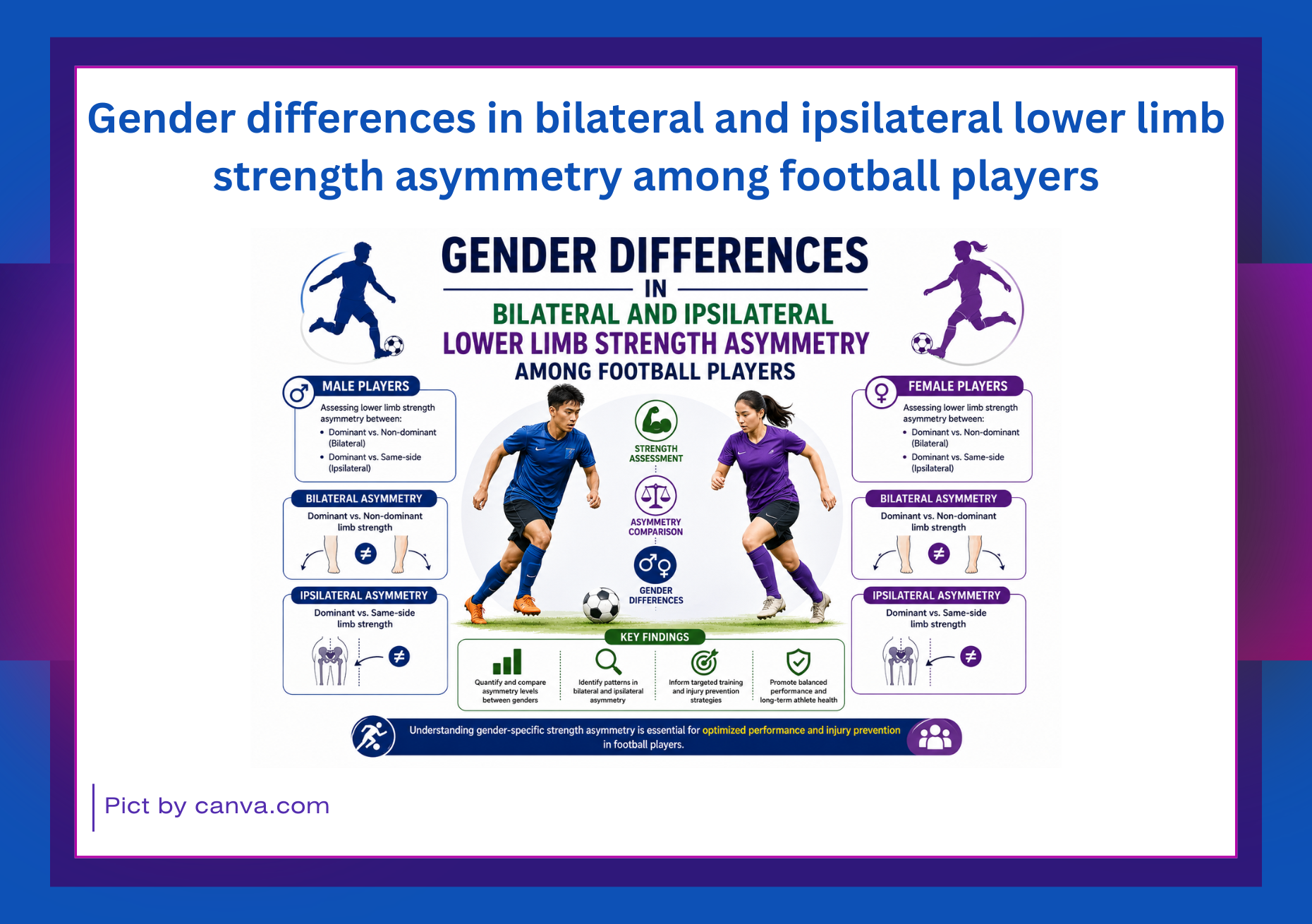
Randy R. Manimtim1, Eissel Ronquillo21. Office of Sports Development Program, Batangas State University The National Engineering University Lipa Campus , PH2. Department of Physical Education, School of Education, Holy Angel University , PH2026-06-02|page 1-10AbstractBackground: Lower limb muscle strength asymmetry is a significant factor that can impact playing ability and increase the risk of injury in soccer players. Differences in leg use and the specific movement requirements of a sport can lead to strength imbalances, either on both sides of the body or on the same side. Lower limb muscle strength asymmetry, particularly bilateral and ipsilateral strength asymmetry, is a significant factor influencing performance and increasing injury risk in football players. Differences in limb dominance and sport-specific movement demands can lead to strength imbalances.
Objectives: This study aimed to compare bilateral and ipsilateral lower limb strength asymmetry between male and female football players.
Methods: A cross-sectional study was conducted involving 50 amateur football players (26 males and 24 females; aged 18–21 years). Isokinetic strength testing of knee extensors and flexors was performed at 60°/s. Bilateral asymmetry was calculated based on peak torque differences between limbs, while ipsilateral asymmetry was assessed using the hamstring-to-quadriceps (H/Q) ratio. Statistical analyses included the Mann–Whitney U test and independent t-test (p < 0.05).
Results: Significant sex differences were found in bilateral strength asymmetry for both quadriceps (7.21 ± 4.04% vs 5.04 ± 3.13%, p = 0.02) and hamstrings (9.13 ± 5.15% vs 5.06 ± 4.04%, p = 0.01), with males showing greater asymmetry. Female athletes demonstrated values closer to the recommended asymmetry threshold (≤10–15%). No significant differences were observed in ipsilateral strength asymmetry (H/Q ratio) between groups (p > 0.05).
Conclusions: Bilateral strength asymmetry differs by sex, with male athletes exhibiting higher imbalance, while ipsilateral strength balance is comparable between groups. These findings highlight the importance of monitoring individual strength asymmetry to inform targeted training strategies, reduce injury risk, and optimize performance in football players.
APA Citation StyleManimtim, R. R. , & Ronquillo, E. (2026). Gender differences in bilateral and ipsilateral lower limb strength asymmetry among football players. Sport, Exercise, and Injury, 1-10. https://doi.org/10.56003/sei.v2i1.681

1 - 2 of 2 items