Search
Search Results
##search.searchResults.foundPlural##
-


Injury trends in Pencak Silat: Impact of regulation changes on sparring athletes
Jhenny Ayu Suryaningrum1, Mohamad Nizam Mohamed Shapie21. State University of Malang , ID2. MARA University of Technology , MY2025-06-17|page 15-26AbstractBackground: Pencak Silat is a martial arts sport with high physical contact intensity, resulting in a high risk of injury. To improve safety and sportsmanship, PERSILAT changed the competition rules in 2017. However, the impact of these changes on athlete injury rates is still debated.
Objectives: This study aimed to compare injury rates between the old and new rules in the sparring category of Pencak Silat athletes.
Methods: The study involved 40 sparring category Pencak Silat athletes in the Greater Malang area, aged 16-25 years, who had experience competing before and after implementing the new rules. Sampling used a purposive sampling technique. Data were collected through an online questionnaire and analyzed descriptively quantitatively with percentage calculations.
Results: The results showed a decrease in injury rates in the new rules compared to the old rules. 50.00% of respondents were injured 1-2 times under the new regulation, lower than 57.50% under the old regulation. The most common injury was bruising (27.06% under the new rules vs. 36.36% under the old rules), while dislocation injuries increased (18.82% vs. 15.58%). The most common injury was to the ankle. Most athletes stated that injuries affected their performance and daily activities.
Conclusions: Rule changes have not eliminated the risk of injury in high-contact sports such as Pencak Silat. A decrease in bruising followed by increased dislocations suggests the need for more specific prevention strategies. This study contributes to understanding the impact of new regulations on athlete safety.
APA Citation StyleSuryaningrum, J. A. , & Shapie, M. N. M. (2025). Injury trends in Pencak Silat: Impact of regulation changes on sparring athletes. Sport, Exercise, and Injury, 15-26. https://doi.org/10.56003/sei.v1i1.511 -
Analysis of sports injuries in the implementation of the new 2023 regulations for the sport of Pencak Silat in the 17-35 age category
Muhammad Miqdam Afis11. State University of Malang , ID2026-01-05|page 80-89AbstractBackground: The changes to the 2022/2023 Pencak Silat competition rules established by PESILAT are aimed at international standardization, but these changes have the potential to affect patterns and injury risks for athletes in competition categories involving intense physical contact.
Objectives: This study aims to describe the types, frequency, and body parts injured, as well as athletes' perceptions of the impact of the implementation of the new 2023 regulations on injuries among 17-35-year-old competitive Pencak Silat athletes in Malang Regency.
Methods: The study used a quantitative descriptive design with a cross-sectional approach. The sample consisted of 30 competitive Pencak Silat athletes (aged 17–35 years) selected using purposive sampling. Data were collected in March 2025 using a questionnaire distributed online via Google Forms. Data analysis was performed descriptively using frequencies and percentages, as well as simple comparative analysis based on gender.
Results: Of the 30 respondents, the most commonly reported injuries were sprains (22.0%) and bruises (19.5%). The body parts most frequently injured were the lower extremities (feet and ankles, 20.7%), followed by the hands (14.1%). The most dominant factors causing injury were lack of warm-up (27.5%) and collision/physical contact (26.4%). A total of 64% of athletes (n = 19) stated that the implementation of the new 2023 regulations had a significant effect on the occurrence of injuries. Severe injuries such as fractures, ACL, and MCL were only found in male athletes with a low percentage, while minor injuries (bruises and sprains) were more commonly reported in female athletes.
Conclusions: Soft tissue injuries, particularly sprains and bruises, are the most common types of injuries experienced by competitive Pencak Silat athletes, with injuries predominantly occurring in the lower extremities.APA Citation StyleAfis, M. M. (2026). Analysis of sports injuries in the implementation of the new 2023 regulations for the sport of Pencak Silat in the 17-35 age category. Sport, Exercise, and Injury, 80-89. https://doi.org/10.56003/sei.v1i2.641 -
Injury patterns and risk factors in high school futsal: An observational study
Rafif Jendra Atmaja11. State University of Malang , ID2025-06-17|page 1-14AbstractBackground: Sports injuries at an early age are crucial and must be given attention.
Objectives: This study aims to analyze injury patterns, causative factors, and prevention strategies specific to high school futsal players.
Methods: The research method used was descriptive quantitative with a cross-sectional study approach. The population in this study were male students of State Senior High School 1 Ponorogo who participated in class meeting activities, with purposive sampling technique found 24 samples. Data collected by questionnaire included information on the type of injury, location of injury, causative factors, injury treatment and type of rehabilitation.
Results: The results showed that the most common injuries were cuts/abrasions (29%) and bruises (23%), most common in the lower extremities, namely knees (23%) and ankles (20%), the most common cause of injury was physical contact (54%), most injuries occurred during the second half (67%), the most common first aid given was cold compresses (51%) and the most common rehabilitation/therapy was massage (25%) and physiotherapy (21%).
Conclusions: The findings can be concluded that the most dominant type of injury experienced by students is abrasion, especially in the knee area. In addition, the main causative factors of injury are fatigue, infrastructure, and collisions between players. The results of this study indicate the urgency of implementing injury prevention programs and the importance of conducting post-injury rehabilitation, in an effort to minimize the risk of injury to support the sustainability of students' careers in sports.
APA Citation StyleAtmaja, R. J. (2025). Injury patterns and risk factors in high school futsal: An observational study. Sport, Exercise, and Injury, 1-14. https://doi.org/10.56003/sei.v1i1.513 -
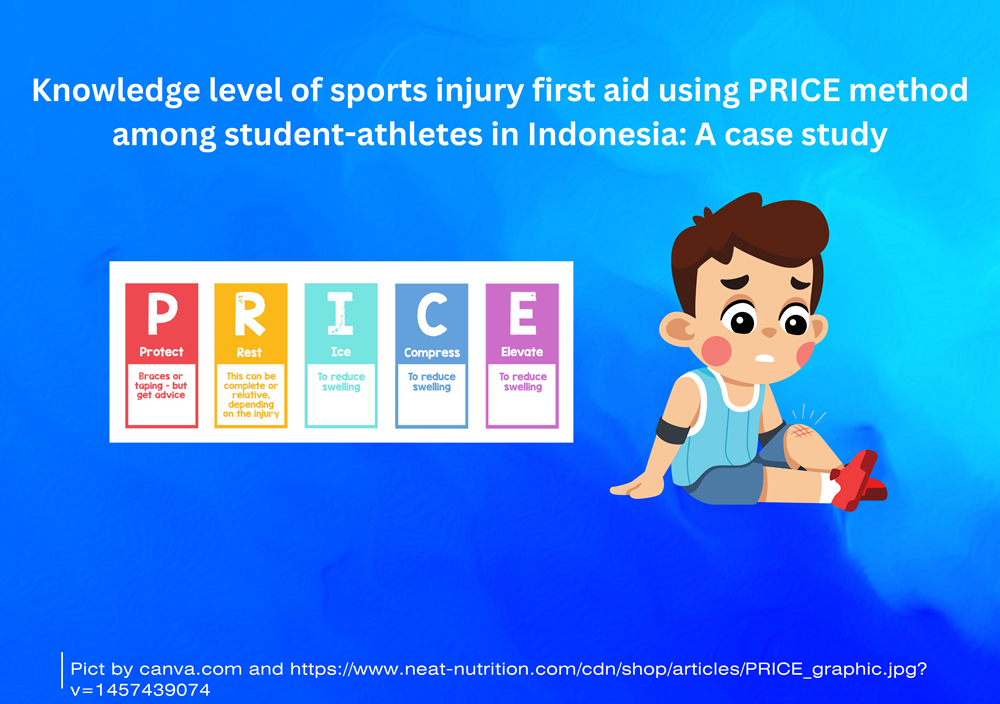
Knowledge level of sports injury first aid using PRICE method among student-athletes in Indonesia: A case study
Hison Naji Ar Rahman11. State University of Malang , ID2025-06-17|page 50-59AbstractBackground: Sports injuries are a risk often experienced by athletes, including special sports class students, so knowledge about proper injury management is needed, one of which is the PRICE method (Protection, Rest, Ice, Compression, Elevation).
Objectives: This study aimed to assess the level of knowledge about first aid in sports injuries using the PRICE method among student-athletes.
Methods: This study used a descriptive quantitative method with a survey technique. The research sample comprised 18 students selected through purposive sampling, using an instrument in the form of a questionnaire containing 48 items related to the PRICE method.
Results: The results showed 33.3% of students had a high level of knowledge, 38.4% were moderate, 22.3% were low, and 5.5% were very low.
Conclusions: The level of student knowledge of the PRICE method is mainly in the moderate to high category, but there are still some students with low understanding, especially in the Compression aspect, so further education is needed to improve the effectiveness of injury management. The compression component had the lowest understanding, indicating a need for further education and training.
APA Citation StyleAr Rahman, H. N. (2025). Knowledge level of sports injury first aid using PRICE method among student-athletes in Indonesia: A case study. Sport, Exercise, and Injury, 50-59. https://doi.org/10.56003/sei.v1i1.555 -

Injury prevalence among cricket athletes in East Java: A cross-sectional study
Ali Ridho Fadlurrahman Najib11. State University of Malang , ID2025-06-17|page 40-49AbstractBackground: Cricket has a risk of injury that needs to be considered, especially for athletes in East Java. This study aims to understand the prevalence of injuries in East Java cricket athletes, including the type, location, cause, time of occurrence, and treatment, as an effort to prevent and improve athlete performance.
Objectives: This study aims to determine the prevalence, types, causes, timing, and management of injuries among cricket athletes in East Java.
Methods: This study uses non-experimental descriptive quantitative methods, with a cross-sectional study and total sampling technique. 25 Indonesian East Java Province Cricket athletes with an age of 22.68+2.32, height of 163.2+6.78, and weight of 60.32+10.06, consisting of 13 male athletes and 12 female athletes, were involved in this study. This research instrument used a questionnaire to collect data. Data were analyzed using percentage analysis.
Results: The results showed that abrasions (36%) and muscle cramps (20%) were the most frequent injuries, especially affecting the lower extremities (56%). Overtraining (52%) was the leading cause, and injuries mainly occurred during training (52%). The RICE method was the most frequently applied treatment (60%).
Conclusions: This study highlights the need for structured training programs and preventive strategies to reduce the incidence of injuries.
APA Citation StyleNajib, A. R. F. (2025). Injury prevalence among cricket athletes in East Java: A cross-sectional study. Sport, Exercise, and Injury, 40-49. https://doi.org/10.56003/sei.v1i1.554

1 - 5 of 5 items