Search
Search Results
##search.searchResults.foundPlural##
-

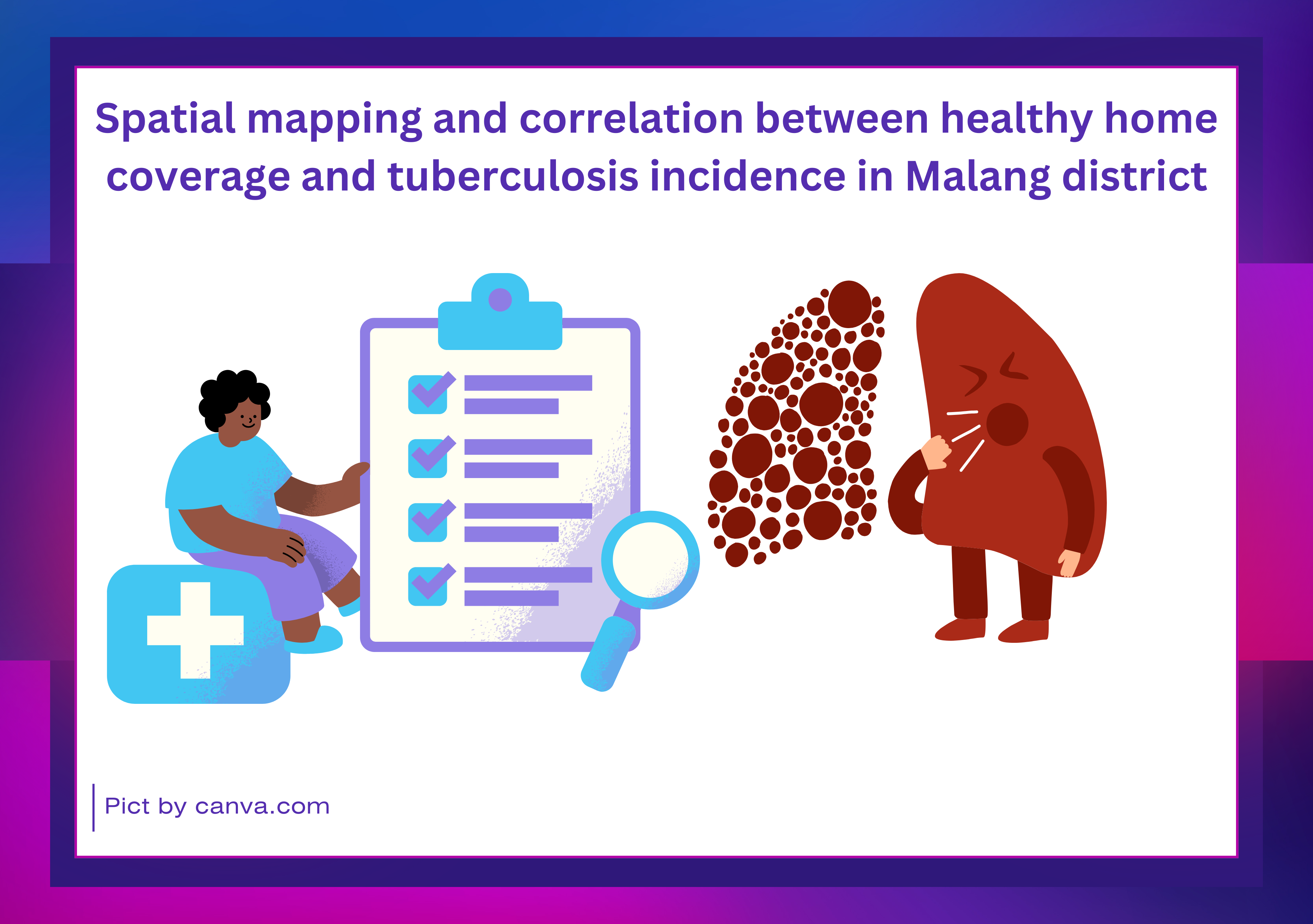
Spatial mapping and correlation between healthy home coverage and tuberculosis incidence in Malang district
Fatma Lidya Zulfa1, Hartati Eko Wardani2, Tika Dwi Tama3, Anindya Hapsari4, Rara Warih Gayatri5, Erni Astutik61. State University of Malang , ID2. State University of Malang , ID3. State University of Malang , ID4. State University of Malang , ID5. State University of Malang , ID6. Airlangga University , ID2025-04-23|page 1-16AbstractBackground: According to the Ministry of Health, 91% of active tuberculosis (TB) cases in Indonesia occur in crowded and slum areas. The Healthy Homes Program under the Healthy Indonesia Indicators (2010) aims to improve housing conditions in such areas to meet health standards. Malang District, with the second-highest housing density in East Java, ranks fifth in TB cases, suggesting residential exposure as a contributing factor.
Objectives: This study aims to map trends and examine the correlation between healthy home coverage and TB incidence in the Malang District Health Center Working Area 2019-2021.
Methods: The study was conducted in January-April 2023 at the Malang District Health Office with a unit of analysis of 39 health centers. The variables of this study were the coverage of healthy homes and the incidence of BTA-positive pulmonary TB. The study used a mixed ecological study and Pearson correlation test with secondary data from the Malang District Health Office and BPS.
Results: TB incidence showed a decreasing trend alongside increasing healthy home coverage. Nine health centers remained in high-incidence zones, and five exhibited poor housing coverage. Correlation analysis revealed a weak, negative relationship (r = -0.084). High TB incidence was still found in areas meeting healthy home criteria.
Conclusions: The incidence rate of BTA-positive pulmonary TB in the working area of the Malang District Health Center showed a downward trend for 3 years. Future research using individual data and other specific risk factors that may influence TB incidence is recommended.
APA Citation StyleZulfa, F. L. , Wardani, H. E. , Tama, T. D. , Hapsari, A. , Gayatri, R. W. , & Astutik, E. (2025). Spatial mapping and correlation between healthy home coverage and tuberculosis incidence in Malang district. Public Health and Occupational Safety Journal, 1-16. https://doi.org/10.56003/phosj.v1i1.532 -
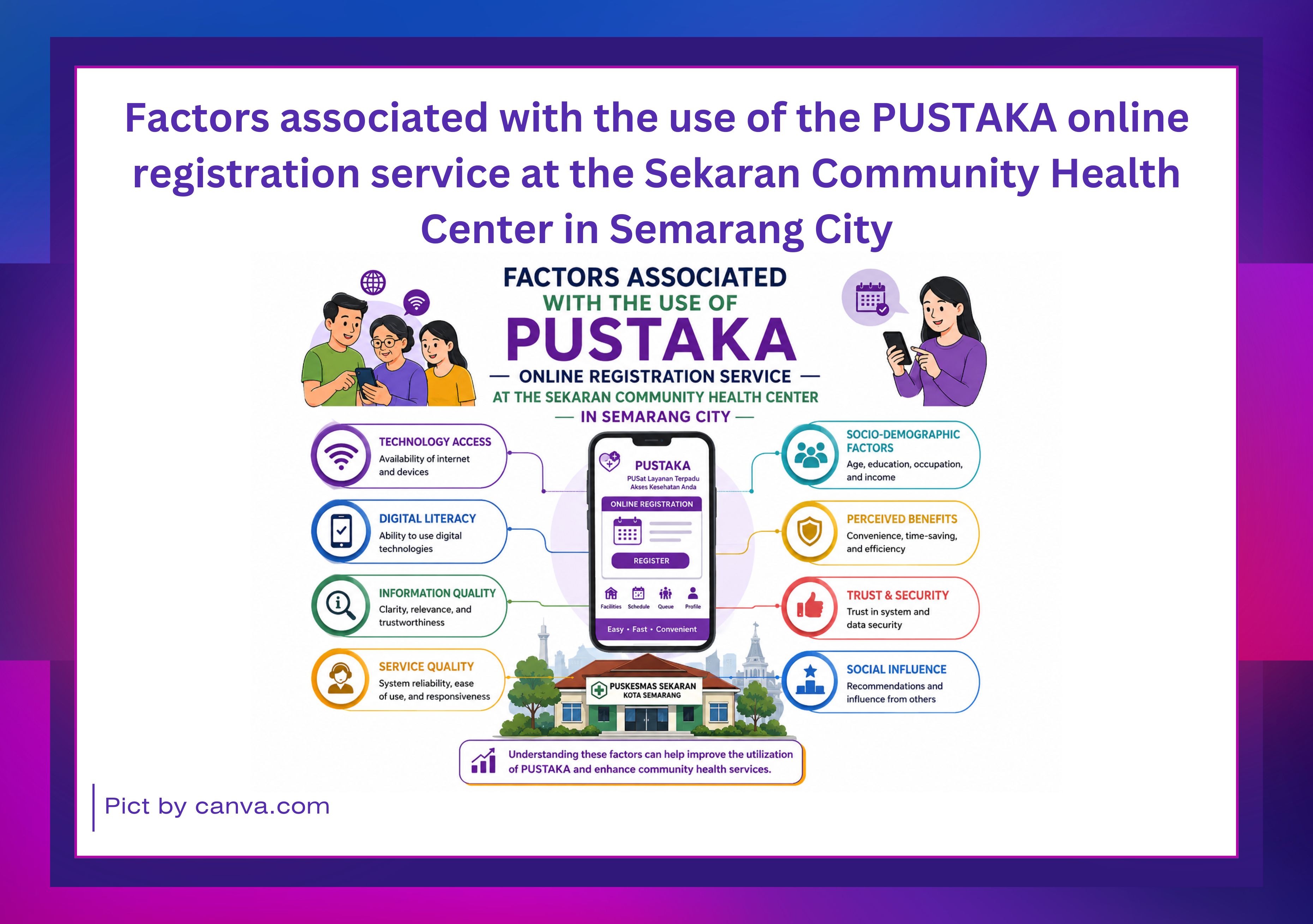
Factors associated with the use of the PUSTAKA online registration service at the Sekaran Community Health Center in Semarang City
Bunga Gustikasari Ismail1, Nurhasmadiar Nandini2, Rani Tiyas Budiyanti31. Faculty of Public Health, Universitas Diponegoro , ID2. Faculty of Public Health, Universitas Diponegoro , ID3. Faculty of Public Health, Universitas Diponegoro , ID2026-05-26|page 57-69AbstractBackground: Online registration services have been implemented in community health centers to facilitate patient access and reduce long queues by enabling appointment scheduling at specific times. However, the utilization of this service in several community health centers in Semarang City remains below the monthly target of 10%. At Sekaran Community Health Center, for example, the average utilization rate was only 1.03% between June and August 2023.
Objectives: This study analyzed the factors associated with the use of the PUSTAKA Online Registration Service at The Sekaran Community Health Center in Semarang City.
Methods: This study employed a quantitative research design with a cross-sectional approach. The population consisted of existing patients at Sekaran Community Health Center, with a sample of 97 respondents selected using accidental sampling. The variables examined included age, education, occupation, attitude, knowledge, perceived need, availability of facilities, and ease of obtaining information in relation to the decision to use PUSTAKA services. Data were collected using a closed-ended questionnaire that had previously undergone validity and reliability testing.
Results: The results of the research analysis using the chi square statistical test showed the conclusion that there was a significant relationship between the factors of age (p = 0.006), education (p = 0.007), occupation (p = 0.044), attitude (p = 0.017), perceived needs (p = 0.006), and ease of obtaining information (p = 0.021) with the decision to use PUSTAKA services at the Sekaran Health Center.
Conclusions: Meanwhile, there is no relationship between knowledge (p = 0.812) and the availability of facilities (p = 0.114) with the decision to use PUSTAKA.
APA Citation StyleIsmail, B. G. , Nandini, N. , & Budiyanti, R. T. (2026). Factors associated with the use of the PUSTAKA online registration service at the Sekaran Community Health Center in Semarang City. Public Health and Occupational Safety Journal, 57-69. https://doi.org/10.56003/phosj.v2i1.739 -
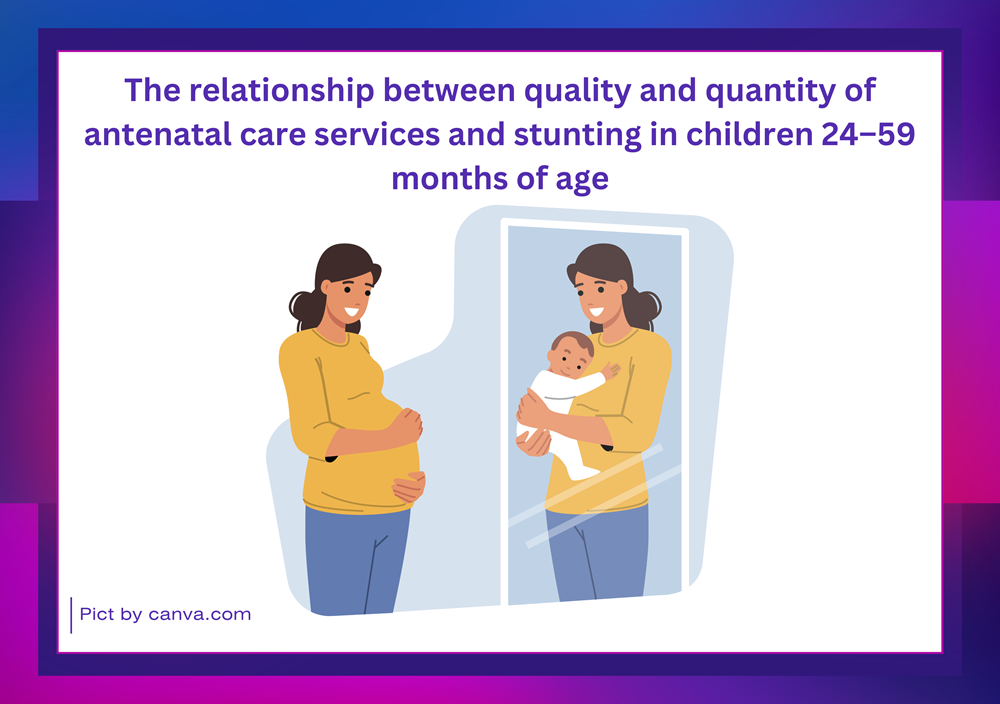
The relationship between quality and quantity of antenatal care services and stunting in children 24–59 months of age
Aulia Pramesti1, Hartati Eko Wardani2, Tika Dwi Tama3, Anindya Hapsari41. State University of Malang , ID2. State University of Malang , ID3. State University of Malang , ID4. State University of Malang , ID2025-06-14|page 97-113AbstractBackground: Stunting is a chronic nutritional problem whose causes include unmet nutrition in pregnant women, lack of infant nutritional intake, and socioeconomic conditions. Dinoyo Health Center covers an area with a high stunting rate in Malang City, particularly Lowokwaru District. Previous research stated that the dominant factor causing stunting in toddlers is antenatal care (ANC).
Objectives: This study aims to determine whether stunting in toddlers in the Dinoyo Community Health Center area is caused by the quality and quantity of ANC.
Methods: The research method is observational analytic with a case-control design using a retrospective approach. The population was 1643 mothers taken from three villages: Tlogomas, Dinoyo, and Sumbersari. The research sample amounted to 69 people using purpose sampling. The research was conducted in February - March 2023. Quality measurement was based on a minimum 10T service standard, while quantity measurement was based on a minimum frequency of 4 visits using a checklist sheet instrument and MCH book with Chi-Square analysis.
Results: The results obtained for ANC quality with stunting p-value = 0.609 with OR value = 1.30 (95% CI: 0.47-3.55), while ANC quantity with stunting p-value = 0.864 with OR value = 1.09 (95% CI: 0.40-2.97).
Conclusions: It is concluded that the quality and quantity of antenatal care have no association with the incidence of stunting in children under 24-59 months in the Dinoyo Community Health Center (Puskesmas) area. These findings highlight the need for multifactor interventions beyond ANC to reduce stunting, such as improved maternal nutrition and environmental sanitation.
APA Citation StylePramesti, A. , Wardani, H. E. , Tama, T. D. , & Hapsari, A. (2025). The relationship between quality and quantity of antenatal care services and stunting in children 24–59 months of age. Public Health and Occupational Safety Journal, 97-113. https://doi.org/10.56003/phosj.v1i1.539 -
Correlation analysis of vaccination coverage, positivity rate, and community mobility rate on COVID-19 effective reproductive rate: SIR modeling study from Indonesia
Meirina Nur Asih Susanti1, Siti Nurrochmah2, Lucky Radita Alma3, Supriyadi Supriyadi41. State University of Malang , ID2. State University of Malang , ID3. State University of Malang , ID4. State University of Malang , ID2025-06-03|page 80-96AbstractBackground: Effective Reproduction Rate (Rt) is used to evaluate COVID-19 transmission; although Tegal City has the lowest cumulative cases in Central Java, the spread of the virus remains rapid. Intervention efforts are carried out through vaccination coverage, positivity rate, and level assessment as a shared responsibility to reduce the transmission rate.
Objectives: The purpose of this study was to estimate the spread of COVID-19 with the intervention and to determine whether there is a correlation between the COVID-19 Rt Number and vaccination coverage, positivity rate, and level assessment situation in Tegal City.
Methods: Observational quantitative research design. The type of research used was SIR (Susceptible Infected Removed) mathematical modeling and descriptive analysis through an ecological study approach and Spearman correlation statistical analysis.
Results: The results of the study showed a decrease in the number of cases of vulnerable and infected subpopulations after public health interventions, followed by the results that the positivity rate and level assessment situation were significantly correlated with the strength of the relationship powerful to the Covid-19 Effective Reproductive Rate with values (r=0.856; p=0.00) and (r=-0.712; p=0.00), while vaccination coverage was not statistically significantly correlated with a value of (r=-0.209; p=0.137).
Conclusions: The positivity rate and COVID-19 level assessment situation were statistically significantly correlated to the effective reproductive rate of COVID-19 in Tegal City with a strong correlation. Meanwhile, vaccination coverage did not correlate statistically with effective reproductive rate. Further studies must evaluate the effectiveness of combined interventions (vaccination + testing + mobility restriction) in various epidemiological settings.
APA Citation StyleSusanti, M. N. A. , Nurrochmah, S. , Alma, L. R. , & Supriyadi, S. (2025). Correlation analysis of vaccination coverage, positivity rate, and community mobility rate on COVID-19 effective reproductive rate: SIR modeling study from Indonesia. Public Health and Occupational Safety Journal, 80-96. https://doi.org/10.56003/phosj.v1i1.534 -
Effects of theory-based education versus simulation-based training on knowledge and skills in managing shortness of breath among university health volunteers
Agus Nur Wahyuda1, Marji Marji2, Nurnaningsih Herya Ulfah3, Anita Sulistyorini41. State University of Malang , ID2. State University of Malang , ID3. State University of Malang , ID4. State University of Malang , ID2026-01-14|page 163-173AbstractBackground: First aid skills for respiratory emergencies, particularly shortness of breath, are crucial for university health volunteers who often serve as the first responders. However, theory-based learning alone is not always adequate for developing practical competencies.
Objectives: This study aims to evaluate the effectiveness of theoretical education compared to the combination of theory and simulation in enhancing the knowledge and skills of university health volunteers in managing cases of shortness of breath.
Methods: A quasi-experimental pre-posttest design was conducted among 40 student volunteers of the Indonesian Red Cross Volunteer Corps (KSR-PMI), aged 18-20 years, who were equally assigned to a theory-only group or a theory-plus-simulation group. The intervention consisted of two 45-minute sessions. Knowledge and skills were assessed before and after the intervention. Data were analyzed using the Wilcoxon Signed Rank Test and the Mann–Whitney U Test with a significance level of α = 0.05.
Results: Knowledge significantly improved in both groups (p < 0.05), with no significant difference between them (p = 0.204). Skill performance improved markedly in the simulation group, increasing from 0% to 100%, compared with only 20% in the theory-only group (p < 0.001).
Conclusions: While theoretical education effectively enhances knowledge, it is insufficient for developing practical skills. Integrating simulation-based training significantly improves psychomotor competence and better prepares university health volunteers to manage respiratory emergencies.
APA Citation StyleWahyuda, A. N. , Marji, M. , Ulfah, N. H. , & Sulistyorini, A. (2026). Effects of theory-based education versus simulation-based training on knowledge and skills in managing shortness of breath among university health volunteers. Public Health and Occupational Safety Journal, 163-173. https://doi.org/10.56003/phosj.v1i2.671 -
Compliance with family planning and its association with quality of life among Meranaw women in rural Philippines
Maslainie Aliola1, Hamdoni Pangandaman21. Mindanao State University - Marawi, Lanao Del Sur, 9700, Philippines , PH2. Mindanao State University, Marawi City , PH2026-05-24|page 1-13AbstractBackground: The COVID-19 pandemic disrupted access to essential health services, including family planning (FP), particularly in rural and underserved communities. These disruptions may influence women’s reproductive practices and overall quality of life (QoL).
Objectives: This study aimed to determine the level of family planning compliance and examine its influence on the quality of life among Meranaw women during the COVID-19 pandemic.
Methods: A descriptive cross-sectional design was employed among 378 Meranaw women who were family planning users in selected municipalities of Lanao del Sur, Philippines. Data were collected from January to October 2022. A stratified random sampling technique was used based on municipal distribution to ensure proportional representation of respondents. A validated researcher-developed questionnaire assessed attitude- and practice-related compliance (CVI = 0.81–0.92; α = 0.79), while QoL was measured using the WHOQOL-BREF. Data were analyzed using descriptive statistics and multiple linear regression.
Results: Respondents demonstrated high compliance in both attitude (mean = 3.61) and practice (mean = 3.41) domains. Overall QoL was rated very satisfactory (mean = 5.72), with the highest scores in the psychological (mean = 5.89) and relational (mean = 5.85) domains. Multiple regression analysis revealed that age (β = .319, p < .001), monthly income (β = –.097, p = .008), number of children (β = .395, p < .001), duration of FP use (β = .092, p = .034), and type of FP method (β = .129, p < .001) significantly predicted QoL. The model explained a substantial proportion of variance (R² = 0.974), indicating strong predictive capacity.
Conclusions: Meranaw women demonstrated high compliance with family planning practices despite pandemic-related constraints, thereby significantly improving the quality of life. Sustaining family planning services during public health crises is essential to maintaining women’s well-being, particularly in rural and culturally distinct populations.
APA Citation StyleAliola, M. , & Pangandaman, H. (2026). Compliance with family planning and its association with quality of life among Meranaw women in rural Philippines. Public Health and Occupational Safety Journal, 1-13. https://doi.org/10.56003/phosj.v2i1.698

1 - 6 of 6 items