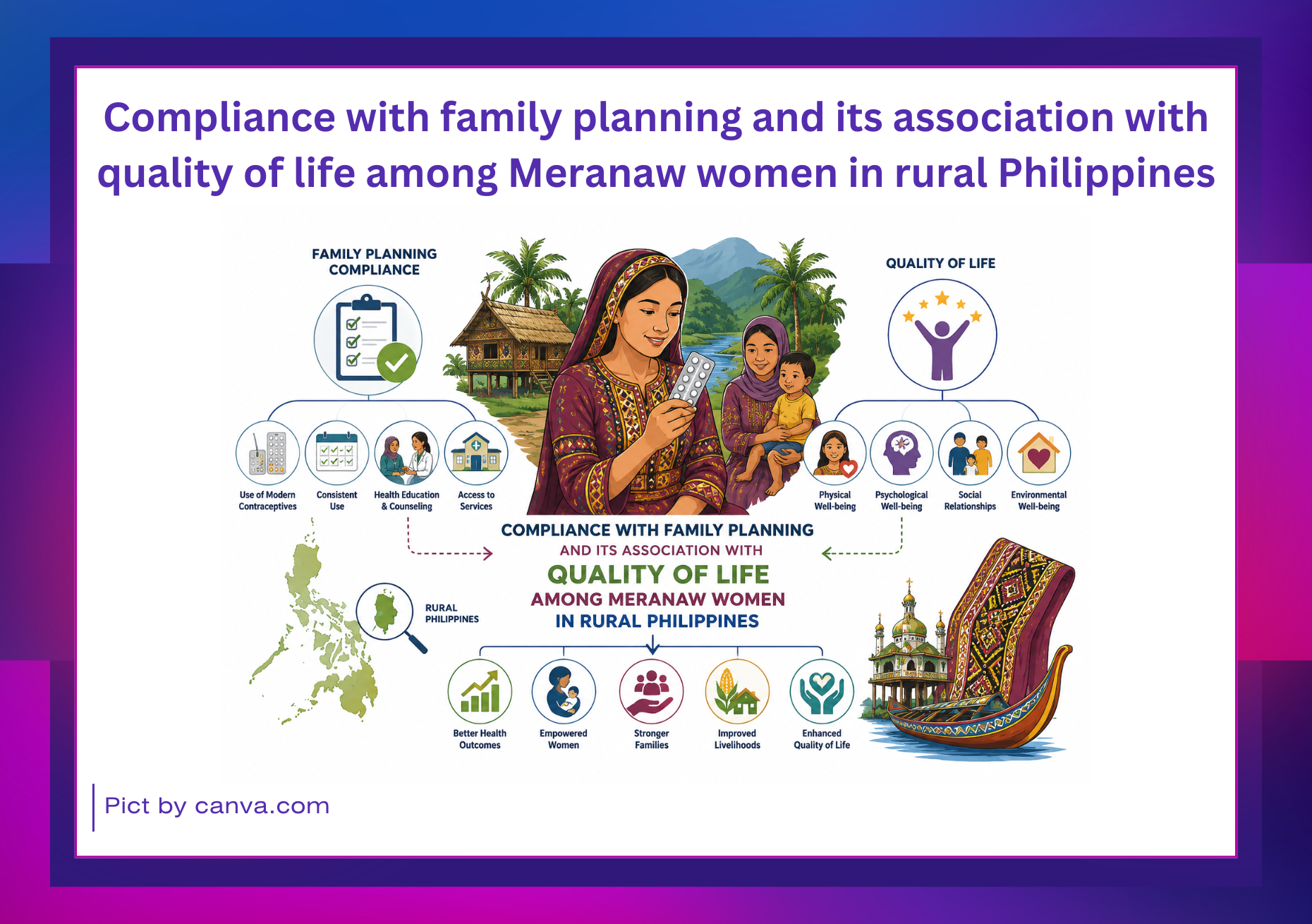
Compliance with family planning and its association with quality of life among Meranaw women in rural Philippines

Downloads
Abstract
Background: The COVID-19 pandemic disrupted access to essential health services, including family planning (FP), particularly in rural and underserved communities. These disruptions may influence women’s reproductive practices and overall quality of life (QoL).
Objectives: This study aimed to determine the level of family planning compliance and examine its influence on the quality of life among Meranaw women during the COVID-19 pandemic.
Methods: A descriptive cross-sectional design was employed among 378 Meranaw women who were family planning users in selected municipalities of Lanao del Sur, Philippines. Data were collected from January to October 2022. A stratified random sampling technique was used based on municipal distribution to ensure proportional representation of respondents. A validated researcher-developed questionnaire assessed attitude- and practice-related compliance (CVI = 0.81–0.92; α = 0.79), while QoL was measured using the WHOQOL-BREF. Data were analyzed using descriptive statistics and multiple linear regression.
Results: Respondents demonstrated high compliance in both attitude (mean = 3.61) and practice (mean = 3.41) domains. Overall QoL was rated very satisfactory (mean = 5.72), with the highest scores in the psychological (mean = 5.89) and relational (mean = 5.85) domains. Multiple regression analysis revealed that age (β = .319, p < .001), monthly income (β = –.097, p = .008), number of children (β = .395, p < .001), duration of FP use (β = .092, p = .034), and type of FP method (β = .129, p < .001) significantly predicted QoL. The model explained a substantial proportion of variance (R² = 0.974), indicating strong predictive capacity.
Conclusions: Meranaw women demonstrated high compliance with family planning practices despite pandemic-related constraints, thereby significantly improving the quality of life. Sustaining family planning services during public health crises is essential to maintaining women’s well-being, particularly in rural and culturally distinct populations.
Ali, S. M. H. O., Bangcola, A. A., & Lawi, A. J. D. (2022). Exploring the issues, practices, and prospects of family planning among married couples in Southern Philippines. Belitung Nursing Journal, 8(1), 35-43. https://doi.org/10.33546/bnj.1939
Alsulaiman, S. A., & Rentner, T. L. (2021). The Use of the Health Belief Model to Assess U.S. College Students’ Perceptions of Covid-19 and Adherence to Preventive Measures. Journal of Public Health Research, 10(4), 1-8. https://doi.org/10.4081/jphr.2021.2273
Arsenault, C., Gage, A., Kim, M. K., Kapoor, N. R., Akweongo, P., Amponsah, F., Aryal, A., Asai, D., Awoonor-Williams, J. K., Ayele, W., Bedregal, P., Doubova, S. V., Dulal, M., Gadeka, D. D., Gordon-Strachan, G., Mariam, D. H., Hensman, D., Joseph, J. P., Kaewkamjornchai, P., . . . Kruk, M. E. (2022). COVID-19 and resilience of healthcare systems in ten countries. Nature Medicine, 28(6), 1314-1324. https://doi.org/10.1038/s41591-022-01750-1
Bali, A. S., He, A. J., & Ramesh, M. (2022). Health policy and COVID-19: path dependency and trajectory. Policy and Society, 41(1), 83-95. https://doi.org/10.1093/polsoc/puab014
Banke-Thomas, A., & Yaya, S. (2021). Looking ahead in the COVID-19 pandemic: emerging lessons learned for sexual and reproductive health services in low- and middle-income countries. Reproductive Health, 18(1), 248. https://doi.org/10.1186/s12978-021-01307-4
Bonnet, J. P. (2024). Content and Face Validation of the Lifestyle Medicine Assessment. American Journal of Lifestyle Medicine, 18(2), 252-259. https://doi.org/10.1177/15598276231214712
Coombs, N. C., Campbell, D. G., & Caringi, J. (2022). A qualitative study of rural healthcare providers’ views of social, cultural, and programmatic barriers to healthcare access. BMC Health Services Research, 22(1), 438. https://doi.org/10.1186/s12913-022-07829-2
Diamond-Smith, N. G., Gopalakrishnan, L., Wawire, S., Kunesh, J., Choi, J., Ali, M., & El Ayadi, A. M. (2025). Does family planning use empower women? A systematic review of the evidence. Reproductive Health, 22(1), 230. https://doi.org/10.1186/s12978-025-02146-3
Duminy, J., Cleland, J., Harpham, T., Montgomery, M. R., Parnell, S., & Speizer, I. S. (2021). Urban family planning in low-and middle-income countries: a critical scoping review. Frontiers in Global Women's Health, 2, 749636. https://doi.org/10.3389/fgwh.2021.749636
Feriani, P., Yunitasari, E., Efendi, F., Krisnana, I., Ernawati, R., Tianingrum, N. A., & Safaah, N. (2024). A Systematic Review of Determinants Influencing Family Planning and Contraceptive Use. Iranian Journal of Nursing and Midwifery Research, 29(5), 596-607. https://doi.org/10.4103/ijnmr.ijnmr_321_23
Finlay, J. E., Gulaid, M., Mibenge, C., Madise, N., Dodoo, N. D., Stover, J., Weinberger, M., O’Brien, M., & Zimmermann, M. (2025). Contraception to women’s economic empowerment: A narrative review. World Development, 196, 107167. https://doi.org/10.1016/j.worlddev.2025.107167
Gaffield, M. E., & Kiarie, J. (2022). Setting global standards: The paramount importance of considering contraceptive values and preferences of clients and providers. Contraception, 111, 1-2. https://doi.org/10.1016/j.contraception.2018.08.006
Geleto, A., Taylor, J., & Beyene, T. (2023). Interruptions in contraception and unintended pregnancy during the COVID-19 pandemic: A protocol for systematic review and meta-analysis. Women's Health, 19, 17455057221147382. https://doi.org/10.1177/17455057221147382
Hayudini, R. I., & Pangandaman, H. K. (2024). Factors and Preferences in Modes of Delivery among Pregnant Tausug Women in Jolo, Sulu [Original Research]. Avicenna Journal of Nursing and Midwifery Care, 32(2), 98-106. https://doi.org/10.32592/ajnmc.32.2.98
Hazel, E. A., Jiwani, S. S., Maïga, A., Mady, G. R. M., Wilson, E., Mwinnyaa, G., & Amouzou, A. (2024). Quality adjusted coverage of family planning services in low-and middle-income countries: Analysis of 33 countries using Demographic and Health Survey data. Journal of global health, 14, 04125. https://doi.org/10.7189/jogh.14.04125
Idris, I. B., Hamis, A. A., Bukhori, A. B. M., Hoong, D. C. C., Yusop, H., Shaharuddin, M. A.-A., Fauzi, N. A. F. A., & Kandayah, T. (2023). Women’s autonomy in healthcare decision making: a systematic review. BMC Women's Health, 23(1), 643. https://doi.org/10.1186/s12905-023-02792-4
Karl, J. A., Fischer, R., Druică, E., Musso, F., & Stan, A. (2022). Testing the Effectiveness of the Health Belief Model in Predicting Preventive Behavior During the COVID-19 Pandemic: The Case of Romania and Italy [Original Research]. Frontiers in Psychology, 12, 627575. https://doi.org/10.3389/fpsyg.2021.627575
Karp, C., Williams, K., Wood, S. N., Olaolorun, F. M., Akilimali, P., Guiella, G., Gichangi, P., Mosso, R., Makumbi, F., Anglewicz, P. A., & Moreau, C. (2024). Family planning service disruptions in the first two years of the COVID-19 pandemic: Evidence from health facilities in seven low- and middle-income countries. PLOS Global Public Health, 4(1), e0002435. https://doi.org/10.1371/journal.pgph.0002435
Khoshmaram, N., Gholipour, K., Farahbakhsh, M., & Tabrizi, J. S. (2025). Strategies and challenges for maintaining the continuity of essential health services during a pandemic: a scoping review. BMC Health Services Research, 25(1), 691. https://doi.org/10.1186/s12913-025-12812-8
Kleine-Bingham, M. B., Rangel, G., Sarakbi, D., Kelleher, T., Mensah Abrampah, N. A., Neilson, M., Bodson, O., White, P., Bothra, V., M de Carvalho, H., da C A Pinto, F., & Babar Syed, S. (2023). Country learning on maintaining quality essential health services during COVID-19 in Timor-Leste: a qualitative analysis. BMJ Open, 13(4), e071879. https://doi.org/10.1136/bmjopen-2023-071879
Kriel, Y., Milford, C., Cordero, J. P., Suleman, F., Steyn, P. S., & Smit, J. A. (2023). Access to public sector family planning services and modern contraceptive methods in South Africa: A qualitative evaluation from community and health care provider perspectives. PloS One, 18(3), e0282996. https://doi.org/10.1371/journal.pone.0282996
Kuandyk, A., Ortega, M. A., Ntegwa, M. J., & Sarria-Santamera, A. (2024). Impact of the COVID-19 pandemic on access to and delivery of maternal and child healthcare services in low-and middle-income countries: a systematic review of the literature. Frontiers in Public Health, 12, 1346268. https://doi.org/10.3389/fpubh.2024.1346268
Marquez, M. P, N., Laguna, E, P., Kabamalan, M. M, M., Cruz, & G, T. (2020). Estimating the Potential Impact of the COVID-19 Pandemic on Key Sexual and Reproductive Health Outcomes in the Philippines. https://www.uppi.upd.edu.ph/sites/default/files/pdf/UPPI-Impact-of-COVID-19-on-SRH.pdf
Marzouk, M., Lam, S. T., Durrance-Bagale, A., Nagashima-Hayashi, M., Neo, P., Ung, M., Zaseela, A., Aribou, Z. M., Agarwal, S., & Howard, N. (2023). Effects of COVID-19 on sexual and reproductive health services access in the Asia-Pacific region: a qualitative study of expert and policymaker perspectives. Sexual and Reproductive Health Matters, 31(1), 2247237. https://doi.org/10.1080/26410397.2023.2247237
Mendoza, O. & Ombao, R. (2022). Evidence for action: Assessing the availability of essential family planning services during COVID-19 in the Philippines. https://www.rti.org/insights/family-planning-services-philippines-covid-19
Mickler, A. K., Carrasco, M. A., Raney, L., Sharma, V., May, A. V., & Greaney, J. (2021). Applications of the High Impact Practices in Family Planning during COVID-19. Sexual and Reproductive Health Matters, 29(1), 9-17. https://doi.org/10.1080/26410397.2021.1881210
Miskeen, E., Korkoman, S., Alhassoun, N. K., Aljuhani, R. F., Alqahtani, R. A. H., Alwabari, S. S., Alamri, M. S., Alshahrani, A. M., Alhalafi, A. H., Almalki, S., Al Fifi, J., Elnour, S., Almuqrin, F. F., Al Ali, Y. A., Karkaman, M. j., & Al-Shahrani, A. M. (2025). Factors influencing family planning decisions in Saudi Arabia. BMC Women's Health, 25(1), 222. https://doi.org/10.1186/s12905-025-03737-9
Panayi, M., Charalambous, G. K., & Jelastopulu, E. (2024). Enhancing quality of life and medication adherence for people living with HIV: the impact of an information system. Journal of Patient-Reported Outcomes, 8(1), 10. https://doi.org/10.1186/s41687-023-00680-x
Pangandaman, H. (2018). Content Validity of Technology Informatics Guiding Education Reform (TIGER) Assessment Instrument for Informatics Competencies of Graduating Nursing Student. International Journal of Advanced Research, 6(11), 682-688. https://doi.org/10.21474/ijar01/8047
Pangandaman, H. (2023). Challenges Faced by Digital Immigrant Nurse Educators in Adopting Flexible Learning Options During the COVID-19 Pandemic: A Phenomenological Study. Journal of Client-Centered Nursing Care, 9(4), 309-316. https://doi.org/10.32598/jccnc.9.4.571.2
Pangandaman, H. K., Mai-Alauya, S. A., Macarambon, R. d. R., Macalaba, S. P., Ali, N. A., Mukattil, N. P., Hayudini, M. A. A., Sadjail, A. H., Abdurasul, J. N. A., & Adjilani-Misah, Z. M. (2025). Bridging Tradition and Modern Medicine: Health Beliefs and Practices of Meranaw Faith Healers Toward Vaccination Against Preventable Communicable Diseases. Frontiers in Health Informatics, 14(2), 36-43.
Rezaei, F., Amiri-Farahani, L., Haghani, S., Pezaro, S., & Behmanesh, F. (2023). The impact of the COVID-19 pandemic on contraceptive methods, abortion, and unintended pregnancy: a cross-sectional study. BMC Women's Health, 23(1), 357. https://doi.org/10.1186/s12905-023-02512-y
Sadang, J. M., Macaronsing, S. I. P., Alawi, N. M., Taib, N. M., & Pangandaman, H. K. (2021). Hypertension self-care management during covid-19 pandemic crisis in the meranao tribe: A phenomenological inquiry. Jurnal Keperawatan Indonesia, 24(2), 74-81. https://doi.org/10.7454/jki.v24i2.1308
Salve, M. M., Tan, N. F. A., Iskandal, I. I., Hayudini, R. I., & Pangandaman, H. K. (2023). Perception on the Use of Artificial Contraception Among Mothers in Jolo, Sulu: A Basis for Policy Implementation. Journal of Namibian Studies, 33, 1722-1730.
Sigdel, A., Bista, A., Sapkota, H., & Teijlingen, E. v. (2023). Barriers in accessing family planning services in Nepal during the COVID-19 pandemic: A qualitative study. PloS One, 18(5), e0285248. https://doi.org/10.1371/journal.pone.0285248
Sileo, K. M., Muhumuza, C., Helal, T., Olfers, A., Lule, H., Sekamatte, S., Kershaw, T. S., Wanyenze, R. K., & Kiene, S. M. (2023). Exploring the effects of COVID-19 on family planning: results from a qualitative study in rural Uganda following COVID-19 lockdown. Reproductive Health, 20(1), 31. https://doi.org/10.1186/s12978-023-01566-3
Skevington, S. M., Schick-Makaroff, K., Rowland, C., Molzahn, A., & and the, W. G. (2024). Women’s environmental quality of life is key to their overall quality of life and health: Global evidence from the WHOQOL-100. PloS One, 19(10), e0310445. https://doi.org/10.1371/journal.pone.0310445
Smallwood, N., Harrex, W., Rees, M., Willis, K., & Bennett, C. M. (2022). COVID-19 infection and the broader impacts of the pandemic on healthcare workers. Respirology, 27(6), 411-426. https://doi.org/10.1111/resp.14208
VanBenschoten, H., Kuganantham, H., Larsson, E. C., Endler, M., Thorson, A., Gemzell-Danielsson, K., Hanson, C., Ganatra, B., Ali, M., & Cleeve, A. (2022). Impact of the COVID-19 pandemic on access to and utilisation of services for sexual and reproductive health: a scoping review. BMJ Global Health, 7(10), e009594. https://doi.org/10.1136/bmjgh-2022-009594
Copyright (c) 2026 Maslainie Aliola, Hamdoni Pangandaman

This work is licensed under a Creative Commons Attribution-ShareAlike 4.0 International License.