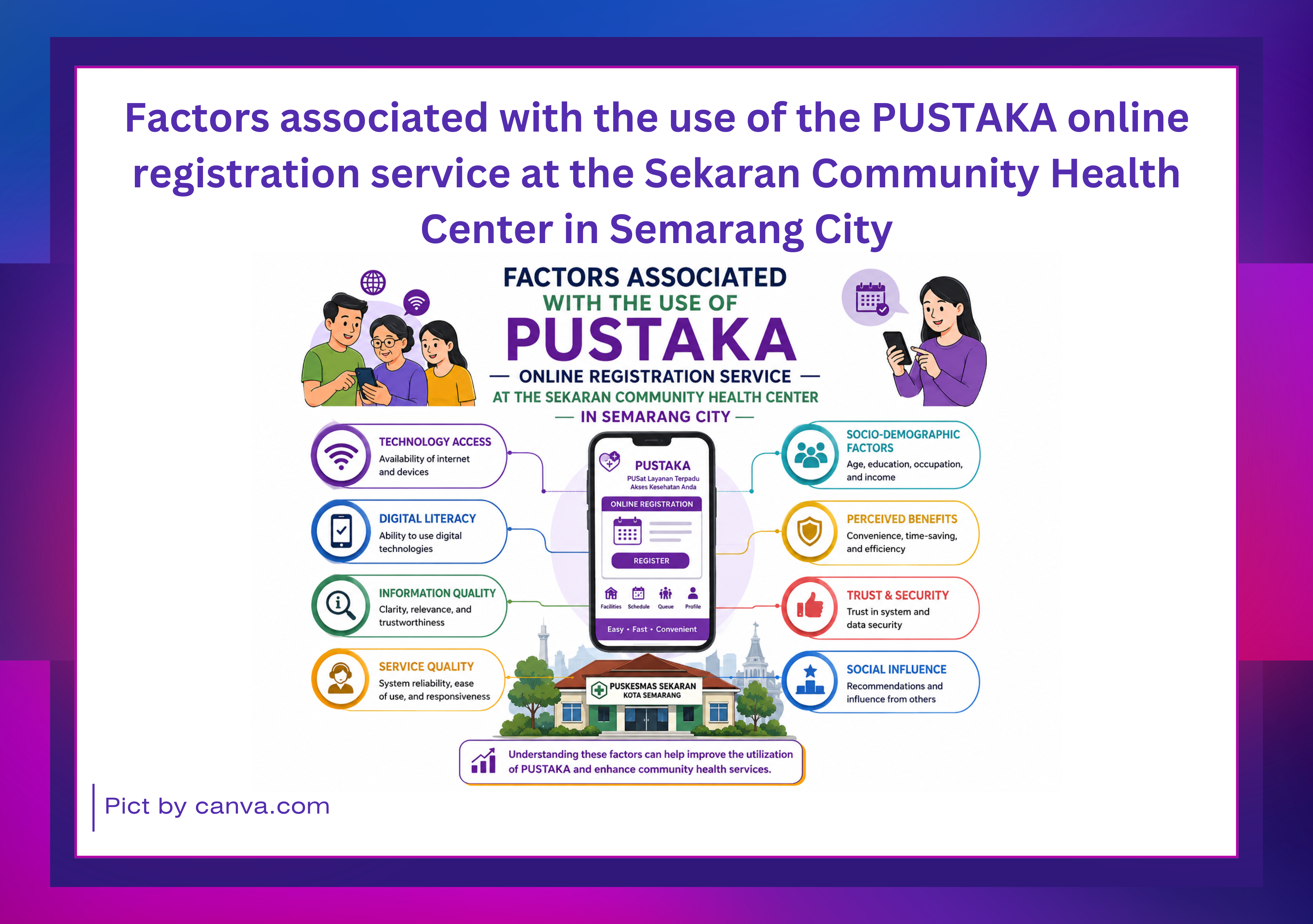
Factors associated with the use of the PUSTAKA online registration service at the Sekaran Community Health Center in Semarang City

Background: Online registration services have been implemented in community health centers to facilitate patient access and reduce long queues by enabling appointment scheduling at specific times. However, the utilization of this service in several community health centers in Semarang City remains below the monthly target of 10%. At Sekaran Community Health Center, for example, the average utilization rate was only 1.03% between June and August 2023.
Objectives: This study analyzed the factors associated with the use of the PUSTAKA Online Registration Service at The Sekaran Community Health Center in Semarang City.
Methods: This study employed a quantitative research design with a cross-sectional approach. The population consisted of existing patients at Sekaran Community Health Center, with a sample of 97 respondents selected using accidental sampling. The variables examined included age, education, occupation, attitude, knowledge, perceived need, availability of facilities, and ease of obtaining information in relation to the decision to use PUSTAKA services. Data were collected using a closed-ended questionnaire that had previously undergone validity and reliability testing.
Results: The results of the research analysis using the chi square statistical test showed the conclusion that there was a significant relationship between the factors of age (p = 0.006), education (p = 0.007), occupation (p = 0.044), attitude (p = 0.017), perceived needs (p = 0.006), and ease of obtaining information (p = 0.021) with the decision to use PUSTAKA services at the Sekaran Health Center.
Conclusions: Meanwhile, there is no relationship between knowledge (p = 0.812) and the availability of facilities (p = 0.114) with the decision to use PUSTAKA.
Downloads
Badr, J., Motulsky, A., & Denis, J.-L. (2024). Digital health technologies and inequalities: A scoping review of potential impacts and policy recommendations. Health Policy, 146, 105122. https://doi.org/10.1016/j.healthpol.2024.105122
Bastami, F., Zamani-Alavijeh, F., Zareban, I., & Araban, M. (2022). Explaining the experiences of health care providers regarding organizational factors affecting health education: a qualitative study. BMC Medical Education, 22(1), 743. https://doi.org/10.1186/s12909-022-03807-8
Bertolazzi, A., Quaglia, V., & Bongelli, R. (2024). Barriers and facilitators to health technology adoption by older adults with chronic diseases: an integrative systematic review. BMC Public Health, 24(1), 506. https://doi.org/10.1186/s12889-024-18036-5
Farsi, D. (2021). Social media and health care, part I: literature review of social media use by health care providers. Journal of Medical Internet Research, 23(4), e23205. https://doi.org/10.2196/23205
Green, L. W., & Kreuter, M. W. (2005). Health program planning: An educational and ecological approach. New York: McGraw-Hill.
Hastini, L. Y., Fahmi, R., & Lukito, H. (2020). Apakah Pembelajaran Menggunakan Teknologi dapat Meningkatkan Literasi Manusia pada Generasi Z di Indonesia? Jurnal Manajemen Informatika (JAMIKA), 10(1), 12–28. https://doi.org/10.34010/jamika.v10i1.2678
Hegland, T. A., & Berdahl, T. A. (2022). High Job Flexibility And Paid Sick Leave Increase Health Care Access And Use Among US Workers. Health Affairs, 41(6), 873–882. https://doi.org/10.1377/hlthaff.2021.01876
Herwansyah, H., Czabanowska, K., Kalaitzi, S., & Schröder-Bäck, P. (2022). Exploring the influence of sociodemographic characteristics on the utilization of maternal health services: a study on community health centers setting in province of Jambi, Indonesia. International Journal of Environmental Research and Public Health, 19(14), 8459. https://doi.org/10.3390/ijerph19148459
Humairah, S. (2020). Determinan yang Berhubungan dengan Pemanfaatan Pelayanan Kesehatan Gigi di Wilayah Kerja Puskesmas Pandere Kecamatan Gumbasa Kabupaten Sigi. Jurnal Ilmiah Kesmas IJ (Indonesia Jaya), 20(2), 97–106.
Juliá Nehme, B., Torres Irribarra, D., Cumsille, P., & Yoon, S. (2021). Waiting Room Physical Environment and Outpatient Experience: The Spatial User Experience Model as Analytical Tool. Journal of Interior Design, 46(4), 27–48. https://doi.org/10.1111/joid.12205
Khoerunnisak, K., Arso, S., & Kusumastuti, W. (2023). Faktor yang Berhubungan dengan Minat Masyarakat dalam Memanfaatkan Layanan PUSTAKA (Puskesmas Tanpa Antrean Kota Semarang). Jurnal Kesehatan Vokasional, 8(2), 73-80. https://doi.org/10.22146/jkesvo.75695
Laker, B., Fontinha, R., & Walker, J. (2024). Balancing health and work: employees demand more flexibility in when, where and how they work. BMJ Leader, 8, 354-357. https://doi.org/10.1136/leader-2023-000869
Lee, C. M. Y., Thomas, E., Norman, R., Wells, L., Shaw, T., Nesbitt, J., … Robinson, S. (2022). Educational attainment and willingness to use technology for health and to share health information – The reimagining healthcare survey. International Journal of Medical Informatics, 164, 104803. https://doi.org/10.1016/j.ijmedinf.2022.104803
Mohammadzadeh, Z., Saeidnia, H. R., Lotfata, A., Hassanzadeh, M., & Ghiasi, N. (2023). Smart city healthcare delivery innovations: a systematic review of essential technologies and indicators for developing nations. BMC Health Services Research, 23(1), 1180. https://doi.org/10.1186/s12913-023-10200-8
Mouloudj, K., Bouarar, A. C., Asanza, D. M., Saadaoui, L., Mouloudj, S., Njoku, A. U., ... & Bouarar, A. (2023). Factors influencing the adoption of digital health apps: an extended technology acceptance model (TAM). In Integrating Digital Health Strategies for Effective Administration (pp. 116-132). IGI Global Scientific Publishing. https://doi.org/10.4018/978-1-6684-8337-4.ch007
Nishan, M. N. H., Akter, K., Sharmin, A., Tithi, T. A., & Ahmed, M. N. U. (2025). Does education sculpt healthcare choices? Exploring factors influencing healthcare utilization among female youths in eight low and lower-middle-income countries. PloS one, 20(3), e0298782. https://doi.org/10.1371/journal.pone.0298782
Notoadmodjo, S. (2010). Metodologi Penelitian Kesehatan. Jakarta: Rineka Cipta.
Prameswati, N. D., Suryoputro, A., & Fatmasari, E. Y. (2022). Analisis Kesiapan Puskesmas Dalam Pelaksanaan Program Puskesmas Tanpa Antrian Kota Semarang (PUSTAKA) di Kota Semarang. Media Kesehatan Masyarakat Indonesia, 8(4), 153–158. https://doi.org/10.14710/mkmi.18.4.%25p
Rizqulloh, L., & Iqbal, M. (2022). Gambaran Penerimaan Aplikasi Puskesmas Tanpa Antrian (Pustaka) Dengan Technology Acceptance Model Di Puskesmas Rowosari Semarang. J-REMI : Jurnal Rekam Medik Dan Informasi Kesehatan, 3(4), 262–268. https://doi.org/10.25047/j-remi.v3i4.3263
Rizqulloh, L., Iqbal, M., & Puspitasari, A. (2022). Analisis Faktor-Faktor Yang Berpengaruh Terhadap Penerimaan Aplikasi Puskesmas Tanpa Antrian (PUSTAKA) di Puskesmas Rowosari. Indonesian of Health Information Management Journal (INOHIM), 10(2), 85–93. https://doi.org/10.47007/inohim.v10i2.440
Thomas, R. K. (2020). Health services demand and utilization. In Health Services Planning (pp. 91-114). New York, NY: Springer US. https://doi.org/10.1007/978-1-0716-1076-3_5
Tlapa, D., Tortorella, G., Fogliatto, F., Kumar, M., Mac Cawley, A., Vassolo, R., … Baez-Lopez, Y. (2022). Effects of Lean Interventions Supported by Digital Technologies on Healthcare Services: A Systematic Review. International Journal of Environmental Research and Public Health, 19(15), 9018. https://doi.org/10.3390/ijerph19159018
Yuliani, K., Arso, S. P., & Nandini, N. (2020). Gambaran Program Puskesmas Tanpa Antrian Kota Semarang (Pustaka) Sebagai Layanan Pendaftaran Online. Jurnal Ilmiah Mahasiswa, 10(3), 70–72. https://ejournal.undip.ac.id/index.php/jim/article/view/31868
Zeng, Y., Xu, W., Chen, L., Chen, F., & Fang, Y. (2020). The influencing factors of health-seeking preference and community health service utilization among patients in primary care reform in Xiamen, China. Patient Preference and Adherence, 653-662. https://doi.org/10.2147/PPA.S242141
Zhang, L., Bullen, C., & Chen, J. (2025). Digital Health Innovations to Catalyze the Transition to Value-Based Health Care. JMIR Medical Informatics, 13, e57385–e57385. https://doi.org/10.2196/57385
Copyright (c) 2026 Bunga Gustikasari Ismail, Nurhasmadiar Nandini, Rani Tiyas Budiyanti

This work is licensed under a Creative Commons Attribution-ShareAlike 4.0 International License.