Search
Search Results
##search.searchResults.foundPlural##
-

Spatial mapping and correlation between healthy home coverage and tuberculosis incidence in Malang district
Fatma Lidya Zulfa1, Hartati Eko Wardani2, Tika Dwi Tama3, Anindya Hapsari4, Rara Warih Gayatri5, Erni Astutik61. State University of Malang , ID2. State University of Malang , ID3. State University of Malang , ID4. State University of Malang , ID5. State University of Malang , ID6. Airlangga University , ID2025-04-23|page 1-16AbstractBackground: According to the Ministry of Health, 91% of active tuberculosis (TB) cases in Indonesia occur in crowded and slum areas. The Healthy Homes Program under the Healthy Indonesia Indicators (2010) aims to improve housing conditions in such areas to meet health standards. Malang District, with the second-highest housing density in East Java, ranks fifth in TB cases, suggesting residential exposure as a contributing factor.
Objectives: This study aims to map trends and examine the correlation between healthy home coverage and TB incidence in the Malang District Health Center Working Area 2019-2021.
Methods: The study was conducted in January-April 2023 at the Malang District Health Office with a unit of analysis of 39 health centers. The variables of this study were the coverage of healthy homes and the incidence of BTA-positive pulmonary TB. The study used a mixed ecological study and Pearson correlation test with secondary data from the Malang District Health Office and BPS.
Results: TB incidence showed a decreasing trend alongside increasing healthy home coverage. Nine health centers remained in high-incidence zones, and five exhibited poor housing coverage. Correlation analysis revealed a weak, negative relationship (r = -0.084). High TB incidence was still found in areas meeting healthy home criteria.
Conclusions: The incidence rate of BTA-positive pulmonary TB in the working area of the Malang District Health Center showed a downward trend for 3 years. Future research using individual data and other specific risk factors that may influence TB incidence is recommended.
APA Citation StyleZulfa, F. L. , Wardani, H. E. , Tama, T. D. , Hapsari, A. , Gayatri, R. W. , & Astutik, E. (2025). Spatial mapping and correlation between healthy home coverage and tuberculosis incidence in Malang district. Public Health and Occupational Safety Journal, 1-16. https://doi.org/10.56003/phosj.v1i1.532 -
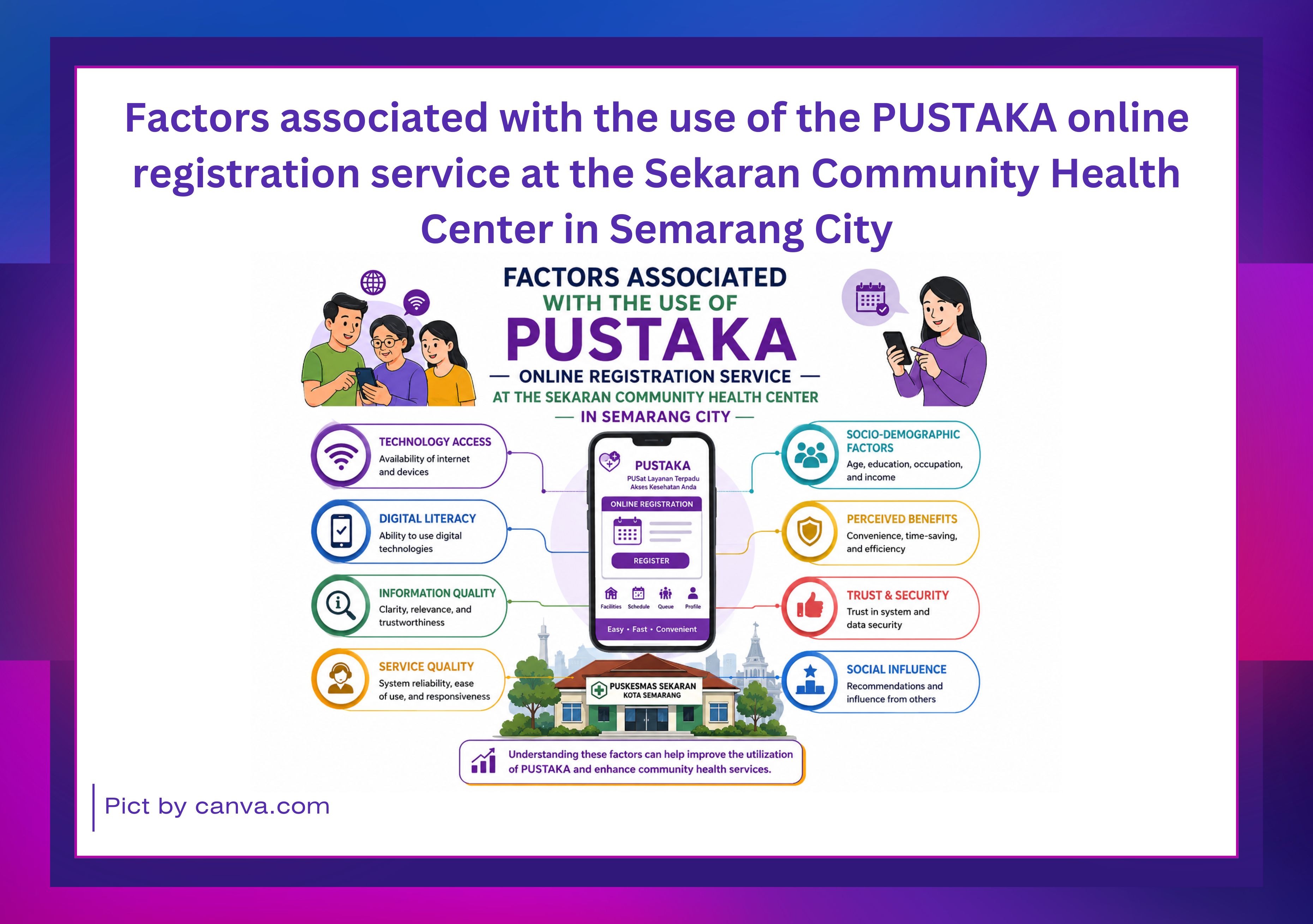
Factors associated with the use of the PUSTAKA online registration service at the Sekaran Community Health Center in Semarang City
Bunga Gustikasari Ismail1, Nurhasmadiar Nandini2, Rani Tiyas Budiyanti31. Faculty of Public Health, Universitas Diponegoro , ID2. Faculty of Public Health, Universitas Diponegoro , ID3. Faculty of Public Health, Universitas Diponegoro , ID2026-05-26|page 57-69AbstractBackground: Online registration services have been implemented in community health centers to facilitate patient access and reduce long queues by enabling appointment scheduling at specific times. However, the utilization of this service in several community health centers in Semarang City remains below the monthly target of 10%. At Sekaran Community Health Center, for example, the average utilization rate was only 1.03% between June and August 2023.
Objectives: This study analyzed the factors associated with the use of the PUSTAKA Online Registration Service at The Sekaran Community Health Center in Semarang City.
Methods: This study employed a quantitative research design with a cross-sectional approach. The population consisted of existing patients at Sekaran Community Health Center, with a sample of 97 respondents selected using accidental sampling. The variables examined included age, education, occupation, attitude, knowledge, perceived need, availability of facilities, and ease of obtaining information in relation to the decision to use PUSTAKA services. Data were collected using a closed-ended questionnaire that had previously undergone validity and reliability testing.
Results: The results of the research analysis using the chi square statistical test showed the conclusion that there was a significant relationship between the factors of age (p = 0.006), education (p = 0.007), occupation (p = 0.044), attitude (p = 0.017), perceived needs (p = 0.006), and ease of obtaining information (p = 0.021) with the decision to use PUSTAKA services at the Sekaran Health Center.
Conclusions: Meanwhile, there is no relationship between knowledge (p = 0.812) and the availability of facilities (p = 0.114) with the decision to use PUSTAKA.
APA Citation StyleIsmail, B. G. , Nandini, N. , & Budiyanti, R. T. (2026). Factors associated with the use of the PUSTAKA online registration service at the Sekaran Community Health Center in Semarang City. Public Health and Occupational Safety Journal, 57-69. https://doi.org/10.56003/phosj.v2i1.739 -
Effectiveness of 3D poster in improving menstrual hygiene knowledge among adolescent girls: A quasi-experimental study
Rani Mustikawati1, Windi Chusniah Rachmawati2, Endang Sri Redjeki3, Nurnaningsih Herya Ulfah41. State University of Malang , ID2. State University of Malang , ID3. State University of Malang , ID4. State University of Malang , ID2025-04-23|page 40-52AbstractBackground: Personal hygiene during menstruation is important and must be applied during the menstrual cycle. Suppose personal hygiene during menstruation is not maintained correctly. In that case, adolescent girls have the potential to experience health problems such as vaginal discharge, irritation of the genital area, allergies, inflammation, and Urinary Tract Infection (UTI). As many as 75% of women in Indonesia have experienced vaginal discharge once, while 45% have experienced it more than 2 times.
Objectives: This study aimed to determine the effectiveness of 3D posters in increasing knowledge about personal hygiene during menstruation.
Methods: The research method used was Research and Development (R&D), which was conducted through a pre-experimental approach with one group pretest-posttest. Ninety-five adolescent girls in class VII of State Junior High School 13 Malang participated in the study obtained using a purposive sampling technique. The research instrument used a closed-type questionnaire with 10 items to measure knowledge.
Results: The 3D poster product obtained a percentage value of media feasibility of 95% for the media aspect and 92% for the material aspect, which means it is very feasible to use. After the intervention, it is known that there is an effect of providing health education using 3D posters on the knowledge of adolescent girls regarding personal hygiene during menstruation according to the p-value = 0.000 from the Wilcoxon test.
Conclusions: Personal hygiene education during menstruation should be done more often to improve the knowledge of adolescent girls. The findings support the use of 3D media in menstrual health promotion, especially in schools with limited resources.
APA Citation StyleMustikawati, R. , Rachmawati, W. C. , Redjeki, E. S. , & Ulfah, N. H. (2025). Effectiveness of 3D poster in improving menstrual hygiene knowledge among adolescent girls: A quasi-experimental study. Public Health and Occupational Safety Journal, 40-52. https://doi.org/10.56003/phosj.v1i1.531 -
The relationship between quality and quantity of antenatal care services and stunting in children 24–59 months of age
Aulia Pramesti1, Hartati Eko Wardani2, Tika Dwi Tama3, Anindya Hapsari41. State University of Malang , ID2. State University of Malang , ID3. State University of Malang , ID4. State University of Malang , ID2025-06-14|page 97-113AbstractBackground: Stunting is a chronic nutritional problem whose causes include unmet nutrition in pregnant women, lack of infant nutritional intake, and socioeconomic conditions. Dinoyo Health Center covers an area with a high stunting rate in Malang City, particularly Lowokwaru District. Previous research stated that the dominant factor causing stunting in toddlers is antenatal care (ANC).
Objectives: This study aims to determine whether stunting in toddlers in the Dinoyo Community Health Center area is caused by the quality and quantity of ANC.
Methods: The research method is observational analytic with a case-control design using a retrospective approach. The population was 1643 mothers taken from three villages: Tlogomas, Dinoyo, and Sumbersari. The research sample amounted to 69 people using purpose sampling. The research was conducted in February - March 2023. Quality measurement was based on a minimum 10T service standard, while quantity measurement was based on a minimum frequency of 4 visits using a checklist sheet instrument and MCH book with Chi-Square analysis.
Results: The results obtained for ANC quality with stunting p-value = 0.609 with OR value = 1.30 (95% CI: 0.47-3.55), while ANC quantity with stunting p-value = 0.864 with OR value = 1.09 (95% CI: 0.40-2.97).
Conclusions: It is concluded that the quality and quantity of antenatal care have no association with the incidence of stunting in children under 24-59 months in the Dinoyo Community Health Center (Puskesmas) area. These findings highlight the need for multifactor interventions beyond ANC to reduce stunting, such as improved maternal nutrition and environmental sanitation.
APA Citation StylePramesti, A. , Wardani, H. E. , Tama, T. D. , & Hapsari, A. (2025). The relationship between quality and quantity of antenatal care services and stunting in children 24–59 months of age. Public Health and Occupational Safety Journal, 97-113. https://doi.org/10.56003/phosj.v1i1.539 -
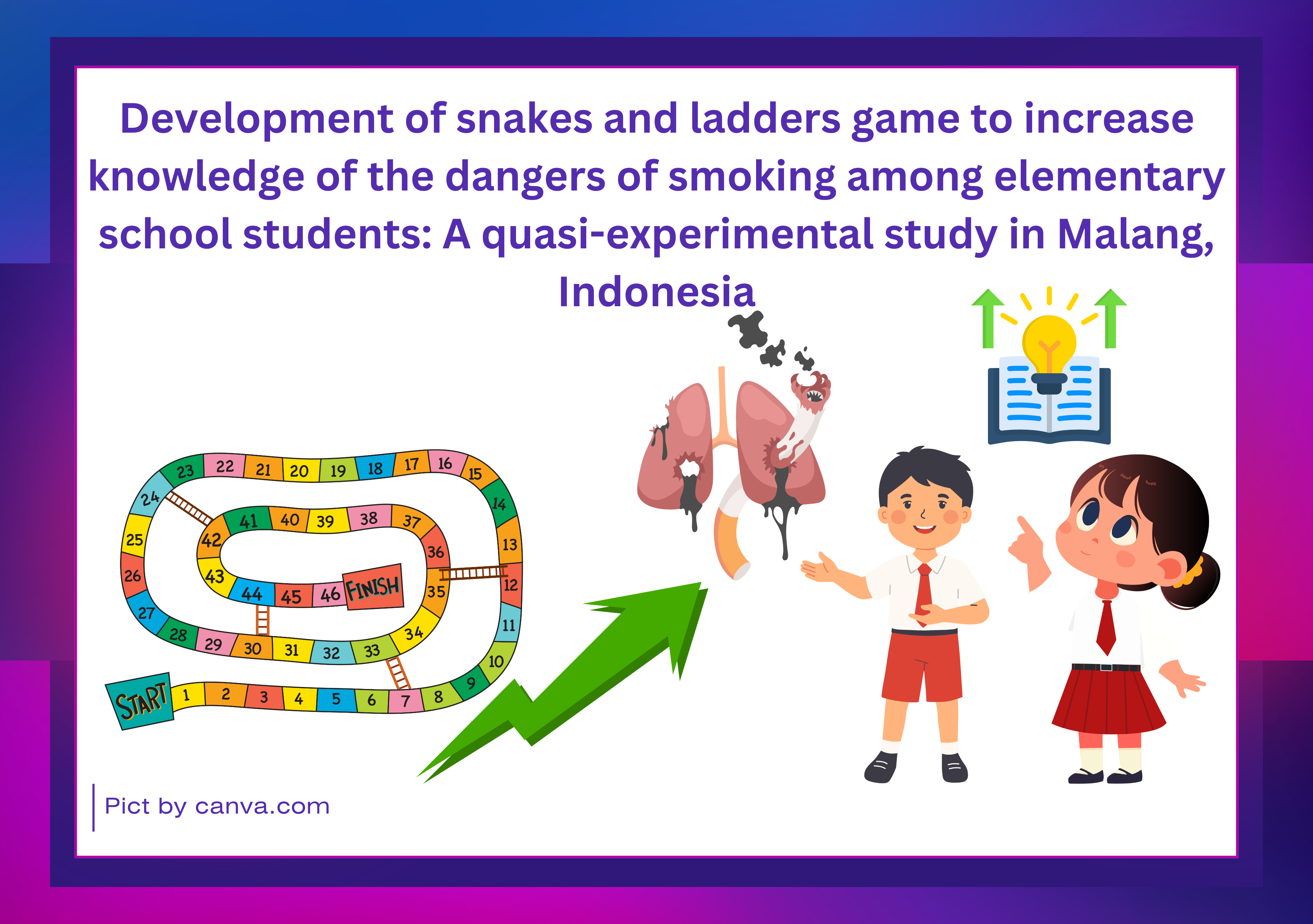
Development of snakes and ladders game to increase knowledge of the dangers of smoking among elementary school students: A quasi-experimental study in Malang, Indonesia
Novita Rizky Ramadhani1, Windi Chusniah Rachmawati2, Moch. Yunus3, Nurnaningsih Herya Ulfah41. State University of Malang , ID2. State University of Malang , ID3. State University of Malang , ID4. State University of Malang , ID2025-04-23|page 53-66AbstractBackground: The smoking trend has now infected school-age children, with 19.2% of students aged 13-15 years in Indonesia and 2,859 children in Malang City recorded as active smokers, which is influenced by a lack of understanding of the dangers of smoking. Educational interventions such as Snakes and Ladders game-based health promotion media must be developed to build a culture of not smoking from an early age.
Objectives: The purpose of the study was to develop educational game media in the form of snakes and ladders as a tool for delivering health information about the dangers of smoking to students of Oro-Oro Dowo Malang State Elementary School.
Methods: Research and Development (R&D) type research with a one-group pretest and posttest trial aims to determine the effectiveness of the Snakes and Ladders game as a health promotion media on the dangers of smoking behavior. The subjects needed in this study are media experts, material experts, and students aged 9-13 years as research samples.
Results: The average result of increasing knowledge is 0.000 using the Wilcoxon test, so there is a difference in the average value of knowledge in the pretest and posttest data. In the feasibility test results, the assessment results were obtained in the very feasible category. Game media is effective and very feasible to be a health promotion media in efforts to promote the dangers of smoking in children.
Conclusions: The Snakes and Ladders game media developed is feasible to be a health promotion media in efforts to promote the dangers of smoking behavior in children. The Snakes and Ladders game media influences increasing students' knowledge of Oro-Oro Dowo Malang State Elementary School about the dangers of smoking. Further research needs to evaluate media's long-term impact and adaptation in various socio-cultural contexts.
APA Citation StyleRamadhani, N. R. , Rachmawati, W. C. , Yunus, M. , & Ulfah, N. H. (2025). Development of snakes and ladders game to increase knowledge of the dangers of smoking among elementary school students: A quasi-experimental study in Malang, Indonesia. Public Health and Occupational Safety Journal, 53-66. https://doi.org/10.56003/phosj.v1i1.530 -
Factors influencing desired family size among women of childbearing age in eastern Indonesia: Evidence from the Indonesian Demographic Health Survey
Cindy Ade Aulia1, Siti Nurrochmah2, Lucky Radita Alma3, Supriyadi Supriyadi41. State University of Malang , ID2. State University of Malang , ID3. State University of Malang , ID4. State University of Malang , ID2025-06-02|page 67-79AbstractBackground: Globally, Indonesia is the fourth most populous country. Based on the results of the Indonesian Central Bureau of Statistics census, it is known that the population of Indonesia in 2017 was around 261 million people, with an average number of children desired by women of childbearing age in East Nusa Tenggara Province of 2.9 or around three children per woman of childbearing age.
Objectives: This study aimed to determine the relationship between marital status, age at first marriage, employment status, and the number of children desired.
Methods: This quantitative study uses a cross-sectional design and an observational analytic survey method. This study took survey data from the 2017 Indonesian Demographic and Health Survey. The study sample was women aged 15-49 years who were recorded as a selected sample in East Nusa Tenggara Province, totaling 1,929 women. Data analysis used the Chi-square test.
Results: The analysis showed that the p-value of marital status was 0.000, the p-value of age at first marriage was 0.000, and the p-value of employment status was 0.000, which means that there is a significant relationship between marital status, age at first marriage, and employment status with the number of children desired by women of childbearing age.
Conclusions: This study found that marital status, age at first marriage, and employment status were significantly associated with the number of children desired by women of childbearing age. The findings suggest the need for employment-based interventions and marriage education to reduce fertility preferences in areas with high TFR.
APA Citation StyleAulia, C. A. , Nurrochmah, S. , Alma, L. R. , & Supriyadi, S. (2025). Factors influencing desired family size among women of childbearing age in eastern Indonesia: Evidence from the Indonesian Demographic Health Survey. Public Health and Occupational Safety Journal, 67-79. https://doi.org/10.56003/phosj.v1i1.533 -

Role of inter-institutional partnerships in promoting holistic employee wellness programs: A convergent mixed-methods study across three public universities in Metro Manila, Philippines
Rosalie Dela Cruz11. University of Makati , PH2025-11-28|page 139-150AbstractBackground: Employee wellness has become an increasingly essential concern in higher education; yet, many public universities continue to struggle with implementing comprehensive and sustainable wellness initiatives. Inter-institutional partnerships offer opportunities to strengthen these efforts through shared resources and coordinated programming.
Objectives: This study examined how such partnerships support the development of holistic employee wellness programs across three public universities in Metro Manila.
Methods: Using a convergent mixed-methods design, quantitative data were collected from 150 employees through an 18-item validated survey and analyzed using descriptive statistics and chi-square tests to assess institutional differences in awareness, participation, and perceived effectiveness. Qualitative data from six key informants were analyzed using grounded theory techniques to identify themes related to institutional practices and collaborative mechanisms.
Results: Findings indicated significant variations among institutions in employee awareness, participation levels, and perceptions of program effectiveness. Despite the availability of wellness initiatives, participation remained limited, mainly due to workload demands, time constraints, and scheduling challenges. Qualitative themes highlighted four central factors influencing the implementation of wellness: institutional support, holistic wellness orientation, program personalization, and persistent participation barriers. These themes helped explain why engagement levels differed among institutions.
Conclusions: Overall, inter-institutional collaboration contributes positively to wellness program development, but its impact depends on strong institutional support, program relevance, and clear communication. Enhancing coordination and tailoring activities to employee needs may improve future wellness outcomes.
APA Citation StyleCruz, R. D. (2025). Role of inter-institutional partnerships in promoting holistic employee wellness programs: A convergent mixed-methods study across three public universities in Metro Manila, Philippines. Public Health and Occupational Safety Journal, 139-150. https://doi.org/10.56003/phosj.v1i2.610 -

The effect of leaflet-based education and simulation of first-aid in accidents (P3K) on the knowledge and skills of tourism workers in Indonesia
Adelia Permatasari1, Anita Sulistyorini2, Supriyadi Supriyadi3, Nurnaningsih Herya Ulfah41. State University of Malang , ID2. State University of Malang , ID3. State University of Malang , ID4. State University of Malang , ID2025-06-15|page 127-138AbstractBackground: Law Number 1 of 1970 concerning Occupational Safety requires all sectors, including tourism, to implement Occupational Safety and Health (K3). Taman Dolan Batu City, as a tourist destination, has a risk of work accidents, so it needs mitigation efforts through First Aid for Accidents (P3K).
Objectives: This study aims to analyze the effect of leaflet-based education and simulation on workers' knowledge and first aid skills.
Methods: The research design used a quasi-experiment conducted with a sample of 16 people divided into two different intervention groups. This study uses questionnaire instruments and observation sheets that have been proven valid and reliable through statistical tests (Pearson, Aiken's V, and Cronbach Alpha) and experts' validation of leaflet educational media. Data analysis used Wilcoxon Signed Rank, and Mann-Whitney U tests with a significance level of 0.05.
Results: The results of hypothesis testing showed that both educational methods significantly improved workers' knowledge and skills (p<0.05). The combined intervention of leaflet and simulation proved more effective than the single method.
Conclusions: Leaflet-based education and simulation together are more effective in improving the knowledge and skills of first aid workers at Dolan Park. Researchers recommend that managers routinely hold K3-related training to reduce the risk of workplace accidents. Future research is recommended to involve a larger sample and evaluate the long-term effectiveness of the intervention provided.
APA Citation StylePermatasari, A. , Sulistyorini, A. , Supriyadi, S. , & Ulfah, N. H. (2025). The effect of leaflet-based education and simulation of first-aid in accidents (P3K) on the knowledge and skills of tourism workers in Indonesia. Public Health and Occupational Safety Journal, 127-138. https://doi.org/10.56003/phosj.v1i1.596

1 - 8 of 8 items