Search
Search Results
##search.searchResults.foundPlural##
-

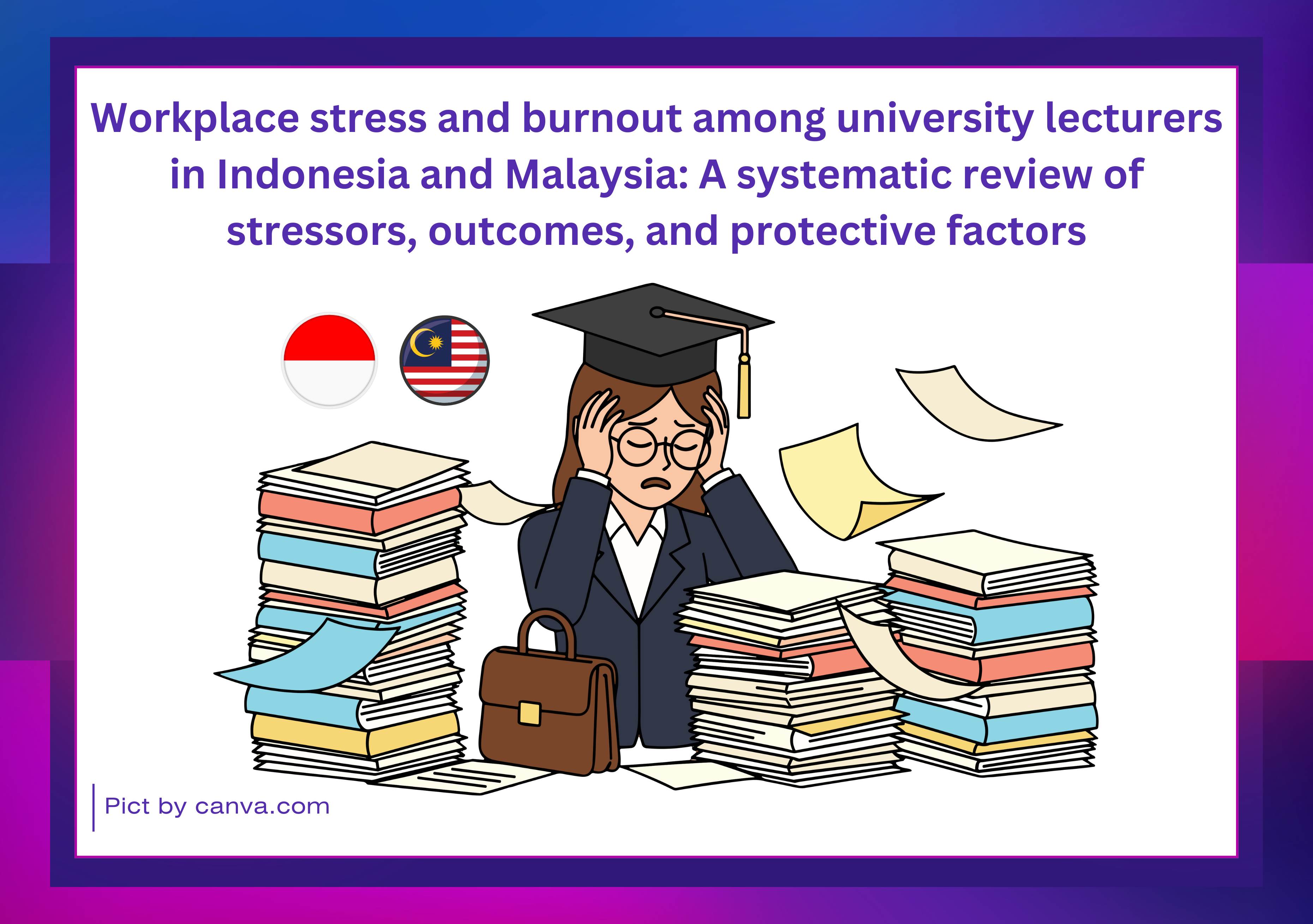
Workplace stress and burnout among university lecturers in Indonesia and Malaysia: A systematic review of stressors, outcomes, and protective factors
Mimi Haryani Hassim1, Dian Puspitaningtyas Laksana2, Rachmy Rosyida Rais3, Ronal Surya Aditya41. University of Technology Malaysia , MY2. State University of Malang , ID3. State University of Malang , ID4. Universitas Jember , ID2026-01-27|page 174-192AbstractBackground: Workplace stress and burnout have emerged as critical occupational health concerns among university lecturers, particularly amid increasing academic workloads, performance pressures, and organizational demands intensified during and after the COVID-19 pandemic. Despite growing empirical attention, evidence remains fragmented, especially within Southeast Asian higher education contexts.
Objectives: This study aims to systematically review empirical research on workplace stress and burnout among university lecturers in Indonesia and Malaysia, with a focus on identifying key stressors, associated outcomes, and protective factors.
Methods: A systematic literature review was conducted following the PRISMA 2020 guidelines. Peer-reviewed articles published in English were retrieved from the Scopus database using predefined search terms related to workplace stress, burnout, lecturers, and higher education in Indonesia and Malaysia. After screening and eligibility assessment, 19 studies published between 2004 and 2025 were included. Methodological quality was assessed using the Newcastle–Ottawa Scale, and findings were synthesized through qualitative narrative analysis due to study heterogeneity.
Results: The review reveals that workplace stress and burnout are prevalent among university lecturers in both countries. Major stressors include excessive workload, role ambiguity, performance-based evaluation systems, work–life imbalance, and limited organizational support. These stressors are consistently associated with adverse outcomes such as emotional exhaustion, reduced job satisfaction, impaired performance, and increased turnover intention. Protective factors, including social support, supportive leadership, emotional intelligence, and workplace spirituality, were found to mitigate stress and burnout effects.
Conclusions: Workplace stress and burnout among university lecturers in Indonesia and Malaysia are multifactorial and systemic issues embedded in contemporary academic work environments. Organizational- and policy-level interventions are essential to promote lecturer well-being and ensure sustainable academic careers.
APA Citation StyleHassim, M. H. , Laksana, D. P. , Rais, R. R. , & Aditya, R. S. (2026). Workplace stress and burnout among university lecturers in Indonesia and Malaysia: A systematic review of stressors, outcomes, and protective factors. Public Health and Occupational Safety Journal, 174-192. https://doi.org/10.56003/phosj.v1i2.674 -
The relationship between quality and quantity of antenatal care services and stunting in children 24–59 months of age
Aulia Pramesti1, Hartati Eko Wardani2, Tika Dwi Tama3, Anindya Hapsari41. State University of Malang , ID2. State University of Malang , ID3. State University of Malang , ID4. State University of Malang , ID2025-06-14|page 97-113AbstractBackground: Stunting is a chronic nutritional problem whose causes include unmet nutrition in pregnant women, lack of infant nutritional intake, and socioeconomic conditions. Dinoyo Health Center covers an area with a high stunting rate in Malang City, particularly Lowokwaru District. Previous research stated that the dominant factor causing stunting in toddlers is antenatal care (ANC).
Objectives: This study aims to determine whether stunting in toddlers in the Dinoyo Community Health Center area is caused by the quality and quantity of ANC.
Methods: The research method is observational analytic with a case-control design using a retrospective approach. The population was 1643 mothers taken from three villages: Tlogomas, Dinoyo, and Sumbersari. The research sample amounted to 69 people using purpose sampling. The research was conducted in February - March 2023. Quality measurement was based on a minimum 10T service standard, while quantity measurement was based on a minimum frequency of 4 visits using a checklist sheet instrument and MCH book with Chi-Square analysis.
Results: The results obtained for ANC quality with stunting p-value = 0.609 with OR value = 1.30 (95% CI: 0.47-3.55), while ANC quantity with stunting p-value = 0.864 with OR value = 1.09 (95% CI: 0.40-2.97).
Conclusions: It is concluded that the quality and quantity of antenatal care have no association with the incidence of stunting in children under 24-59 months in the Dinoyo Community Health Center (Puskesmas) area. These findings highlight the need for multifactor interventions beyond ANC to reduce stunting, such as improved maternal nutrition and environmental sanitation.
APA Citation StylePramesti, A. , Wardani, H. E. , Tama, T. D. , & Hapsari, A. (2025). The relationship between quality and quantity of antenatal care services and stunting in children 24–59 months of age. Public Health and Occupational Safety Journal, 97-113. https://doi.org/10.56003/phosj.v1i1.539 -

Correlation analysis of vaccination coverage, positivity rate, and community mobility rate on COVID-19 effective reproductive rate: SIR modeling study from Indonesia
Meirina Nur Asih Susanti1, Siti Nurrochmah2, Lucky Radita Alma3, Supriyadi Supriyadi41. State University of Malang , ID2. State University of Malang , ID3. State University of Malang , ID4. State University of Malang , ID2025-06-03|page 80-96AbstractBackground: Effective Reproduction Rate (Rt) is used to evaluate COVID-19 transmission; although Tegal City has the lowest cumulative cases in Central Java, the spread of the virus remains rapid. Intervention efforts are carried out through vaccination coverage, positivity rate, and level assessment as a shared responsibility to reduce the transmission rate.
Objectives: The purpose of this study was to estimate the spread of COVID-19 with the intervention and to determine whether there is a correlation between the COVID-19 Rt Number and vaccination coverage, positivity rate, and level assessment situation in Tegal City.
Methods: Observational quantitative research design. The type of research used was SIR (Susceptible Infected Removed) mathematical modeling and descriptive analysis through an ecological study approach and Spearman correlation statistical analysis.
Results: The results of the study showed a decrease in the number of cases of vulnerable and infected subpopulations after public health interventions, followed by the results that the positivity rate and level assessment situation were significantly correlated with the strength of the relationship powerful to the Covid-19 Effective Reproductive Rate with values (r=0.856; p=0.00) and (r=-0.712; p=0.00), while vaccination coverage was not statistically significantly correlated with a value of (r=-0.209; p=0.137).
Conclusions: The positivity rate and COVID-19 level assessment situation were statistically significantly correlated to the effective reproductive rate of COVID-19 in Tegal City with a strong correlation. Meanwhile, vaccination coverage did not correlate statistically with effective reproductive rate. Further studies must evaluate the effectiveness of combined interventions (vaccination + testing + mobility restriction) in various epidemiological settings.
APA Citation StyleSusanti, M. N. A. , Nurrochmah, S. , Alma, L. R. , & Supriyadi, S. (2025). Correlation analysis of vaccination coverage, positivity rate, and community mobility rate on COVID-19 effective reproductive rate: SIR modeling study from Indonesia. Public Health and Occupational Safety Journal, 80-96. https://doi.org/10.56003/phosj.v1i1.534 -
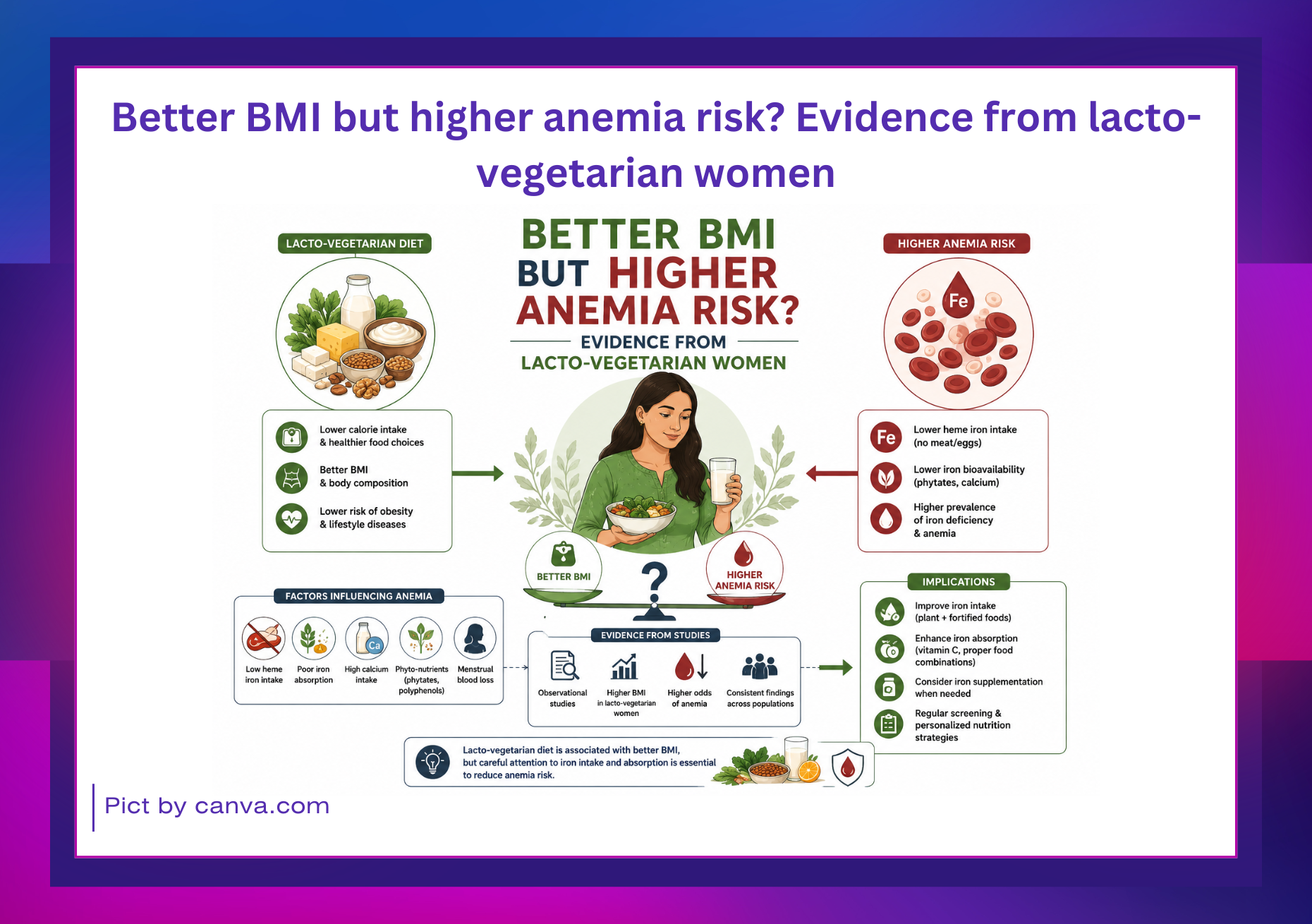
Better BMI but higher anemia risk? Evidence from lacto-vegetarian women
Hamid Nurrohman1, Ha Thi Thu Trang21. Department of Preventive and Restorative Dental Sciences, University of California , US2. Nursing Program, School of Medicine and Pharmacy, Vietnam National University, Hanoi , VN2026-05-24|page 14-24AbstractBackground: The increasing adoption of plant-based diets in the United States, particularly lacto-vegetarian patterns, has been driven by their perceived metabolic benefits. However, middle-aged women represent a nutritionally vulnerable group due to menopausal transitions and a high risk of anemia. In this context, the potential trade-off between improved body weight and micronutrient deficiencies remains insufficiently explored.
Objectives: This study examined the nutritional trade-offs between lacto-vegetarian and non-vegetarian diets, focusing on body mass index (BMI), anemia status, and lifestyle behaviors among middle-aged women in California, USA.
Methods: A cross-sectional study was conducted between June and September 2025 in California, USA, involving 40 women aged 40–65 years (20 lacto-vegetarians and 20 non-vegetarians), selected purposively. Socio-demographic characteristics and lifestyle behaviors were collected using a validated structured questionnaire. BMI, blood pressure, and hemoglobin levels were measured using standardized procedures. Data were analyzed using the Mann–Whitney U test and Spearman rank correlation, with results summarized using median and interquartile range (IQR) where appropriate. Statistical significance was set at p < 0.05.
Results: Lacto-vegetarian women showed a higher proportion of normal BMI compared to non-vegetarians (50% vs 30%, p=0.04). However, anemia prevalence was markedly higher among lacto-vegetarians (70% vs 10%, p=0.001). No significant differences were observed in physical activity, smoking, or blood pressure (p>0.05). These findings indicate a clear nutritional trade-off: improved weight status is associated with increased anemia risk.
Conclusions: Lacto-vegetarian diets were associated with more favorable BMI profiles but a significantly higher risk of anemia. These findings highlight the need for targeted nutritional strategies and public health interventions in the United States, particularly emphasizing iron and vitamin B12 adequacy among middle-aged women adopting plant-based diets.
APA Citation StyleNurrohman, H. , & Trang, H. T. T. (2026). Better BMI but higher anemia risk? Evidence from lacto-vegetarian women. Public Health and Occupational Safety Journal, 14-24. https://doi.org/10.56003/phosj.v2i1.714

1 - 4 of 4 items