Better BMI but higher anemia risk? Evidence from lacto-vegetarian women

Downloads
Abstract
Background: The increasing adoption of plant-based diets in the United States, particularly lacto-vegetarian patterns, has been driven by their perceived metabolic benefits. However, middle-aged women represent a nutritionally vulnerable group due to menopausal transitions and a high risk of anemia. In this context, the potential trade-off between improved body weight and micronutrient deficiencies remains insufficiently explored.
Objectives: This study examined the nutritional trade-offs between lacto-vegetarian and non-vegetarian diets, focusing on body mass index (BMI), anemia status, and lifestyle behaviors among middle-aged women in California, USA.
Methods: A cross-sectional study was conducted between June and September 2025 in California, USA, involving 40 women aged 40–65 years (20 lacto-vegetarians and 20 non-vegetarians), selected purposively. Socio-demographic characteristics and lifestyle behaviors were collected using a validated structured questionnaire. BMI, blood pressure, and hemoglobin levels were measured using standardized procedures. Data were analyzed using the Mann–Whitney U test and Spearman rank correlation, with results summarized using median and interquartile range (IQR) where appropriate. Statistical significance was set at p < 0.05.
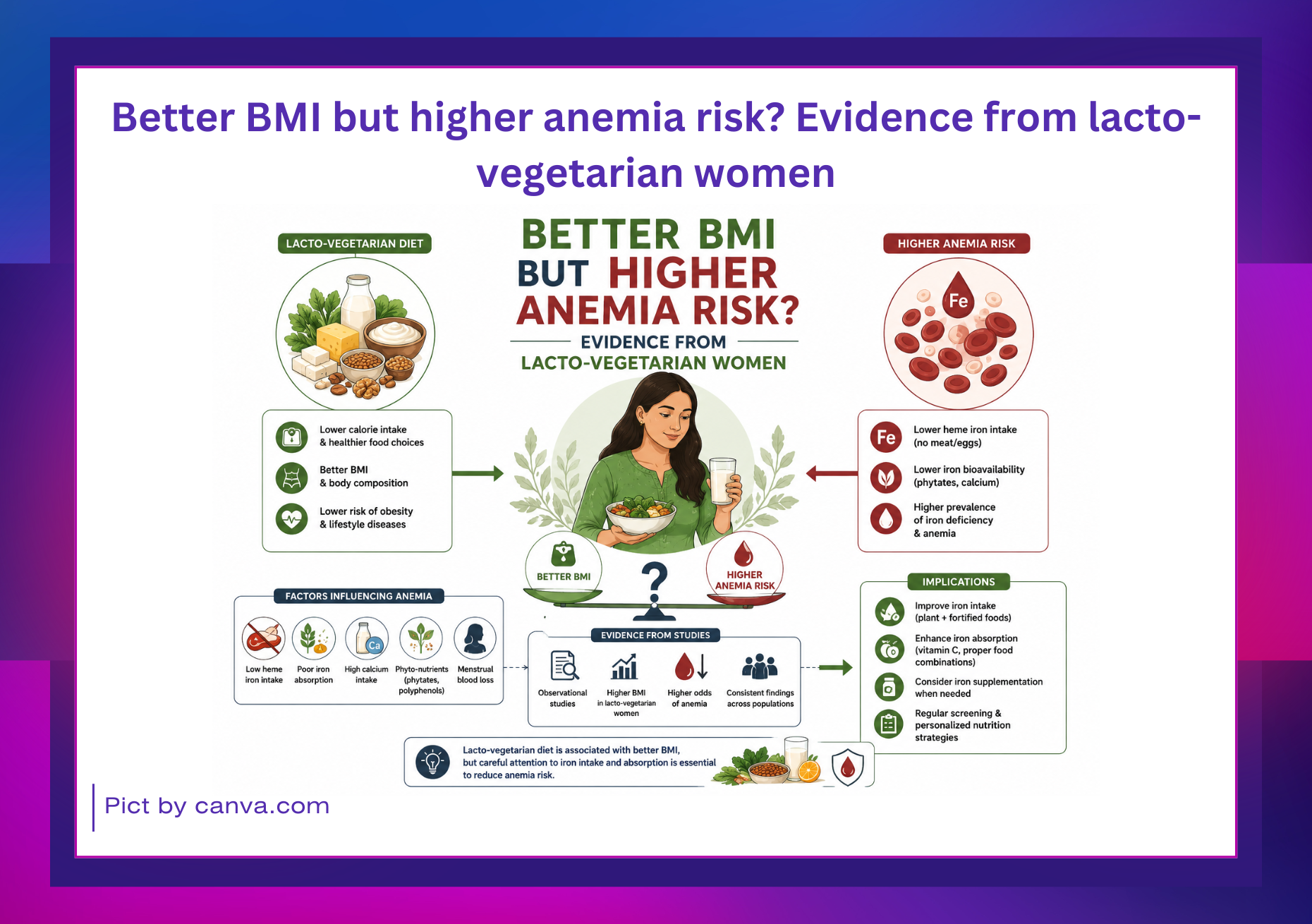
Results: Lacto-vegetarian women showed a higher proportion of normal BMI compared to non-vegetarians (50% vs 30%, p=0.04). However, anemia prevalence was markedly higher among lacto-vegetarians (70% vs 10%, p=0.001). No significant differences were observed in physical activity, smoking, or blood pressure (p>0.05). These findings indicate a clear nutritional trade-off: improved weight status is associated with increased anemia risk.
Conclusions: Lacto-vegetarian diets were associated with more favorable BMI profiles but a significantly higher risk of anemia. These findings highlight the need for targeted nutritional strategies and public health interventions in the United States, particularly emphasizing iron and vitamin B12 adequacy among middle-aged women adopting plant-based diets.
Alexy, U., Fischer, M., Weder, S., Längler, A., Michalsen, A., Sputtek, A., & Keller, M. (2021). Nutrient Intake and Status of German Children and Adolescents Consuming Vegetarian, Vegan or Omnivore Diets: Results of the VeChi Youth Study. Nutrients, 13(5), 1707. https://doi.org/10.3390/nu13051707
Azhar, W., Aljabiri, S., Bushnaq, T., Azzeh, F. S., Alyamani, R. A., Alkholy, S. O., Alhassani, W. E., Abusudah, W. F., Qadhi, A., Bukhari, H. M., Bakr, E. H., & Ghafouri, K. (2023). Knowledge, attitudes, and factors associated with vegetarianism in the Saudi Population. BMC Public Health, 23(1), 688. https://doi.org/10.1186/s12889-023-15636-5
Benjamin, E. J., Muntner, P., Alonso, A., Bittencourt, M. S., Callaway, C. W., Carson, A. P., Chamberlain, A. M., Chang, A. R., Cheng, S., Das, S. R., Delling, F. N., Djousse, L., Elkind, M. S. V., Ferguson, J. F., Fornage, M., Jordan, L. C., Khan, S. S., Kissela, B. M., Knutson, K. L., … Virani, S. S. (2019). Heart Disease and Stroke Statistics—2019 Update: A Report From the American Heart Association. Circulation, 139(10). https://doi.org/10.1161/CIR.0000000000000659
Chai, Z. F., Gan, W. Y., Chin, Y. S., Ching, Y. K., & Appukutty, M. (2019). Factors associated with anemia among female adult vegetarians in Malaysia. Nutrition Research and Practice, 13(1), 23. https://doi.org/10.4162/nrp.2019.13.1.23
Corrin, T., & Papadopoulos, A. (2017). Understanding the attitudes and perceptions of vegetarian and plant-based diets to shape future health promotion programs. Appetite, 109, 40–47. https://doi.org/10.1016/j.appet.2016.11.018
Dinu, M., Abbate, R., Gensini, G. F., Casini, A., & Sofi, F. (2017). Vegetarian, vegan diets and multiple health outcomes: A systematic review with meta-analysis of observational studies. Critical Reviews in Food Science and Nutrition, 57(17), 3640–3649. https://doi.org/10.1080/10408398.2016.1138447
Heniková, M., Ouřadová, A., Selinger, E., Tichánek, F., Polakovičová, P., Hrnčířová, D., Dlouhý, P., Světnička, M., El-Lababidi, E., Potočková, J., Kühn, T., Cahová, M., & Gojda, J. (2025). Dietary intake, nutritional status, and health outcomes among vegan, vegetarian, and omnivorous Czech families. Communications Medicine, 5(1), 538. https://doi.org/10.1038/s43856-025-01257-z
Kennedy, J., Alexander, P., Taillie, L. S., & Jaacks, L. M. (2024). Estimated effects of reductions in processed meat consumption and unprocessed red meat consumption on occurrences of type 2 diabetes, cardiovascular disease, colorectal cancer, and mortality in the USA: a microsimulation study. The Lancet Planetary Health, 8(7), e441–e451. https://doi.org/10.1016/S2542-5196(24)00118-9
López-Moreno, M., Castillo-García, A., Roldán-Ruiz, A., Viña, I., & Bertotti, G. (2025a). Plant-Based Diet and Risk of Iron-deficiency Anemia. A Review of the Current Evidence and Implications for Preventive Strategies. Current Nutrition Reports, 14(1), 81. https://doi.org/10.1007/s13668-025-00671-y
Medawar, E., Enzenbach, C., Roehr, S., Villringer, A., Riedel-Heller, S., & Witte, A. (2020). Less Animal-Based Food, Better Weight Status: Associations of the Restriction of Animal-Based Product Intake with Body-Mass-Index, Depressive Symptoms and Personality in the General Population. Nutrients, 12(5), 1492. https://doi.org/10.3390/nu12051492
Pawlak, R., Berger, J., & Hines, I. (2018). Iron Status of Vegetarian Adults: A Review of Literature. American Journal of Lifestyle Medicine, 12(6), 486–498. https://doi.org/10.1177/1559827616682933
Rahfiludin, M. Z., Arso, S. P., Joko, T., Asna, A. F., Murwani, R., & Hidayanti, L. (2021). Plant-based Diet and Iron Deficiency Anemia in Sundanese Adolescent Girls at Islamic Boarding Schools in Indonesia. Journal of Nutrition and Metabolism, 2021, 1–7. https://doi.org/10.1155/2021/6469883
Rammohan, A., Awofeso, N., & Robitaille, M.-C. (2012). Addressing Female Iron-Deficiency Anaemia in India: Is Vegetarianism the Major Obstacle? ISRN Public Health, 2012, 1–8. https://doi.org/10.5402/2012/765476
Rapsomaniki, E., Timmis, A., George, J., Pujades-Rodriguez, M., Shah, A. D., Denaxas, S., White, I. R., Caulfield, M. J., Deanfield, J. E., Smeeth, L., Williams, B., Hingorani, A., & Hemingway, H. (2014). Blood pressure and incidence of twelve cardiovascular diseases: lifetime risks, healthy life-years lost, and age-specific associations in 1·25 million people. The Lancet, 383(9932), 1899–1911. https://doi.org/10.1016/S0140-6736(14)60685-1
Reis, D., Schwermer, M., Nowak, L., Naami, N., Zuzak, T. J., & Längler, A. (2025). Vegetarian Diet and Dietary Intake, Health, and Nutritional Status in Infants, Children, and Adolescents: A Systematic Review. Nutrients, 17(13), 2183. https://doi.org/10.3390/nu17132183
Wang, C., Yuan, Y., Zheng, M., Pan, A., Wang, M., Zhao, M., Li, Y., Yao, S., Chen, S., Wu, S., & Xue, H. (2020). Association of Age of Onset of Hypertension With Cardiovascular Diseases and Mortality. Journal of the American College of Cardiology, 75(23), 2921–2930. https://doi.org/10.1016/j.jacc.2020.04.038
World Health Organization. (2025). WHO global anaemia estimates: Key findings 2025. https://www.who.int/data/gho/data/themes/topics/anaemia_in_women_and_children
Copyright (c) 2026 Hamid Nurrohman, Ha Thi Thu Trang

This work is licensed under a Creative Commons Attribution-ShareAlike 4.0 International License.