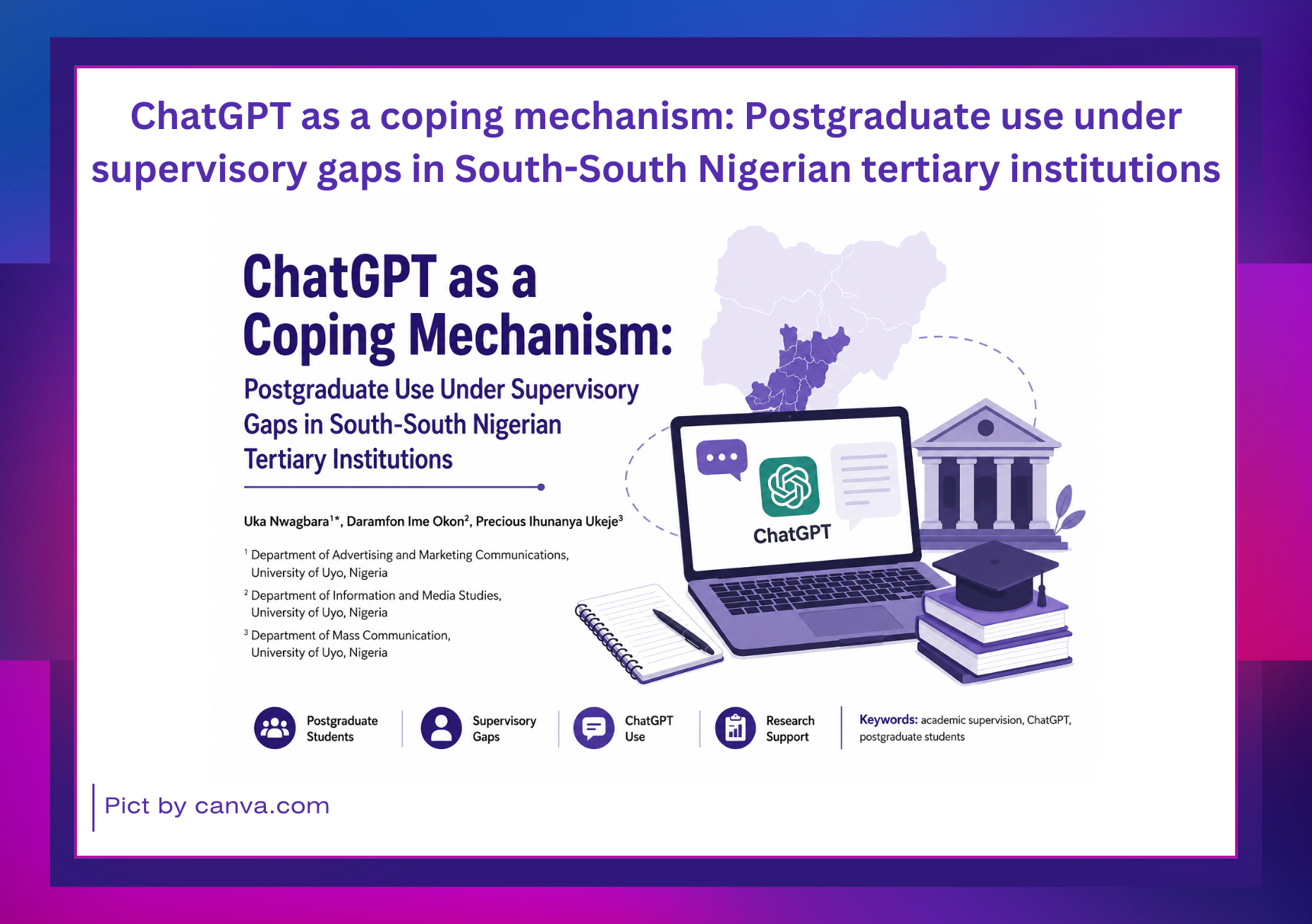
ChatGPT as a coping mechanism: Postgraduate use under supervisory gaps in South-South Nigerian tertiary institutions

Downloads
Abstract
Background: Generative AI tools like ChatGPT are common in higher education, especially where students lack timely academic support. In many South-South Nigerian universities, gaps in postgraduate supervision may influence how students use such tools.
Objectives: This study examines how postgraduate students become aware of ChatGPT, how much they use it, and why they rely on it when supervision is limited.
Methods: A qualitative exploratory design was used. Twenty-one postgraduate students were purposively selected from universities in South-South Nigeria. Data were collected through online semi-structured interviews using a validated guide. Inductive thematic analysis, using Braun & Clarke’s framework, was applied to identify patterns in the data.
Results: Findings show that awareness of ChatGPT is mostly informal, driven by peers, social media, and personal trial and error. Many students use ChatGPT frequently, especially during proposal writing, data analysis, and thesis development. Its use is strongly linked to delays or gaps in supervision.
Conclusions: ChatGPT is widely used as a support tool and coping strategy, rather than merely a convenience. Its role reflects gaps in supervision and the need for clearer institutional guidance and training.
Abdelazim, A., Al Breiki, M., & Khlaif, Z. N. (2025). AI in education: The mediating role of perceived trust in adoption decisions of school leaders. Education and Information Technologies, 30(15), 20943-20975. https://doi.org/10.1007/s10639-025-13596-4
Adams, D., Chuah, K. M., Devadason, E., & Azzis, M. S. A. (2024). From novice to navigator: Students’ academic help-seeking behaviour, readiness, and perceived usefulness of ChatGPT in learning. Education and Information Technologies, 29(11), 13617-13634. https://doi.org/10.1007/s10639-023-12427-8
Adewojo, A. A., Olatunji, O. M., & Olalere, P. M. (2026). Effects of AI-driven tools on reference services and staff roles in academic libraries. Reference Services Review, 54(1), 15-30. https://doi.org/10.1108/RSR-02-2025-0008
Akinbobola, A. O., Omojuwa, O. S., & Olorunfemi, A. A. (2025). Assessing Undergraduates' Perceptions of Use of AI Generative Tools for Academic Activities in Adeyemi Federal University of Education, Ondo, Ondo State, Nigeria. Humanities, 5(5), 159-166. https://doi.org/10.36348/merjhss.2025.v05i05.003
Al Zakwani, A. A. A., Thuwarakesh, D. M., & Khalil, M. K. (2024). Enhancing Academic Guidance with AI: Investigating the Present Capabilities and Future Prospects of ChatGPT in Empowering Students. In Empowering Digital Education with ChatGPT (pp. 175-188). Chapman and Hall/CRC. https://doi.org/10.1201/9781032716350-12
Braun, V., & Clarke, V. (2006). Using thematic analysis in psychology. Qualitative research in psychology, 3(2), 77-101. https://doi.org/10.1191/1478088706qp063oa
Brown, A., & Rossouw, J. (2026). Artificial intelligence as a reflexive collaborator in graduate studies supervision. Transformation in Higher Education, 11, 657. https://doi.org/10.4102/THE.v11i0.657
Cowling, M., Crawford, J., Allen, K. A., & Wehmeyer, M. (2023). Using leadership to leverage ChatGPT and artificial intelligence for undergraduate and postgraduate research supervision. Australasian Journal of Educational Technology, 39(4), 89-103. https://doi.org/10.14742/ajet.8598
Črček, N., & Patekar, J. (2023). Writing with AI: University students’ use of ChatGPT. Journal of Language and Education, 9(4 (36), 128-138. https://doi.org/10.17323/jle.2023.17379
Creswell, J. W., & Poth, C. N. (2016). Qualitative inquiry and research design: Choosing among five approaches. Sage publications. https://docs.edtechhub.org/lib/XAH8M47G
Dai, Y., Lai, S., Lim, C. P., & Liu, A. (2023). ChatGPT and its impact on research supervision: Insights from Australian postgraduate research students. Australasian Journal of Educational Technology, 39(4), 74-88. https://doi.org/10.14742/ajet.8843
Daud, N. M. (2026). Beyond ‘Good’or ‘Bad’: Investigating Trust and Techno-Resistance in Postgraduate Students’ Voluntary Use of AI Technologies. Technology in Society, 103213. https://doi.org/10.1016/j.techsoc.2026.103213
Ekarika, C. B., Chidozie, V. N., Okon, B. E. K., & Akpan, B. E. (2025). Navigating Postgraduate Research in University Of Calabar Through Artificial Intelligence (AI): Implications For Skill Development, Mentorship and Supervision. Gaspro International Journal Of Eminent Scholars, 12(3), 14-30. https://www.globalacademicstar.com/article/navigating-postgraduate-research-in-university-of-calabar-through-artificial-intelligence-ai-implications-for-skill-development-mentorship-and-supervision
Ezeani, C. C. (2024). ChatGPT: Impact on Academic Research and Education in Nigeria. Nigerian Journal of African Studies (NJAS), 6(1), 1-8. https://nigerianjournalsonline.org/index.php/NJAS/article/view/3622
Farhi, F., Jeljeli, R., Aburezeq, I., Dweikat, F. F., Al-shami, S. A., & Slamene, R. (2023). Analyzing the students' views, concerns, and perceived ethics about ChatGPT usage. Computers and Education: Artificial Intelligence, 5, 100180. https://doi.org/10.1016/j.caeai.2023.100180
Galjak, M., & Budić, M. (2025). Generational Divide in AI Adoption for Academic Writing: Evidence From Serbian Social Scientists. Social Science Computer Review, 08944393251413796. https://doi.org/10.1177/08944393251413796
Gammoh, L. A. (2024). ChatGPT in Academia: Exploring university students’ risks, misuses, and challenges in Jordan. Journal of Further and Higher Education, 48(6), 608-624. https://doi.org/10.1080/0309877X.2024.2378298
Iatrellis, O., Bania, A., Samaras, N., Kosmopoulou, I., & Panagiotakopoulos, T. (2025). ChatGPT in PhD Mentoring: Exploring the Potential of Generative AI for Academic Guidance and Sustainable Educational Practices. https://doi.org/10.20944/preprints202502.0041.v1
Itua, E., & Frederick, O. (2025). Evaluation of The Use of ChatGPT as a Tool of Academic Research Among Undergraduate Students Of Ambrose Alli University, Ekpoma, Edo State. ESUI Journal of Politics and Administrative Studies, 2(2), 10-16. https://ejpas.ng/article/evaluation-of-the-use-of-chatgpt-as-a-tool-of-academic-research-among-undergraduate-students-of-ambrose-alli-university-ekpoma-edo-state
Khelfat, N., & Benadda, A. (2025). Promoting responsible AI use in academic writing: The role of supervisors in fostering ethical practices. Majallat al-Buhuth al-Tarbawiyyah wa al-Ta'limiyyah, 14(2), 47–68. https://asjp.cerist.dz/en/article/284719
Malterud, K., Siersma, V. D., & Guassora, A. D. (2016). Sample size in qualitative interview studies: guided by information power. Qualitative health research, 26(13), 1753-1760. https://doi.org/10.1177/1049732315617444
Mbodila, M. (2025). Postgraduate supervision in the age of ChatGPT: Redefining the role of supervisors. Foundations and Trends® in Information Systems, 9(2), 60-68. https://doi.org/10.5281/zenodo.17557705
Mingyi, M. B., & Moses, J. M. (2025). Knowledge and Application of ChatGPT For Academic Purposes Among University Students in Borno State, Nigeria. ADIADA Research Review, 1(1), 1-17. https://doi.org/10.5281/zenodo.18334893
Mormul, Y., Przybyszewski, J., Nakoud, A., & Cuffe, P. (2024). Reliance on Artificial Intelligence Tools May Displace Research Skills Acquisition Within Engineering Doctoral Programmes: Examples and Implications. In 2024 21st International Conference on Information Technology Based Higher Education and Training (ITHET) (pp. 1-10). IEEE. https://doi.org/10.1109/ITHET61869.2024.10837618
Ngo, T. T. A. (2023). The perception by university students of the use of ChatGPT in education. International Journal of Emerging Technologies in Learning (Online), 18(17), 4-19. https://doi.org/10.3991/ijet.v18i17.39019
Ngonso, B. F., Egielewa, P. E., Egenti, G., Uduehi, I., Sunny-Duke, F., Ukhurebor, K. E., ... & Osemengbe, U. O. (2025). Influence of artificial intelligence on educational performance of Nigerian students in tertiary institutions in Nigeria. Journal of Infrastructure, Policy and Development, 9(1), 9949. https://doi.org/10.24294/jipd9949
Nwagbara, U. U. (2025). From curiosity to dependency: Nigerian students’ perspectives on AI Integration in academic research. Journal of Academic Ethics, 23(4), 2051-2068. https://doi.org/10.1007/s10805-025-09641-z
Nwuke, T. J., & Yellowe, A. N. (2025). Utilization of artificial intelligence in school supervision for effective administration in public secondary schools in Rivers State, Nigeria. International Journal of Educational Management, Rivers State University., 1(1), 318-334. https://ijedm.com/index.php/ijedm/article/view/27
Okorie, E. J. C., & West, B. T. I. (2025). Exploring Student Perspectives on ChatGPT Use In Academia: Attitudes And Barriers. Ayden International Journal of Education and Social sciences, 13(2), 1-14. https://doi.org/10.5281/zenodo.15462459
Omodan, B. I. (2025). Redefining the role of supervisors in the era of artificial intelligence: implications for hybrid postgraduate research governance. Cogent Education, 12(1), 2536534. https://doi.org/10.1080/2331186X.2025.2536534
Shittu, O. I., Busari, D. A., & Olonade, O. Y. (2025). Knowledge, Attitude, and Perception of Learners Towards the Use of ChatGPT in the University of Ibadan, Nigeria. International Journal of Sociology of Education, 14(2), 146-168. https://doi.org/10.17583/rise.15313
Suleman, T. A., Okimiji, O. P., Atoro, T. K., & Adejo, J. E. (2025). Deployment of ChatGPT in Nigerian Universities: Addressing Research Challenges and Ethical Considerations. LASU Journal of Environmental Sciences, 1(1), 338-363. https://lasujournals.ng/index.php/lasujes/article/view/50
Watermeyer, R., Phipps, L., Lanclos, D., & Knight, C. (2024). Generative AI and the automating of academia. Postdigital Science and Education, 6(2), 446-466. https://doi.org/10.1007/s42438-023-00440-6
Wibowo, G. A., Rahman, A., & Anis, M. (2023). The impact of ChatGPT use on the quality of academic support for students. Technology and Society Perspectives (TACIT), 1(3), 132-138. https://doi.org/10.61100/tacit.v1i3.69
Wynn, M. G., & Skuridin, A. (2025, May). AI Assistant for PhD Supervision. In 3rd Symposium on AI Opportunities and Challenges (SAIOC) (pp. 1-14). https://eprints.glos.ac.uk/15053/
Xu, Y., Ye, S., & Zhu, X. (2023). The ScholarNet and artificial intelligence (AI) supervisor in material science research. The Journal of Physical Chemistry Letters, 14(36), 7981-7991. https://doi.org/10.1021/acs.jpclett.3c01668
Yusmaliana, D., Abubakari, M. S., Monib, W. K., & Shafik, W. (2026). Between Independence and Supervision: A Reflective Account of a PhD Student in the Era of AI. In International Student Narratives in Globalized Higher Education (pp. 307-336). IGI Global Scientific Publishing. https://doi.org/10.4018/979-8-3373-4212-2.ch012
Copyright (c) 2026 Uka Nwagbara, Daramfon Okon, Precious Ukeje

This work is licensed under a Creative Commons Attribution-ShareAlike 4.0 International License.