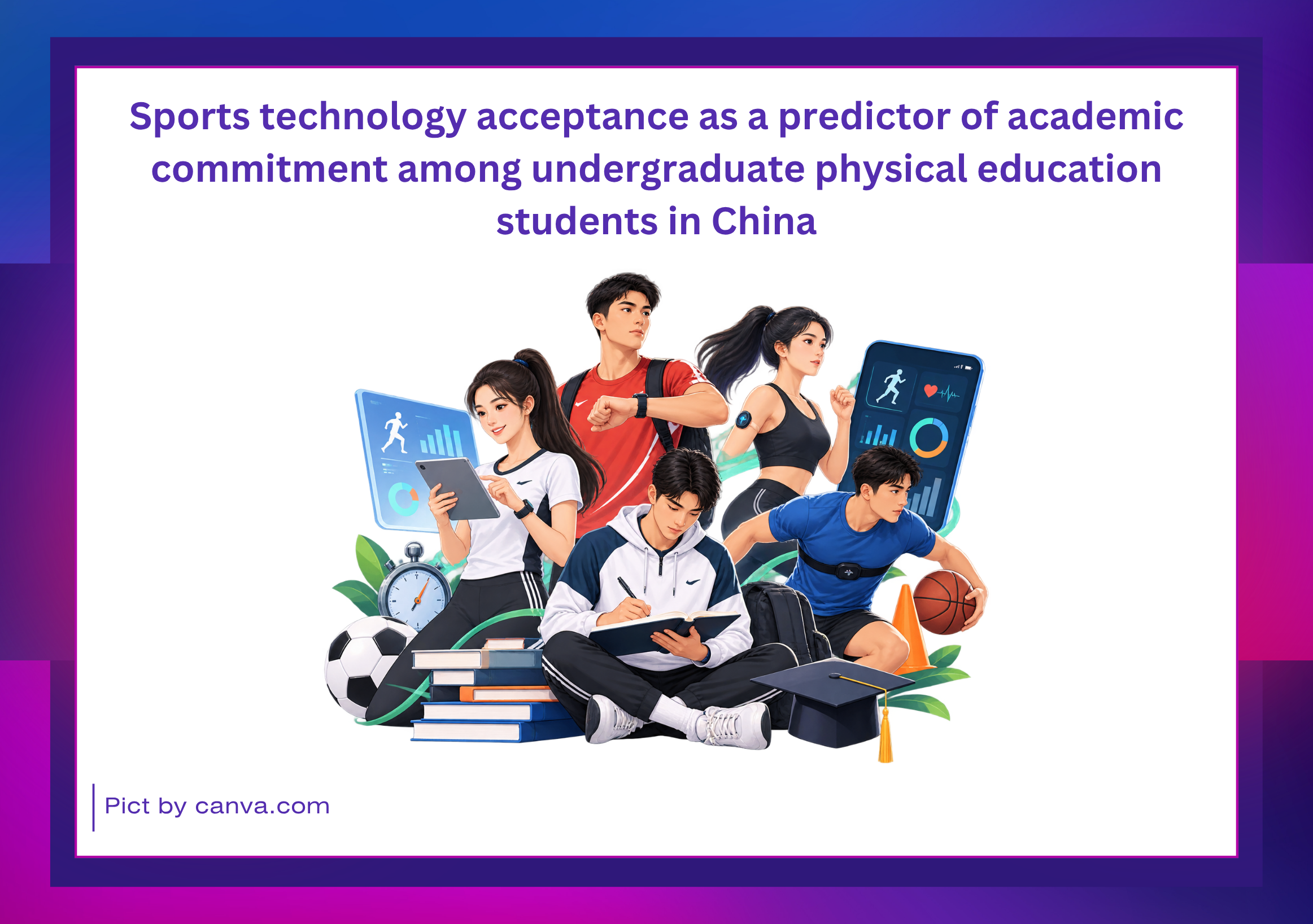
Sports technology acceptance as a predictor of academic commitment among undergraduate physical education students in China

Downloads
Background: Sports analytics and digital learning technologies are increasingly incorporated into physical education and sport-related higher education. However, evidence regarding the relationship between students’ acceptance of sports-related technologies and their academic commitment remains limited, particularly among undergraduate Physical Education students in China.
Objectives: This study aimed to examine the association between Sports Technology Acceptance (STA) and Academic Commitment and to determine whether STA statistically predicts Academic Commitment within a cross-sectional structural model among undergraduate Physical Education students.
Methods: This quantitative study employed a cross-sectional correlational design involving 150 undergraduate students enrolled in the Bachelor of Physical Education program at Inner Mongolia Normal University, China, who were recruited using convenience sampling. Data were collected using the Higher Education Student Commitment Scale and an adapted Technology Use Tendency Scale in the Classroom to assess STA. Descriptive statistics, Pearson correlation analysis, and structural equation modeling (SEM) were performed using IBM SPSS Statistics 26 and IBM SPSS Amos 24.
Results: The mean Academic Commitment score was 3.68 (SD = 0.71), while the mean STA score was 4.01 (SD = 0.65). STA was moderately and positively correlated with Academic Commitment (r = .47, p < .01). The structural model showed a significant positive path from STA to Academic Commitment (β = .49, t = 6.81, p < .001), accounting for 24% of the variance in Academic Commitment (R² = .24). The reported model-fit indices indicated acceptable fit (CFI = .956, RMSEA = .057).
Conclusions: Sports Technology Acceptance was moderately and positively associated with Academic Commitment among undergraduate Physical Education students at one university in China. Within the cross-sectional structural model, STA accounted for 24% of the variance in Academic Commitment; therefore, the observed statistical prediction should not be interpreted as evidence of temporal or causal effects.
Downloads
An, F., Xi, L., & Yu, J. (2024). The relationship between technology acceptance and self-regulated learning: the mediation roles of intrinsic motivation and learning engagement. Education and Information Technologies, 29(3), 2605-2623. https://doi.org/10.1007/s10639-023-11959-3
Çınkır, Ş., Kurum, G., & Yıldız, S. (2021). Yükseköğretimde öğrenci bağlılığı ölçeği: Geçerlik ve güvenirlik çalışması. Cumhuriyet International Journal of Education, 10(1), 273-298. http://dx.doi.org/10.30703/cije.717825
Davis, F. D. (1989). Perceived usefulness, perceived ease of use, and user acceptance of information technology. MIS quarterly, 13(3), 319-340. https://doi.org/10.2307/249008
Doğan, Y., & Akça, C. (2025). Effect of Technology Acceptance on Student Commitment in Turkish Higher Education. Journal of Learning for Development, 12(1), 143–154. https://doi.org/10.56059/jl4d.v12i1.1237
Ferrier, B., Lee, J., Mbuli, A., & James, D. A. (2022). Translational applications of wearable sensors in education: implementation and efficacy. Sensors, 22(4), 1675. https://doi.org/10.3390/s22041675
Günüç, S., & Kuzu, A. (2014). Tendency scale for technology use in class: Development, reliability and validity. Journal of Theory and Practice in Education, 10(4), 863-884. https://izlik.org/JA78MJ59XX
Kahu, E. R. (2013). Framing student engagement in higher education. Studies in Higher Education, 38(5), 758-773. https://doi.org/10.1080/03075079.2011.598505
Kala, D., & Chaubey, D. S. (2023). Examination of relationships among technology acceptance, student engagement, and perceived learning on tourism-related MOOCs. Journal of Teaching in Travel & Tourism, 23(1), 39-56. https://doi.org/10.1080/15313220.2022.2038342
Nigussie Worku, B., & Urgessa Gita, D. (2024). Students’ academic culture: the mediating role of academic commitment in the relationship between academic resilience and academic performance of university students. Cogent Education, 11(1), 2377004. https://doi.org/10.1080/2331186X.2024.2377004
Okros, N. I., Baciu, E. L., Lazăr, T. A., Ungureanu, R., Trancă, L. M., & Onițiu, A. (2025). Staying Attached: How Students' Attachment to the University Enhances Their Satisfaction and Reduces the Intentions to Drop Out. European Journal of Education, 60(4), e70350. https://doi.org/10.1111/ejed.70350
Page, E. J., Massey, A. S., Prado-Romero, P. N., & Albadawi, S. (2020). The use of self-monitoring and technology to increase physical activity: A review of the literature. Perspectives on Behavior Science, 43(3), 501-514. https://doi.org/10.1007/s40614-020-00260-0
Schindler, L. A., Burkholder, G. J., Morad, O. A., & Marsh, C. (2017). Computer-based technology and student engagement: a critical review of the literature. International Journal of Educational Technology in Higher Education, 14(1), 25. https://doi.org/10.1186/s41239-017-0063-0
Schuster, R., & King, B. R. (2022). First-year student retention, goal commitment, and institutional commitment: two meta-analyses. SN Social Sciences, 2(8), 145. https://doi.org/10.1007/s43545-022-00446-0
Soffer, T., & Yaron, E. (2017). Perceived learning and students’ perceptions toward using tablets for learning: The mediating role of perceived engagement among high school students. Journal of Educational Computing Research, 55(7), 951-973. https://doi.org/10.1177/0735633117689892
Venkatesh, V., Morris, M. G., Davis, G. B., & Davis, F. D. (2003). User acceptance of information technology: Toward a unified view1. MIS quarterly, 27(3), 425-478. https://doi.org/10.2307/30036540
Yukhymenko-Lescroart, M. A., & Sharma, G. (2026). Exploring academic identity, degree commitment, and life purpose in first-time full-time college students: A six-year degree attainment study (2017–2023). Journal of College Student Retention: Research, Theory & Practice, 28(2), 454-471. https://doi.org/10.1177/15210251241282612
Zhao, Z., & Su, Y. (2026). Wearable Technologies in School Physical Education: A Systematic Review of Pedagogical Implications. Physical Education Theory and Methodology, 26(1), 79-89. https://doi.org/10.17309/tmfv.2026.1.07
Copyright (c) 2026 Yingxue Su

This work is licensed under a Creative Commons Attribution-ShareAlike 4.0 International License.