Search
Search Results
##search.searchResults.foundPlural##
-


Implementation of a smokeless incinerator for environmentally friendly waste management in Ploso Village, Kediri Regency
Dentina Nurhayati Elmi1, Muhammad Budi Hidayat2, Talitha Leila Arsanti3, Qurrota A’yunin4, Laela Dwi Lestari5, Dimas Yasin Romli6, M. Ubaidillah Ridwanulloh7, Agus Miftakus Surur81. Universitas Islam Negeri (UIN) Syekh Wasil, Kediri , ID2. Universitas Islam Negeri (UIN) Syekh Wasil, Kediri , ID3. Universitas Islam Negeri (UIN) Syekh Wasil, Kediri , ID4. Universitas Islam Negeri (UIN) Syekh Wasil, Kediri , ID5. Universitas Islam Negeri (UIN) Syekh Wasil, Kediri , ID6. Universitas Islam Negeri (UIN) Syekh Wasil, Kediri , ID7. Universitas Islam Negeri (UIN) Syekh Wasil, Kediri , ID8. Universitas Islam Negeri (UIN) Syekh Wasil Kediri , ID2025-11-21|page 1-12AbstractEnvironmental management, particularly waste management, is one of the main challenges that requires serious attention. In communities, household waste and dry leaves are generally still disposed of through open burning, which has become a daily habit. This practice has the potential to cause various negative impacts on the environment, public health, and the quality of life of residents. This program aims to introduce the Smokeless Burn Barrel as an innovative solution for household waste management and burning. The activity was conducted in Ploso Village, Mojo District, Kediri Regency, utilizing a Participatory Action Research (PAR) approach that encompassed observation, problem identification, and action stages. The results of the implementation demonstrate that the use of the Smokeless Burn Barrel can accelerate the burning process, with an average time of 14.75 minutes, resulting in a 49.17% increase in efficiency compared to conventional methods. The combustion temperature also increased significantly, reaching an average of 351°C, representing a 63.94% increase, which resulted in a more complete combustion process with significantly less black and white smoke and minimal ash residue. Thus, the Smokeless Burn Barrel method has been proven effective in reducing the amount of residual waste, increasing energy efficiency during the combustion process, and having a positive impact on environmental management at the household level.
APA Citation StyleElmi, D. N. , Hidayat, M. B. , Arsanti, T. L. , A’yunin, Q. , Lestari, L. D. , Romli, D. Y. , Ridwanulloh, M. U. , & Surur, A. M. (2025). Implementation of a smokeless incinerator for environmentally friendly waste management in Ploso Village, Kediri Regency. Darmabakti: Jurnal Pengabdian kepada Masyarakat, 1-12. https://doi.org/10.56003/darmabakti.v2i1.628 -
Making biopackaging from paper and leaf waste for women in the family welfare empowerment program and early childhood education teachers
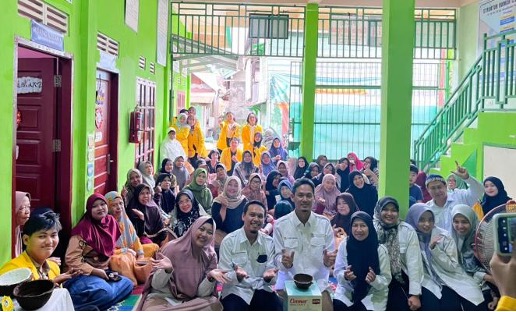
Rahmatullah Rahmatullah1, Muhammad Djoni Bustan2, Budi Santoso3, Harry Waristian4, Rizka Wulandari Putri5, Rianyza Gayatri61. Department of Chemical Engineering, Faculty of Engineering, Universitas Sriwijaya , ID2. Department of Chemical Engineering, Faculty of Engineering, Universitas Sriwijaya , ID3. Department of Chemical Engineering, Faculty of Engineering, Universitas Sriwijaya , ID4. Department of Mining Engineering, Faculty of Engineering, Universitas Sriwijaya , ID5. Department of Chemical Engineering, Faculty of Engineering, Universitas Sriwijaya , ID6. Department of Chemical Engineering, Faculty of Engineering, Universitas Sriwijaya , ID2026-06-13|page 1-11AbstractVarious creative approaches can be developed to reduce the generation of both organic and inorganic waste. On the other hand, office and school paper waste, as well as plant matter such as dry leaves, are still not being utilized optimally. Biopack is an innovative cardboard container made from a mixture of paper pulp and dry leaves. This product can be used as eco-friendly packaging because it easily degrades when disposed of in soil or water after use. School paper waste and dry leaves available in the Wanaasri Palembang area hold significant potential as raw materials for Biopack. Utilizing this potential is expected to increase public awareness, particularly among the PKK Rumah Cinta Dahlia Wanaasri and the teachers at PAUD Permata Bunda, as key drivers in promoting the innovation of waste management into economically valuable products that can support the establishment of community-based businesses or entrepreneurship. This community service activity was carried out through outreach and a biopack-making demonstration using lectures and hands-on simulations. The evaluation was conducted through a questionnaire to analyze the level of effectiveness and the potential for sustainability of the activity. Survey results from activity participants revealed that 93% were not yet able to recycle used paper and leaves, 63% still disposed of used paper and leaves in trash bins, and 93–100% of participants rated the activity as beneficial, noting that it broadened their knowledge and understanding of making biopack from used paper and leaves, and that they liked the biopack products and were able to use them at home. Furthermore, it is hoped that the Wanaasri community will be able to produce its own biopack, that it will be adopted by teachers at the Permata Bunda Early Childhood Education Center as a teaching aid in the learning process, and that it will eventually be commercialized.
APA Citation StyleRahmatullah, R. , Bustan, M. D. , Santoso, B. , Waristian, H. , Putri, R. W. , & Gayatri, R. (2026). Making biopackaging from paper and leaf waste for women in the family welfare empowerment program and early childhood education teachers. Darmabakti: Jurnal Pengabdian kepada Masyarakat, 1-11. https://doi.org/10.56003/darmabakti.v3i1.742

1 - 2 of 2 items