Search
Search Results
##search.searchResults.foundPlural##
-


Technical guidance on mental toughness in achieving final match results for students in the Special Sports Class (KKO)
Sugeng Purwanto1, Sujarwo2, Agus Supriyanto3, Yuyun Ari Wibowo41. Yogyakarta State University , ID2. Yogyakarta State University , ID3. Yogyakarta State University , ID4. Yogyakarta State University , ID2025-05-15|page 48-53AbstractMental toughness is a set of attitudes, values, behaviors, and emotions that enable an individual to survive, face various obstacles or pressures that are felt, and achieve the desired goals. Special Sports Class (KKO) is a co-curricular activity intended to increase students' interest and talent to become potential athletes in the future. There are various factors related to mental toughness, such as self-development through challenges, sports awareness of students, how students' attitudes or behavior when facing pressure, and the desire or enthusiasm of students in reaching the match. According to interviews with several KKO students, 70% of KKO students do not understand mental toughness, so it is necessary to provide technical guidance related to it. This community service activity was carried out thanks to the collaboration of lecturers from the Faculty of Sport and Health Sciences (FIKK), Universitas Negeri Yogyakarta (UNY) as resource persons and those in charge of the KKO Class of State Junior High School (SMPN) I Kalasan, Sleman Regency. The activity was carried out in theory and practice on July 10-11, 2024, at SMPN I Kalasan with the participants of all students, coaches, and sports teachers who handle KKO at SMPN 1 Kalasan, totaling 50 people, consisting of 6 coaches, two sports teachers, and 42 KKO students. The results of this activity show that 92% of KKO students need mental toughness guidance in facing matches, and the remaining 8% of KKO students need further mental toughness guidance assistance in facing matches.
APA Citation StylePurwanto, S. , Sujarwo, S. , Supriyanto, A. , & Wibowo, Y. A. (2025). Technical guidance on mental toughness in achieving final match results for students in the Special Sports Class (KKO). Darmabakti: Jurnal Pengabdian kepada Masyarakat, 48-53. https://doi.org/10.56003/darmabakti.v1i2.461 -

Optimizing the use of personal smartphones to support safe and measurable physical activity among middle school students
Yudhi Teguh Pambudi1, Topo Suhartoyo2, Abdul Malik Firdaus3, Mukhammad Miftakhul Farkhan41. Jenderal Soedirman University , ID2. Jenderal Soedirman University , ID3. Jenderal Soedirman University , ID4. Sekolah Menengah Pertama Negeri 1 Banyumas , ID2026-05-23|page 51-58AbstractThe high smartphone ownership among junior high school students in Banyumas Regency (99%) has not been matched by their use to support physical fitness. The majority of device use is limited to entertainment (games or social media), and smartphone ownership has not been fully leveraged for its functions or its role in supporting physical activity. This community service program aims to educate and train students and teachers in utilizing smartphone-based sports applications to support higher-quality physical activity. The activity was carried out in partnership with the Subject Teacher Working Group (MGMP) Physical Education, Sports, and Health (PJOK) Junior High School (SMP) Sub Rayon 06 Banyumas, involving 16 teachers and 547 students. The implementation methods included socialization, training in the implementation of the Strava (performance monitoring) and IQAir AirVisual (environmental air quality monitoring) applications, and monitoring and evaluation. The activity results showed significant behavioral changes, with 99% of participants adopting the technology. This program successfully transformed smartphones from mere entertainment devices into health-tech tools, improved students' digital literacy, and created a safe, measurable, and data-driven sports culture in the school environment.
APA Citation StylePambudi, Y. T. , Suhartoyo, T. , Firdaus, A. M. , & Farkhan, M. M. (2026). Optimizing the use of personal smartphones to support safe and measurable physical activity among middle school students. Darmabakti: Jurnal Pengabdian kepada Masyarakat, 51-58. https://doi.org/10.56003/darmabakti.v2i2.668 -
Knowledge and attitudes toward balanced nutrition among children of Indonesian migrant workers at Pondok An-Nahdloh, Selangor, Malaysia
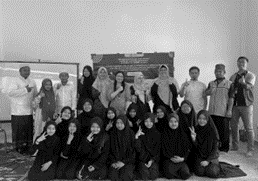
Nohan Arum Romadlona1, Septa Katmawanti2, Farah Paramita3, Suci Puspita Ratih4, Evada Mutiara Ramadhani5, Nadia Fauziyah Nashih61. State University of Malang , ID2. State University of Malang , ID3. State University of Malang , ID4. State University of Malang , ID5. State University of Malang , ID6. State University of Malang , ID2025-02-15|page 1-7AbstractThe number of Indonesian migrant workers in Malaysia is very high. However, access to education for Indonesian citizens' families is not yet spread evenly and appropriately. Hundreds of Indonesian migrant workers' children attended school at Sanggar Bimbingan (SB). However, various problems arise, including the lack of healthy living behavior and low-nutrition food consumption. Community service activities were carried out at Pondok An Nahdloh in Tanjung Sepat, Selangor, Malaysia, by a team of lecturers from the Department of Public Health, Universitas Negeri Malang. The core material presented includes 1) Introduction to Adolescent Nutrition, 2) Adolescent Nutrition Problems, and 3) Healthy Body Image, which is interesting through video presentations and modules. The students also underwent height and weight measurements to measure body mass index (BMI). The service activity involved 33 junior high school students aged 13-16 years, including 18 male students (55%) and 15 female students (45%). Body weight measurements showed that 61% of students weighed under 60 kg. Furthermore, the student's height is generally less than 160 cm. Calculating nutritional status based on BMI shows that 64% of students have an abnormal weight, either underweight or overweight. The average knowledge score before training was 6.8 and increased to 8.4 after training. Meanwhile, the average attitude value before training was 30.4 and increased to 31.2 after training. This score increase shows that the training program effectively increases students' knowledge and attitudes toward balanced nutrition.
APA Citation StyleRomadlona, N. A. , Katmawanti, S. , Paramita, F. , Ratih, S. P. , Ramadhani, E. M. , & Nashih, N. F. (2025). Knowledge and attitudes toward balanced nutrition among children of Indonesian migrant workers at Pondok An-Nahdloh, Selangor, Malaysia. Darmabakti: Jurnal Pengabdian kepada Masyarakat, 1-7. https://doi.org/10.56003/darmabakti.v1i1.385

1 - 3 of 3 items