Search
Search Results
##search.searchResults.foundPlural##
-

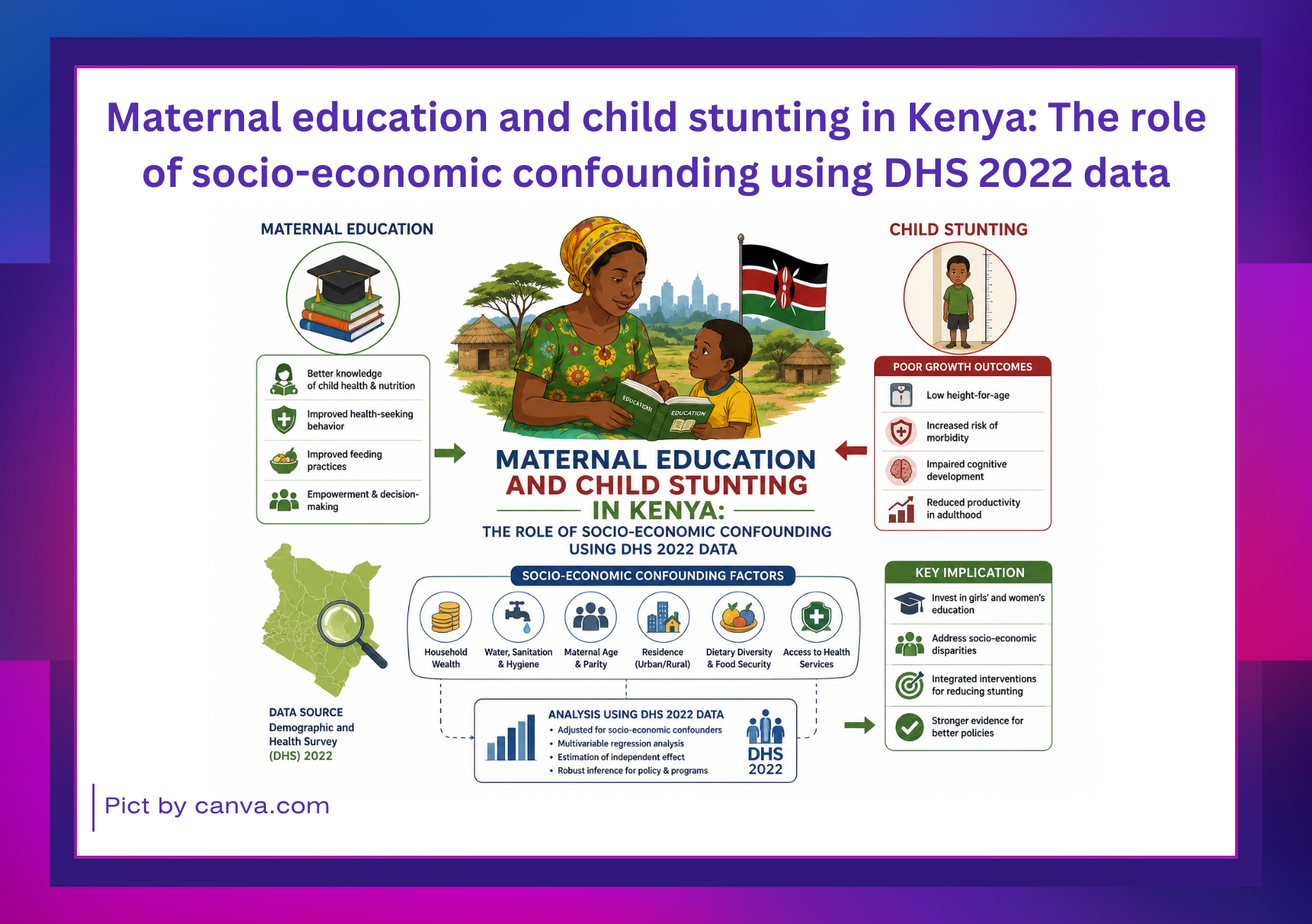
Maternal education and child stunting in Kenya: The role of socio-economic confounding using DHS 2022 data
Anastacia Katungo Maluki1, Zerai Hagos2, Kabiru Gulma3, Michael Musili Nzau41. Doctoral Programme in Epidemiology and Biostatistics, Euclid University, Banjul , GM2. Doctoral Programme in Epidemiology and Biostatistics, Euclid University, Banjul , GM3. School of Global Health and Bioethics, Euclid University, Bangui , CF4. United Nations Development Programme, New York , US2026-05-24|page 41-56AbstractBackground: Child stunting remains a major public health challenge in Kenya, reflecting long‑term nutritional deprivation and socioeconomic inequalities. Although maternal education is widely considered protective, its independent effect is often unclear due to confounding by structural factors.
Objectives: To examine the association between maternal education and child stunting among children under five in Kenya and to assess the extent of confounding and effect modification by key sociodemographic factors.
Methods: A cross‑sectional analytical study was conducted using data from the 2022 Kenya Demographic and Health Survey (KDHS). The sample included 19,530 children aged 0–59 months. Stunting was defined using height‑for‑age z-scores (<-2 SD). Descriptive, bivariate, stratified, and multivariable logistic regression analyses were performed, accounting for the complex survey design.
Results: Stunting prevalence was 18.2%. Stunting decreased with increasing maternal education, from 21.4–21.7% among children of mothers with no or primary education to 8.7% among those with higher education (χ² = 238, p < 0.001). However, the association was weak (Cramer’s V = 0.117) and attenuated after adjustment for socioeconomic factors. Household wealth was the strongest predictor, with children in the richest households having significantly lower odds of stunting than those in the poorest households (AOR = 0.268; 95% CI: 0.222–0.323; p < 0.001). Stunting risk increased with age, particularly among children aged 6–23 months, while females had lower odds than males (OR = 0.717; 95% CI: 0.662–0.776). Stratified analyses showed stronger protective effects of maternal education among older children. In contrast, variation across wealth groups should be interpreted cautiously, given inconsistent and non-significant findings in some strata. No meaningful effect modification by child sex was identified.
Conclusions: Child stunting in Kenya is primarily driven by structural socioeconomic factors. While maternal education is associated with reduced stunting, its effect is highly context dependent. Addressing poverty and inequality is essential for effective and equitable reductions in child stunting.
APA Citation StyleMaluki, A. K. , Hagos, Z. , Gulma, K. , & Nzau, M. M. (2026). Maternal education and child stunting in Kenya: The role of socio-economic confounding using DHS 2022 data. Public Health and Occupational Safety Journal, 41-56. https://doi.org/10.56003/phosj.v2i1.743 -
Exploring the interplay of gender, breastfeeding practices, and minimum dietary diversity on stunting among Indonesian children aged 6–23 months
Rossa Amalia1, Hartati Eko Wardani2, Tika Dwi Tama3, Anindya Hapsari41. State University of Malang , ID2. State University of Malang , ID3. State University of Malang , ID4. State University of Malang , ID2025-06-14|page 114-126AbstractBackground: Stunting has the highest prevalence compared to other major malnutrition problems. Risk factors for stunting include gender, breastfeeding, and complementary feeding practices. Stunting requires a faster reduction in prevalence to avoid functional losses in children.
Objectives: This study aimed to determine the association between gender, early breastfeeding initiation, exclusive breastfeeding, breastfeeding status, and Minimum Dietary Diversity with the incidence of stunting.
Methods: This study was an observational analytic study with a cross-sectional approach. The population of the study was children aged 6-23 months in West Java who were sampled by the Indonesian Nutrition Status Study (SSGI) 2021, and the study sample was all members of the population who met the inclusion criteria. Data in this study were obtained through SSGI 2021 documentation and analyzed using the Chi-Square and logistic regression tests.
Results: The results of the bivariate analysis showed a significant association between gender (OR=1.249; 95%CI 1.013-1.540; p=0.042) and breastfeeding status (OR=0.693; 95%CI 0.533-0.901; p=0.007) with the incidence of stunting. Early breastfeeding initiation (p=0.792), exclusive breastfeeding (p=0.059), and MDD (p=0.882) had no significant association with the incidence of stunting in children aged 6-23 months in West Java. Multivariate analysis showed that the most influential factor in the incidence of stunting was gender (OR=1.260; 95%CI 1.022-1.555; p=0.031).
Conclusions: This study shows the association between gender and breastfeeding status on the incidence of stunting. Further research is recommended to explore the role of complementary feeding practices and maternal nutrition in stunting prevention.
APA Citation StyleAmalia, R. , Wardani, H. E. , Tama, T. D. , & Hapsari, A. (2025). Exploring the interplay of gender, breastfeeding practices, and minimum dietary diversity on stunting among Indonesian children aged 6–23 months. Public Health and Occupational Safety Journal, 114-126. https://doi.org/10.56003/phosj.v1i1.540 -

The relationship between quality and quantity of antenatal care services and stunting in children 24–59 months of age
Aulia Pramesti1, Hartati Eko Wardani2, Tika Dwi Tama3, Anindya Hapsari41. State University of Malang , ID2. State University of Malang , ID3. State University of Malang , ID4. State University of Malang , ID2025-06-14|page 97-113AbstractBackground: Stunting is a chronic nutritional problem whose causes include unmet nutrition in pregnant women, lack of infant nutritional intake, and socioeconomic conditions. Dinoyo Health Center covers an area with a high stunting rate in Malang City, particularly Lowokwaru District. Previous research stated that the dominant factor causing stunting in toddlers is antenatal care (ANC).
Objectives: This study aims to determine whether stunting in toddlers in the Dinoyo Community Health Center area is caused by the quality and quantity of ANC.
Methods: The research method is observational analytic with a case-control design using a retrospective approach. The population was 1643 mothers taken from three villages: Tlogomas, Dinoyo, and Sumbersari. The research sample amounted to 69 people using purpose sampling. The research was conducted in February - March 2023. Quality measurement was based on a minimum 10T service standard, while quantity measurement was based on a minimum frequency of 4 visits using a checklist sheet instrument and MCH book with Chi-Square analysis.
Results: The results obtained for ANC quality with stunting p-value = 0.609 with OR value = 1.30 (95% CI: 0.47-3.55), while ANC quantity with stunting p-value = 0.864 with OR value = 1.09 (95% CI: 0.40-2.97).
Conclusions: It is concluded that the quality and quantity of antenatal care have no association with the incidence of stunting in children under 24-59 months in the Dinoyo Community Health Center (Puskesmas) area. These findings highlight the need for multifactor interventions beyond ANC to reduce stunting, such as improved maternal nutrition and environmental sanitation.
APA Citation StylePramesti, A. , Wardani, H. E. , Tama, T. D. , & Hapsari, A. (2025). The relationship between quality and quantity of antenatal care services and stunting in children 24–59 months of age. Public Health and Occupational Safety Journal, 97-113. https://doi.org/10.56003/phosj.v1i1.539

1 - 3 of 3 items