Search
Search Results
##search.searchResults.foundPlural##
-

Role of inter-institutional partnerships in promoting holistic employee wellness programs: A convergent mixed-methods study across three public universities in Metro Manila, Philippines
Rosalie Dela Cruz11. University of Makati , PH2025-11-28|page 139-150AbstractBackground: Employee wellness has become an increasingly essential concern in higher education; yet, many public universities continue to struggle with implementing comprehensive and sustainable wellness initiatives. Inter-institutional partnerships offer opportunities to strengthen these efforts through shared resources and coordinated programming.
Objectives: This study examined how such partnerships support the development of holistic employee wellness programs across three public universities in Metro Manila.
Methods: Using a convergent mixed-methods design, quantitative data were collected from 150 employees through an 18-item validated survey and analyzed using descriptive statistics and chi-square tests to assess institutional differences in awareness, participation, and perceived effectiveness. Qualitative data from six key informants were analyzed using grounded theory techniques to identify themes related to institutional practices and collaborative mechanisms.
Results: Findings indicated significant variations among institutions in employee awareness, participation levels, and perceptions of program effectiveness. Despite the availability of wellness initiatives, participation remained limited, mainly due to workload demands, time constraints, and scheduling challenges. Qualitative themes highlighted four central factors influencing the implementation of wellness: institutional support, holistic wellness orientation, program personalization, and persistent participation barriers. These themes helped explain why engagement levels differed among institutions.
Conclusions: Overall, inter-institutional collaboration contributes positively to wellness program development, but its impact depends on strong institutional support, program relevance, and clear communication. Enhancing coordination and tailoring activities to employee needs may improve future wellness outcomes.
APA Citation StyleCruz, R. D. (2025). Role of inter-institutional partnerships in promoting holistic employee wellness programs: A convergent mixed-methods study across three public universities in Metro Manila, Philippines. Public Health and Occupational Safety Journal, 139-150. https://doi.org/10.56003/phosj.v1i2.610 -
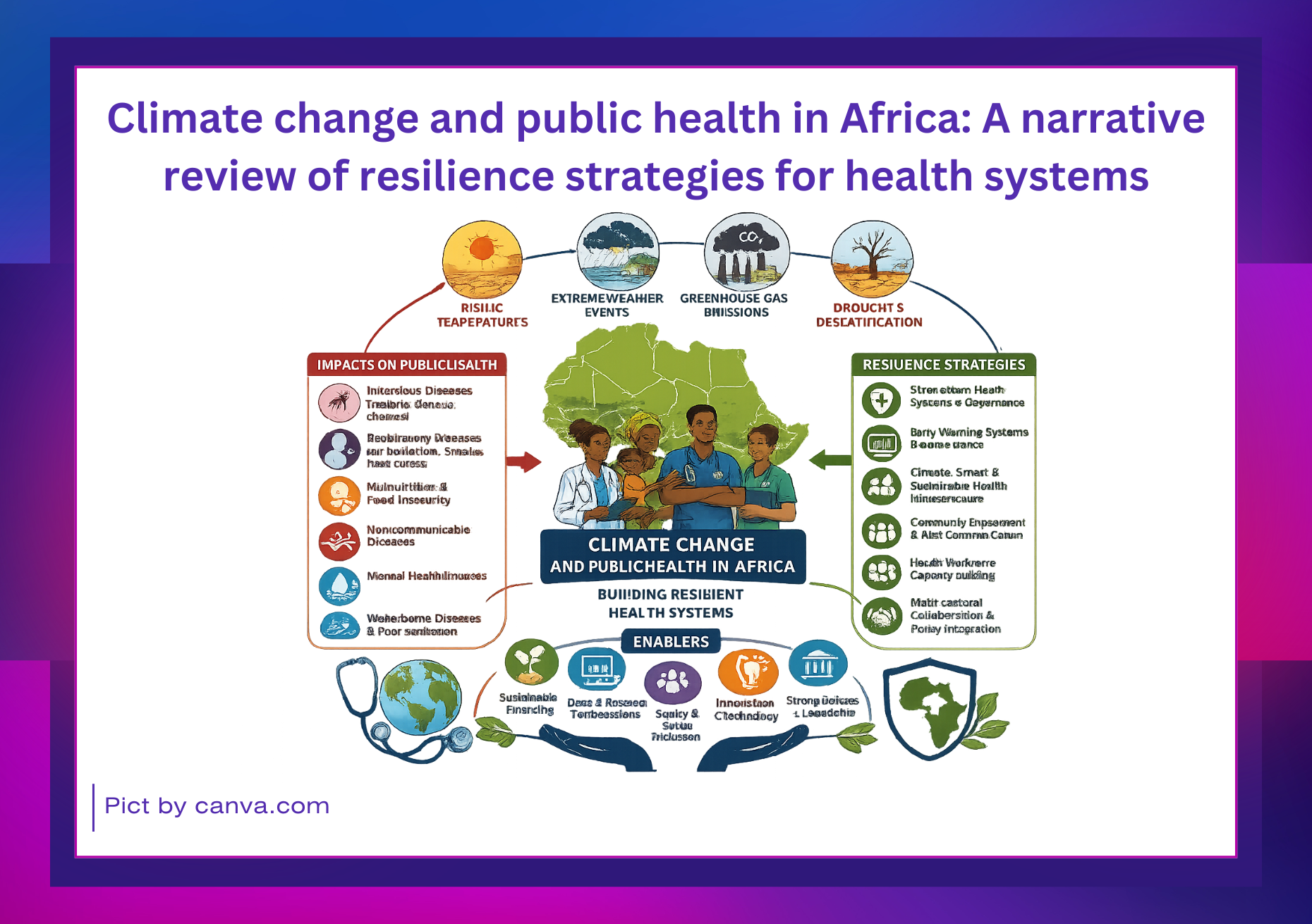
Climate change and public health in Africa: A narrative review of resilience strategies for health systems
Kabiru Gulma1, Sa’adatu M. Julde2, Isman Wais3, Emmanuel Morna4, Abubakar S. Danbatta5, Bakam Rodine6, Anastacia Katungo Maluki71. School of Global Health and Bioethics, Euclid University, Banjul , GM2. Faculty of Pharmaceutical Sciences, Bayero University, Kano , NG3. Euclid Caisse Nationale de Sécurité Sociale de Djibouti , DJ4. Doctoral Programme in Monitoring, Measurement and Evaluation, Euclid University, Bangui , CF5. Faculty of Pharmaceutical Sciences, Bayero University, Kano , NG6. Doctoral Programme in Global Energy Policy, Euclid University, Douala , CM7. Doctoral Programme in Epidemiology and Biostatistics, Euclid University, Banjul , GM2026-05-24|page 25-40AbstractBackground: Climate change poses an escalating threat to public health in Africa, a continent responsible for less than 10% of global greenhouse gas emissions yet disproportionately bearing the burden of its consequences. Existing health systems remain fragile, under-resourced, and ill-equipped to absorb climate-related shocks.
Objectives: To synthesize evidence on the health impacts of climate change in Africa and identify strategies for building climate-resilient health systems.
Methods: This study is a narrative literature review. A comprehensive search of peer-reviewed databases and gray literature was conducted. Sources were screened against predefined inclusion criteria and synthesized thematically across six domains: climate science, contextual vulnerabilities, health systems strengthening, governance, community engagement, and financing. A total of 22 studies and reports were included and analyzed using thematic synthesis following Thomas and Harden’s (2008) three-step approach.
Results: Climate change intensifies the burden of infectious and non-communicable diseases, disrupts health infrastructure, and deepens health inequities across African regions. Resilience-building requires strengthened governance, sustained domestic and international financing, multisectoral partnerships, community engagement, and climate-adaptive health information systems.
Conclusions: Concerted, context-sensitive action that integrates climate adaptation into health policy frameworks is urgently needed to protect the health and well-being of African populations from the accelerating impacts of climate change. Practical implications include strengthening health system governance, mobilizing climate finance, investing in climate-adaptive surveillance systems, and fostering community engagement and multisectoral collaboration to build durable climate resilience across African health systems.
APA Citation StyleGulma, K. , Julde, S. M. , Wais, I. , Morna, E. , Danbatta, A. S. , Rodine, B. , & Maluki, A. K. (2026). Climate change and public health in Africa: A narrative review of resilience strategies for health systems. Public Health and Occupational Safety Journal, 25-40. https://doi.org/10.56003/phosj.v2i1.719 -
Mapping the intellectual structure of lead exposure and occupational health research in mining: A bibliometric analysis (2015–2025)
Ismi Farah Syarifah1, Rizal Maulana Hasby21. Department of Public Health, Faculty of of Health Sciences, Universitas Pembangunan Nasional Veteran Jakarta , ID2. Program of Biology, Faculty of Education and Teacher Training, Universitas Bina Bangsa , ID2026-01-28|page 193-204AbstractBackground: Lead exposure remains a significant occupational health issue in the mining industry, where workers are frequently exposed to dust, particulate matter, and contaminated environments. While research has increased, the literature often develops in separate thematic streams, making it difficult to capture the overall structure and relationships between key areas of study.
Objectives: This study aims to map research trends and thematic developments related to lead exposure and occupational health in the mining industry from 2015 to 2025. The goal is to provide a comprehensive bibliometric overview of the field and identify dominant and emerging themes.
Methods: A bibliometric approach was applied using Scopus-indexed publications. Peer-reviewed articles and review papers published between 2015 and 2025 were screened for relevance, resulting in a dataset of 133 documents. Descriptive analyses examined publication trends, subject areas, document types, leading journals, authors, affiliations, and contributing countries. Keyword co-occurrence analysis was performed using VOSviewer to map thematic patterns.
Results: The volume of publications increased significantly after 2020, peaking in the early 2020s. Research predominantly focused on environmental and health-related topics, driven by empirical studies. The thematic mapping revealed three major clusters: (1) mining assessment, (2) epidemiological outcomes, and (3) occupational health risks. Although connections between exposure assessment and health outcomes were observed, these relationships remain weak.
Conclusions: Research on lead exposure and occupational health in mining has shown sustained growth and thematic maturity. However, there is limited integration between exposure monitoring and health outcome studies. Future research should focus on integrating exposure monitoring with health outcomes, particularly in high-risk mining sectors.
APA Citation StyleSyarifah, I. F. , & Hasby, R. M. (2026). Mapping the intellectual structure of lead exposure and occupational health research in mining: A bibliometric analysis (2015–2025). Public Health and Occupational Safety Journal, 193-204. https://doi.org/10.56003/phosj.v1i2.675

1 - 3 of 3 items