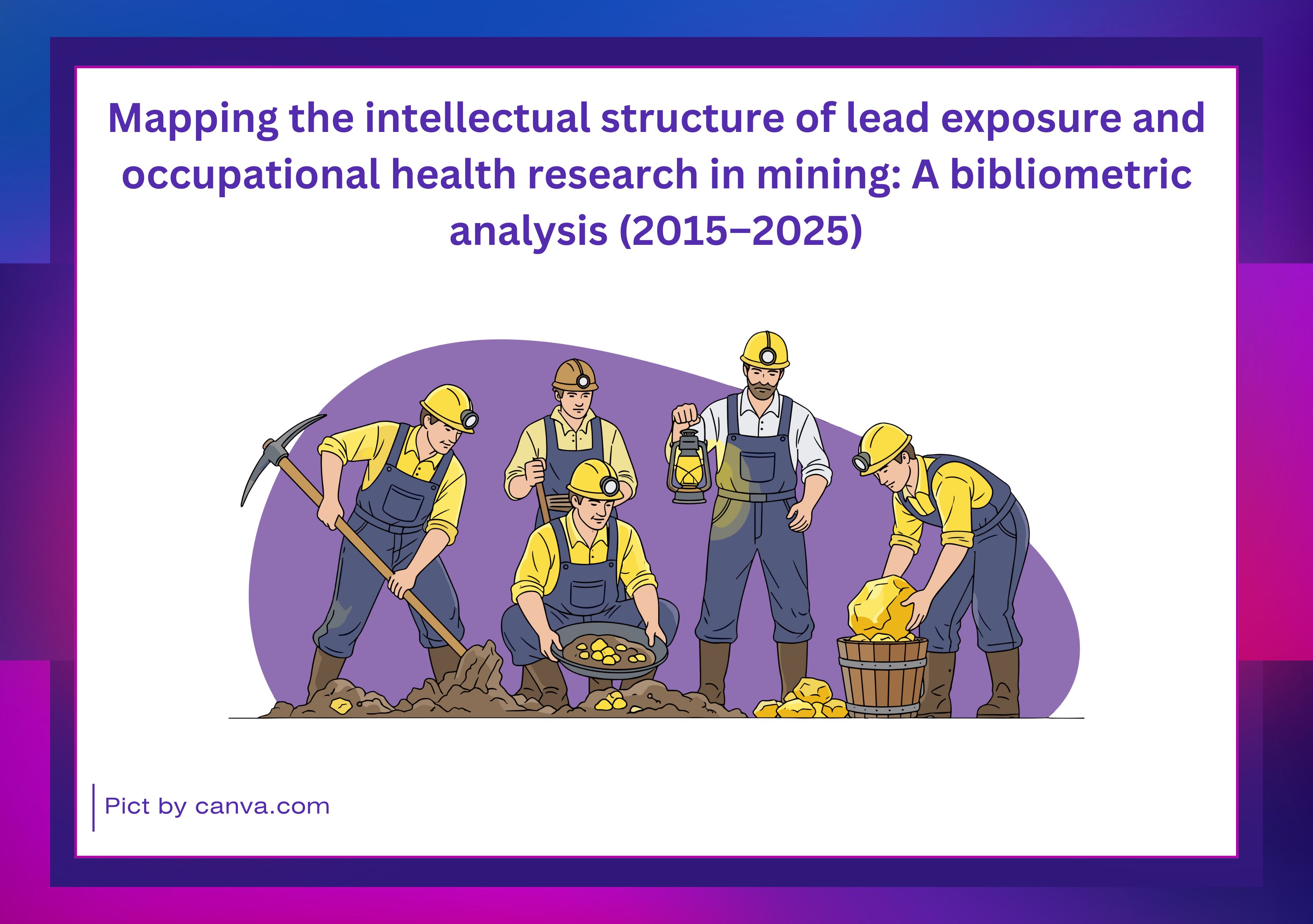
Mapping the intellectual structure of lead exposure and occupational health research in mining: A bibliometric analysis (2015–2025)

Downloads
Abstract
Background: Lead exposure remains a significant occupational health issue in the mining industry, where workers are frequently exposed to dust, particulate matter, and contaminated environments. While research has increased, the literature often develops in separate thematic streams, making it difficult to capture the overall structure and relationships between key areas of study.
Objectives: This study aims to map research trends and thematic developments related to lead exposure and occupational health in the mining industry from 2015 to 2025. The goal is to provide a comprehensive bibliometric overview of the field and identify dominant and emerging themes.
Methods: A bibliometric approach was applied using Scopus-indexed publications. Peer-reviewed articles and review papers published between 2015 and 2025 were screened for relevance, resulting in a dataset of 133 documents. Descriptive analyses examined publication trends, subject areas, document types, leading journals, authors, affiliations, and contributing countries. Keyword co-occurrence analysis was performed using VOSviewer to map thematic patterns.
Results: The volume of publications increased significantly after 2020, peaking in the early 2020s. Research predominantly focused on environmental and health-related topics, driven by empirical studies. The thematic mapping revealed three major clusters: (1) mining assessment, (2) epidemiological outcomes, and (3) occupational health risks. Although connections between exposure assessment and health outcomes were observed, these relationships remain weak.
Conclusions: Research on lead exposure and occupational health in mining has shown sustained growth and thematic maturity. However, there is limited integration between exposure monitoring and health outcome studies. Future research should focus on integrating exposure monitoring with health outcomes, particularly in high-risk mining sectors.
Allen, E. M., Alexander, B. H., Neumark-Sztainer, D., Ramachandran, G., Mandel, J. H., & MacLehose, R. F. (2015). Occupational exposures and lung cancer risk among Minnesota taconite mining workers. Occupational and Environmental Medicine. https://doi.org/10.1136/oemed-2015-102825
Aria, M., & Cuccurullo, C. (2017). Bibliometrix: An R-tool for comprehensive science mapping analysis. Journal of Informetrics, 11(4), 959–975. https://doi.org/10.1016/j.joi.2017.08.007
Arrandale, V. H., Shakeel, A., Hedges, K., O’Connell, K., & Gorman-Ng, M. (2025). Recent trends in respirable crystalline silica and elemental carbon exposure in the Ontario, Canada mining industry. Annals of Work Exposures and Health. https://doi.org/10.1093/annweh/wxae094
Cortes-Ramirez, J., Michael, R. N., Toms, L.-M., & Haswell, M. (2025). The public health impacts of mining in Australia. Medical Journal of Australia. https://doi.org/10.5694/mja2.70005
Delgado-Caballero, M. R., Valles-Aragón, M. C., & colleagues. (2018). Risk assessment through IEUBK model in an inhabited area contaminated with lead. Environmental Progress and Sustainable Energy. https://doi.org/10.1002/ep.12692
Donthu, N., Kumar, S., Mukherjee, D., Pandey, N., & Lim, W. M. (2021). How to conduct a bibliometric analysis: An overview and guidelines. Journal of Business Research, 133, 285–296. https://doi.org/10.1016/j.jbusres.2021.04.070
Galgani, F., Bouchoucha, M., Brach-Papa, C., et al. (2025). Long term changes of associated metal contamination of marine sediments affected by coastal mining of asbestos. Marine Pollution Bulletin. https://doi.org/10.1016/j.marpolbul.2025.118093
Goryaev, D. V., Fadeev, A. G., Shur, P. Z., Fokin, V. A., & colleagues. (2023). Hygienic assessment of working conditions and occupational diseases among mining workers in the Arctic zone of the Norilsk industrial area. Health Risk Analysis. https://doi.org/10.21668/health.risk/2023.2.08.eng
Mazurek, J. M., Dodd, K. E., Syamlal, G., Blackley, D. J., & Weissman, D. N. (2025). Coal workers’ pneumoconiosis-associated deaths—United States, 2020–2023. Morbidity and Mortality Weekly Report. https://doi.org/10.15585/mmwr.mm7441a1
Miranda, L. S., & Anjos, J. Â. S. A. (2018). Occupational impacts and adaptation to standards in accordance with Brazilian legislation: The case of Santo Amaro, Brazil. Safety Science. https://doi.org/10.1016/j.ssci.2017.12.034
Obiri, S., Yeboah, P. O., Osae, S., Adu-Kumi, S., & colleagues. (2016). Human health risk assessment of artisanal mining activities. International Journal of Environmental Research and Public Health. https://doi.org/10.3390/ijerph13010139
Rajput, P., Singh, A., Mandzhieva, S., Ghazaryan, K., Minkina, T., & Rajput, V. D. (2025). Emerging remediation approaches for mining contaminated soils by heavy metals: Recent updates and future perspective. Environmental Geochemistry and Health. https://doi.org/10.1007/s10653-025-02553-2
Saldaña-Villanueva, K., Pérez-Vázquez, F. J., Álvarez, R., & colleagues. (2022). A preliminary study on health impacts of Mexican mercury mining workers in a context of precarious employment. Journal of Trace Elements in Medicine and Biology. https://doi.org/10.1016/j.jtemb.2022.126925
Sharifi, S. A., Zaeimdar, M., Jozi, S. A., & Hejazian, M. (2023). Effects of soil, water and air pollution with heavy metal ions around lead and zinc mining and processing factories. Water, Air, & Soil Pollution. https://doi.org/10.1007/s11270-023-06758-y
van Eck, N. J., & Waltman, L. (2010). Software survey: VOSviewer, a computer program for bibliometric mapping. Scientometrics, 84(2), 523–538. https://doi.org/10.1007/s11192-009-0146-3
Zupic, I., & Čater, T. (2015). Bibliometric methods in management and organization. Organizational Research Methods, 18(3), 429–472. https://doi.org/10.1177/1094428114562629
Copyright (c) 2025 Ismi Farah Syarifah, Rizal Maulana Hasby

This work is licensed under a Creative Commons Attribution-ShareAlike 4.0 International License.