Search
Search Results
##search.searchResults.foundPlural##
-

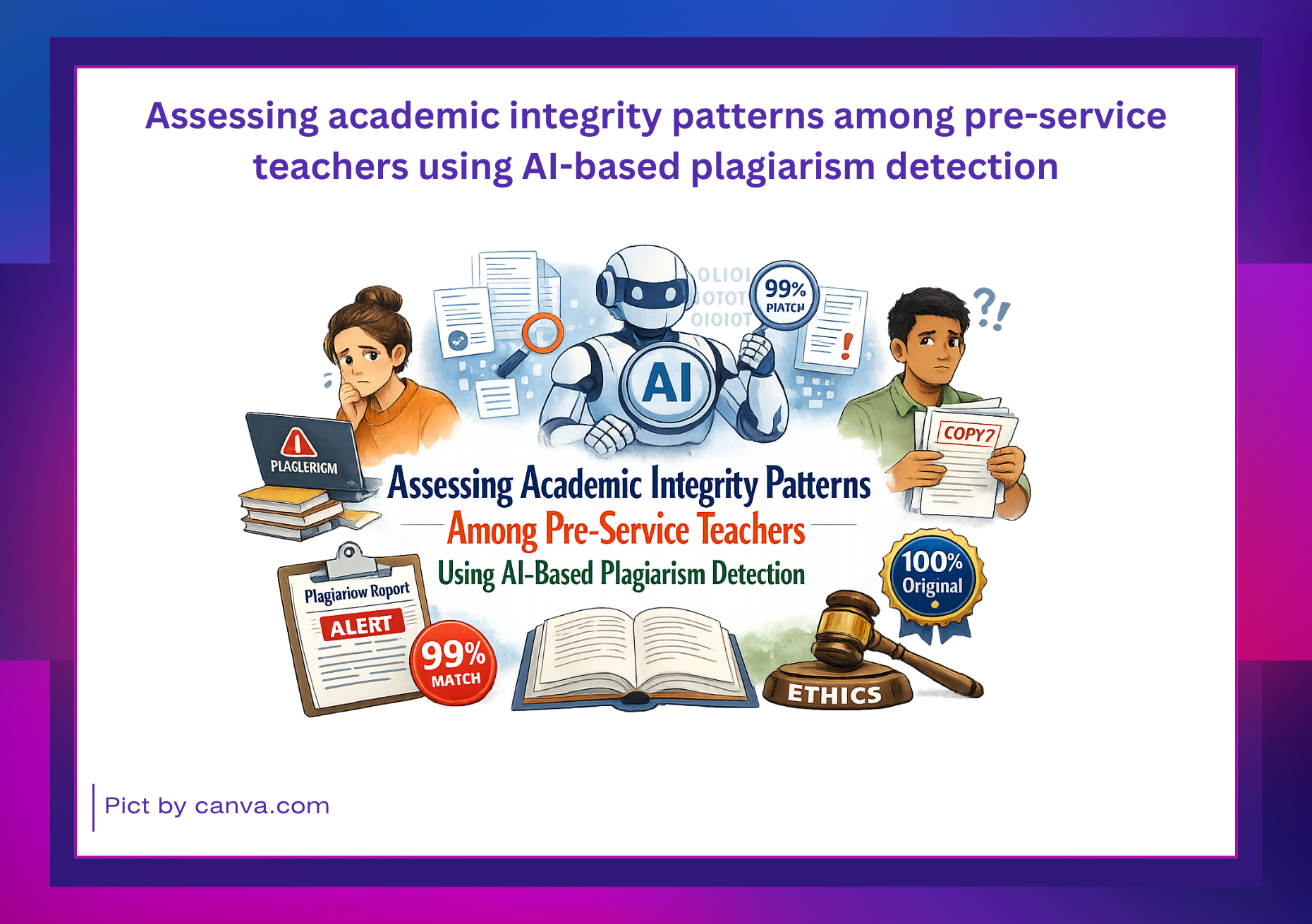
Assessing academic integrity patterns among pre-service teachers using AI-based plagiarism detection
Irish Arroyo1, Sittie Nor Aisha Rusiana2, Daniere Maryje Tabada3, Kim Silva4, Carla Marie Rubio5, Esmeraldo Sarad6, Cathy Mae Toquero71. College of Education, Mindanao State University-General Santos , PH2. College of Education, Mindanao State University-General Santos , PH3. College of Education, Mindanao State University-General Santos , PH4. College of Education, Mindanao State University-General Santos , PH5. College of Education, Mindanao State University-General Santos , PH6. College of Education, Mindanao State University-General Santos , PH7. Faculty of Psychology, Malang State University , ID2026-04-06|page 148-163AbstractBackground: The advent of artificial intelligence has intensified concerns about academic dishonesty among students, particularly in written outputs. Plagiarism, a common form of misconduct, involves using others’ ideas without proper attribution.
Objectives: This study aimed to determine the degree and patterns of academic integrity in the pre-service teachers’ book reviews.
Methods: Employing a descriptive research design through document analysis, the study used purposive sampling to collect 40 book reviews, applying set inclusion and exclusion criteria. An AI-based plagiarism detection tool, Grammarly, was used to identify instances of plagiarism and assess the level of academic integrity reflected in the outputs. Descriptive statistical methods were applied to examine plagiarism levels across different sections of the book reviews.
Results: Results showed that the majority of pre-service teachers demonstrated a very high level of academic integrity in their book reviews, scoring 97% or interpreted as students committing 3% plagiarism. Furthermore, sectional analysis showed that the introduction and conclusion exhibited higher integrity, while the body contained the most instances of plagiarism. This suggests that students struggled more with sections requiring critical thinking, original insights, and proper citation. Most plagiarism cases were linked to failure to cite sources and unintentional misuse of references.
Conclusions: Teacher Education Institutions integrate AI-supported evaluation tools and plagiarism detection systems into instruction and assessment. Embedding academic integrity modules and discussions on AI ethics is also encouraged. Future research should involve larger and more diverse samples and utilize multiple AI detection tools to enhance the reliability and validity of findings through cross-verification.
APA Citation StyleArroyo, I. , Rusiana, S. N. A. , Tabada, D. M. , Silva, K. , Rubio, C. M. , Sarad, E. , & Toquero, C. M. (2026). Assessing academic integrity patterns among pre-service teachers using AI-based plagiarism detection. Journal of Artificial Intelligence in Education & Learning Innovation, 148-163. https://doi.org/10.56003/jaieli.v1i2.685 -

Effects of Chat-GPT (Generative Pre-Trained Transformer) in the Writing Skills of Undergraduate Students: A Scoping Review
Hamdoni Pangandaman1, Mirella Veras2, Samiel Macalaba3, Abolbashar Mangontawar4, Sittie Ainah Mai-Alauya5, Saliha Janine Gubaten6, Maslainie Aliola7, Norhanie Lininding8, Paida Abdulmalik9, Sittie Hainieh Taratingan101. Mindanao State University, Marawi City , PH2. Department of Physical Therapy, College of Rehabilitation Sciences, Rady Faculty of Health Sciences, University of Manitoba , CA3. Mindanao State University, Main Campus, Marawi City , PH4. Mindanao State University, Marawi City , PH5. Mindanao State University, Marawi City , PH6. Mindanao State University, Marawi City , PH7. Mindanao State University, Marawi City , PH8. Mindanao State University, Marawi City , PH9. Mindanao State University, Marawi City , PH10. Mindanao State University, Marawi City , PH2026-07-02|page 14-31AbstractBackground: The integration of artificial intelligence (AI) in academic settings has gained increasing attention, particularly in improving students' writing skills. ChatGPT, a generative AI tool, has been explored as a potential aid in academic writing, providing instant feedback and enhancing students' ability to structure, revise, and refine their written work. However, there remains a need to systematically assess its effectiveness in undergraduate education
Objectives: This study aimed to evaluate the impact of ChatGPT on the writing skills of undergraduate students through a scoping review, analyzing its effectiveness in enhancing grammar, vocabulary, coherence, and overall writing proficiency.
Methods: A scoping review methodology was employed to identify relevant studies published between 2020 and 2024. A comprehensive search was conducted across seven academic databases: ScienceDirect, Scopus, ProQuest, EBSCOhost, Sage Journals, Taylor & Francis, and PubMed, using Boolean operators and predefined inclusion criteria. The studies were appraised using the Joanna Briggs Institute (JBI) Critical Appraisal Tool for quasi-experimental research and the ROBVIS checklist for randomized controlled trials (RCTs) to assess the risk of bias. The synthesis was conducted following the Synthesis Without Meta-Analysis (SWiM) guidelines, with PRISMA used for article selection and appraisal.
Results: A total of nine studies were included in the review, conducted in Saudi Arabia, China, Ecuador, Indonesia, Iran, Pakistan, and India, involving a total of 839 undergraduate students. The duration of interventions varied, with most lasting between 10 to 16 weeks. The overall risk of bias was low, indicating strong methodological reliability. The findings revealed that ChatGPT significantly improved students' writing proficiency, particularly in areas of grammatical accuracy, vocabulary use, organization, and argument structure. Also, students using ChatGPT exhibited increased engagement and motivation in writing tasks compared to traditional methods. However, some studies cautioned against over-reliance on AI-generated text and raised concerns about academic integrity and originality.
Conclusion: ChatGPT demonstrates promising potential as an AI-assisted writing tool, offering immediate feedback, structured learning support, and improved writing outcomes for undergraduate students. While its effectiveness is evident, further research is needed to establish best practices for integrating AI into academic writing instruction, ensuring that students develop critical thinking and independent writing skills while leveraging AI’s benefits responsibly.
APA Citation StylePangandaman, H. , Veras, M. , Macalaba, S. , Mangontawar, A. , Mai-Alauya, S. A. , Gubaten, S. J. , Aliola, M. , Lininding, N. , Abdulmalik, P. , & Taratingan, S. H. (2026). Effects of Chat-GPT (Generative Pre-Trained Transformer) in the Writing Skills of Undergraduate Students: A Scoping Review. Journal of Artificial Intelligence in Education & Learning Innovation, 14-31. https://doi.org/10.56003/jaieli.v2i1.712 -
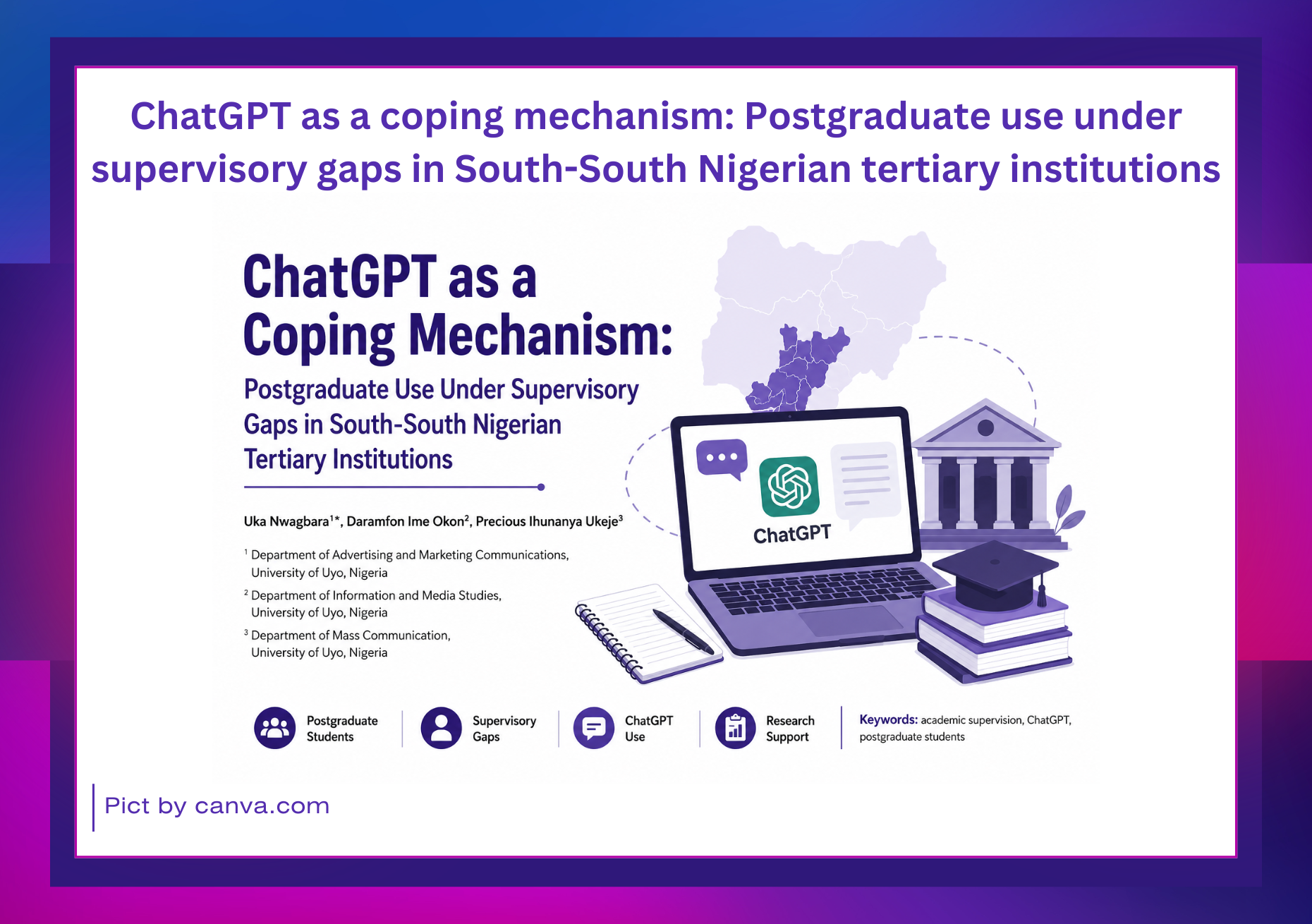
ChatGPT as a coping mechanism: Postgraduate use under supervisory gaps in South-South Nigerian tertiary institutions
Uka Nwagbara1, Daramfon Okon2, Precious Ukeje31. University of Uyo , NG2. University of Uyo , NG3. University of Uyo , NG2026-07-02|page 1-13AbstractBackground: Generative AI tools like ChatGPT are common in higher education, especially where students lack timely academic support. In many South-South Nigerian universities, gaps in postgraduate supervision may influence how students use such tools.
Objectives: This study examines how postgraduate students become aware of ChatGPT, how much they use it, and why they rely on it when supervision is limited.
Methods: A qualitative exploratory design was used. Twenty-one postgraduate students were purposively selected from universities in South-South Nigeria. Data were collected through online semi-structured interviews using a validated guide. Inductive thematic analysis, using Braun & Clarke’s framework, was applied to identify patterns in the data.
Results: Findings show that awareness of ChatGPT is mostly informal, driven by peers, social media, and personal trial and error. Many students use ChatGPT frequently, especially during proposal writing, data analysis, and thesis development. Its use is strongly linked to delays or gaps in supervision.
Conclusions: ChatGPT is widely used as a support tool and coping strategy, rather than merely a convenience. Its role reflects gaps in supervision and the need for clearer institutional guidance and training.
APA Citation StyleNwagbara, U. , Okon, D. , & Ukeje, P. (2026). ChatGPT as a coping mechanism: Postgraduate use under supervisory gaps in South-South Nigerian tertiary institutions. Journal of Artificial Intelligence in Education & Learning Innovation, 1-13. https://doi.org/10.56003/jaieli.v2i1.711

1 - 3 of 3 items