Abstract
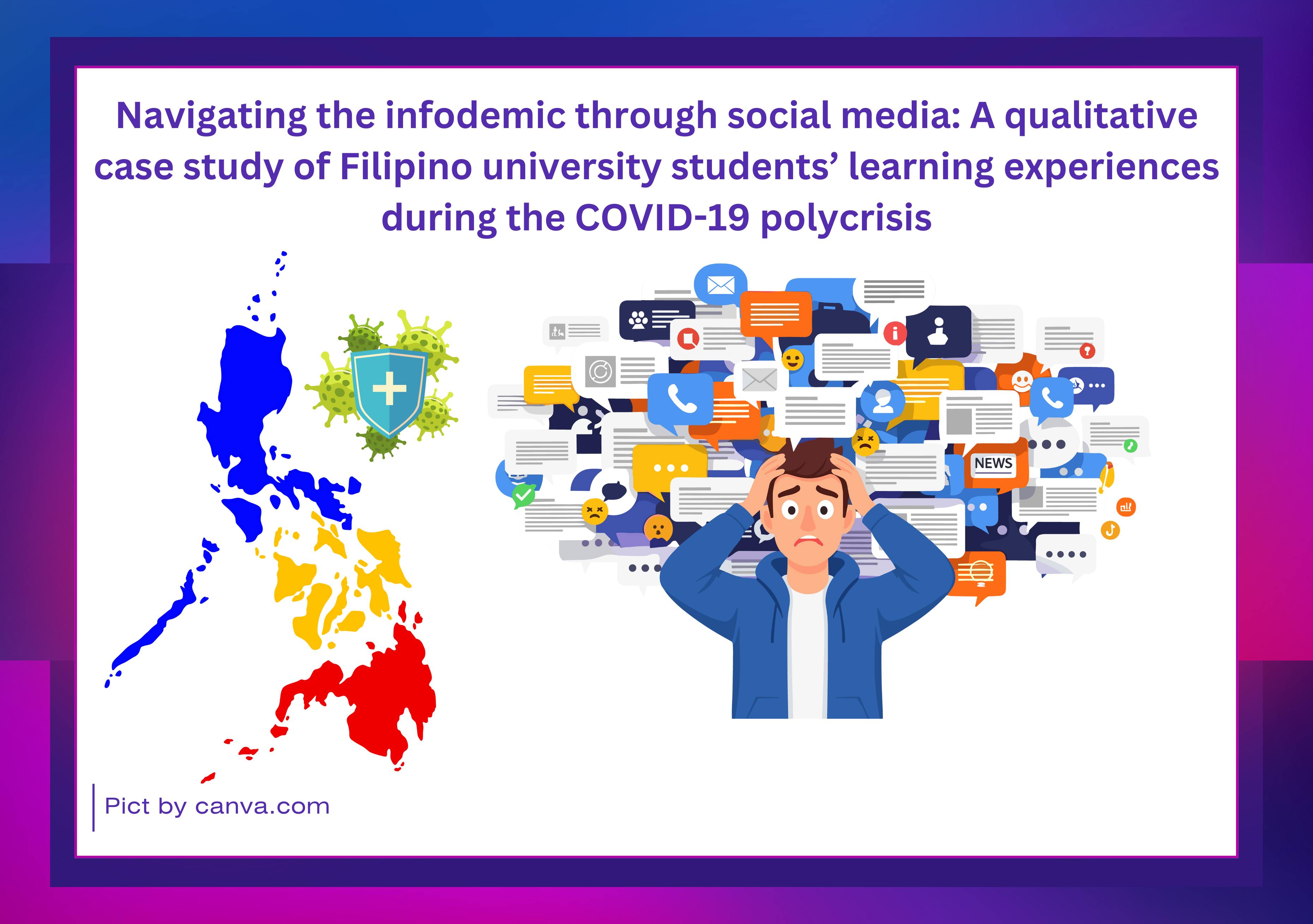
Background: The COVID-19 pandemic has triggered a complex crisis in higher education that has not only disrupted formal learning but also given rise to an infodemic through the rapid spread of misinformation on digital platforms, making social media both a source of learning and a source of epistemic risk for students.
Objectives: This study aims to explore how Filipino university students navigated learning experiences through social media during the COVID-19 polycrisis, focusing on preferred platforms, perceived educational relevance, and strategies for evaluating information credibility amid an infodemic.
Methods: A qualitative case study design was employed. Six Filipino university students enrolled in a Bachelor of Elementary Education program participated in this study through purposive sampling. Data were collected via online semi-structured interviews, group chat discussions, document analysis of shared social media content, and follow-up interviews. Thematic analysis was conducted following Braun and Clarke's framework to identify recurring patterns across data sources.
Results: Findings reveal that social media—particularly Facebook—served as a supplementary learning space, enabling students to access real-time information, engage with societal issues, and sustain their learning during the suspension of formal instruction. Students demonstrated active information-seeking behaviors, including cross-checking sources and exercising caution in sharing content. However, persistent exposure to misinformation highlighted their vulnerability within infodemic environments, especially in the absence of structured institutional guidance.
Conclusions: Social media can support authentic and socially relevant learning during educational disruption, but its pedagogical value depends on students' critical and digital literacy capacities.Keywords:
ARTICLE INFORMATION
LICENSE
Copyright (c) 2026 Janel Talaman, Mc Denver Necosia, Larence Villalon, Edrian Mark Tomines

This work is licensed under a Creative Commons Attribution-ShareAlike 4.0 International License.
HOW TO CITE
Talaman, J. , Necosia, M. D. , Villalon, L. , & Tomines, E. M. (2026). Navigating the infodemic through social media: A qualitative case study of Filipino university students’ learning experiences during the COVID-19 polycrisis. Journal of Artificial Intelligence in Education & Learning Innovation, 1(2), 119-134. https://doi.org/10.56003/jaieli.v1i2.571
DOWNLOADS
References
Adedoyin, O. B. & Soykan, E. (2020): Covid-19 pandemic and online learning: the challenges and opportunities, Interactive Learning Environments, https://doi.org/10.1080/10494820.2020.1813180
Alipio, M. (2020). Education during COVID-19 era: Are learners in a less-economically developed country ready for e-learning?. ZBW-Leibniz Information Centre for Economics. https://hdl.handle.net/10419/234960
Awidi, I. T., Paynter, M., & Vujosevic, T. (2019). Facebook group in the learning design of a higher education course: An analysis of factors influencing positive learning experience for students. Computers & Education, 129, 106-121. https://doi.org/10.1016/j.compedu.2018.10.018
Bao, W. (2020). COVID-19 and online teaching in higher education: A case study of Peking University. Human Behavior and Emerging Techologies, 2(2), 113-115. https://doi.org/10.1002/hbe2.191
Bode, L., Vraga, E. K., & Tang, R. (2024). User correction. Current Opinion in Psychology, 56, 101786. https://doi.org/10.1016/j.copsyc.2023.101786
Bozkurt, A., & Sharma, R. (2020). Emergency remote teaching in a time of global crisis due to CoronaVirus pandemic. Asian Journal of Distance Education, 15(1), i-vi. http://asianjde.com/ojs/index.php/AsianJDE/article/view/447
Braun, V. and Clarke, V. (2006) Using thematic analysis in psychology. Qualitative Research in Psychology, 3 (2). pp. 77-101. ISSN 1478-0887 Available from: http://eprints.uwe.ac.uk/11735
Brennen, J. S., Simon, F. M., Howard, P. N., & Nielsen, R. K. (2020). Types, sources, and claims of COVID-19 misinformation (RISJ Factsheets). Reuters Institute for the Study of Journalism. https://dx.doi.org/10.60625/risj-awvq-sr55
Cinelli, M., Quattrociocchi, W., Galeazzi, A., Valensise, C. M., Brugnoli, E., Schmidt, A. L., ... & Scala, A. (2020). The COVID-19 social media infodemic. Scientific reports, 10(1), 16598. https://doi.org/10.1038/s41598-020-73510-5
Clark, J. L., Algoe, S. B., & Green, M. C. (2018). Social Network Sites and Well-Being: The Role of Social Connection. Current Directions in Psychological Science, 27(1), 32–37. https://doi.org/10.1177/0963721417730833
Crowe, S., & Sarma, K. (2022). Coping with Covid-19: stress, control and coping among pregnant women in Ireland during the Covid-19 pandemic. BMC Pregnancy and Childbirth, 22(1), 274. https://doi.org/10.1186/1471-2288-11-100
Dumitru, E. A. (2020). Testing Children and Adolescents’ Ability to Identify Fake News: A Combined Design of Quasi-Experiment and Group Discussions. Societies, 10(3), 71. https://doi.org/10.3390/soc10030071
Eickelmann, B., and J. Gerick. 2020. “Lernen Mit Digitalen Medien: Zielsetzungen in Zeiten Von Corona Und Unter Besonderer Berücksichtigung Von Sozialen Ungleichheiten [Learning with Digital Media: Objectives in Times of Corona and under Special Consideration of Social Inequities].” Die Deutsche Schule 16: 153–162. https://doi.org/10.31244/9783830992318.09
Farboodi, M., Jarosch, G., & Shimer, R. (2021). Internal and external effects of social distancing in a pandemic. Journal of Economic Theory, 196, 105293. https://doi.org/10.1016/j.jet.2021.105293
Greenstone, M., & Nigam, V. (2020). Does social distancing matter?. University of Chicago, Becker Friedman Institute for economics working paper, (2020-26). https://dx.doi.org/10.2139/ssrn.3561244
Grewenig, E., Lergetporer, P., Werner, K., Woessmann, L., & Zierow, L. (2021). COVID-19 and educational inequality: How school closures affect low-and high-achieving students. European economic review, 140, 103920. https://doi.org/10.1016/j.euroecorev.2021.103920
Islam, M. S., Sarkar, T., Khan, S. H., Kamal, A. H. M., Hasan, S. M., Kabir, A., ... & Seale, H. (2020). COVID-19–related infodemic and its impact on public health: A global social media analysis. The American Journal of Tropical Medicine and Hygiene, 103(4), 1621. https://doi.org/10.4269/ajtmh.20-0812
Khairunissa, K. (2020). University Students' Ability in Evaluating Fake News on Social Media. Record and Library Journal, 6(2), 136-145. http://dx.doi.org/10.20473/rlj.V6-I2.2020.136-145
König, J., Jäger-Biela, D. & Glutsch, N. (2020) Adapting to online teaching during COVID-19 school closure: teacher education and teacher competence effects among early career teachers in Germany. European Journal of Teacher Education, 43(4), 608-622. https://doi.org/10.1080/02619768.2020.1809650
Kuhfeld, M., Soland, J., Tarasawa, B., Johnson, A., Ruzek, E., & Liu, J. (2020). Projecting the Potential Impact of COVID-19 School Closures on Academic Achievement. Educational Researcher, 49(8), 549–565. https://doi.org/10.3102/0013189X20965918
Likar, B., & Trcek, D. (2021). Orde ab chao method for disruptive innovations creation (with COVID-19 pandemic case application). Frontiers in psychology, 11, 581968. https://doi.org/10.3389/fpsyg.2020.581968
Manca, S. (2020). Snapping, pinning, liking or texting: Investigating social media in higher education beyond Facebook. The Internet and Higher Education, 44, 100707. https://doi.org/10.1016/j.iheduc.2019.100707
Mirbabaie, M., Bunker, D., Stieglitz, S., Marx, J., & Ehnis, C. (2020). Social media in times of crisis: Learning from Hurricane Harvey for the coronavirus disease 2019 pandemic response. Journal of Information Technology, 35(3), 195-213. https://doi.org/10.1177/0268396220929258
Sobaih, A. E. E., & Moustafa, M. A. (2016). Speaking the same language: The value of social networking sites for hospitality and tourism higher education in Egypt. Journal of Hospitality & Tourism Education, 28(1), 21-31. https://doi.org/10.1080/10963758.2015.1127169
Sobaih, A. E., Hasanein, A. & Abu Elnasr, A. (2020). Responses to COVID-19 in Higher Education: Social Media Usage for Sustaining Formal Academic Communication in Developing Countries. Sustainability 12 (16), 6520, https://doi.org/10.3390/su12166520
Toquero, C. M. D. (2023). Addressing infodemic through the comprehensive competency framework of media and information literacy, Journal of Public Health, 45(1), e132–e133, https://doi.org/10.1093/pubmed/fdab412
Toquero, C. M. D., & Talidong, K. J. B. (2021). Socio‐educational implications of technology use during COVID‐19: A case study in General Santos City, Philippines. Human Behavior and Emerging Technologies, 3(1), 194-198. https://doi.org/10.1002/hbe2.214
World Health Organization, 2020. Coronavirus Disease 2019 (COVID-19) Situation Report – 13. Geneva, Switzerland: WHO.