Search
Search Results
##search.searchResults.foundPlural##
-

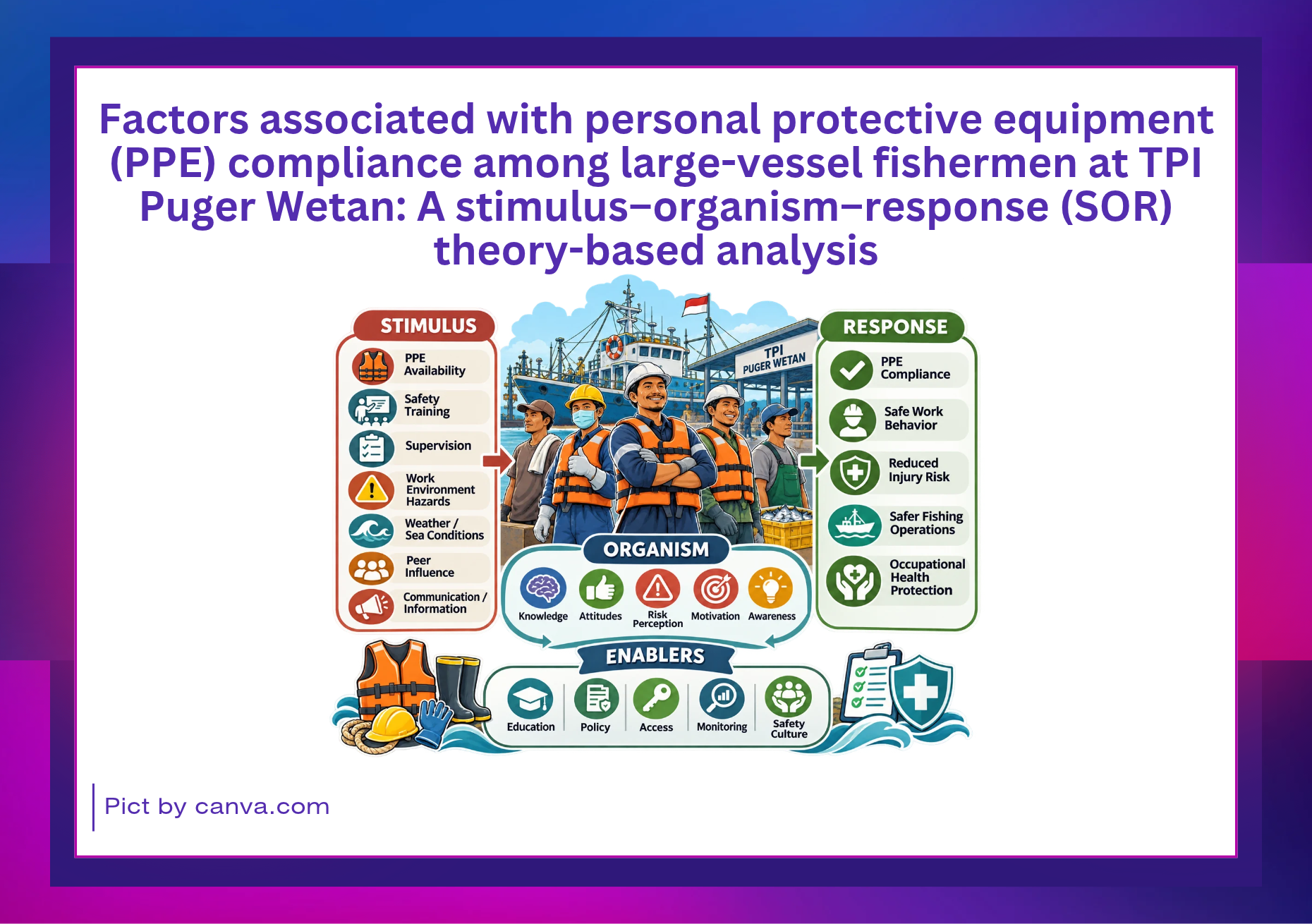
Factors associated with personal protective equipment (PPE) compliance among large-vessel fishermen at TPI Puger Wetan: A stimulus–organism–response (SOR) theory-based analysis
Putri Alifah Salsabila1, Nesya Nesya2, Fazilatu Afza3, Alisya Puspita Sari4, Kamiliyatul Yanani5, Rachel Mutiara Jasmine6, Bunga Tri Cantika7, Nazwa Ajeng Vania Putri8, Davina Zahra Fernanda9, Farida Wahyu Ningtyias10, Sri Rahayu Pudjiati11, Yunus Ariyanto12, Taufan Asrisyah Ode131. Universitas Jember , ID2. Universitas Jember , ID3. Universitas Jember , ID4. Universitas Jember , ID5. Universitas Jember , ID6. Universitas Jember , ID7. Universitas Jember , ID8. Universitas Jember , ID9. Universitas Jember , ID10. Universitas Jember , ID11. Universitas Jember , ID12. Universitas Jember , ID13. Universitas Jember , ID2026-11-19|page 70-86AbstractBackground: Large-vessel fishermen face substantial occupational hazards, yet compliance with personal protective equipment (PPE) requirements remains low. The stimulus–organism–response (SOR) theory provides a framework for exam-ining factors associated with PPE compliance.
Objectives: To identify factors associated with PPE compliance among large-vessel fishermen at the Puger Wetan Fish Landing Site (TPI Puger Wetan).
Methods: This analytical cross-sectional study included 52 fishermen selected through simple random sampling. Data were collected through structured ques-tionnaire-based interviews. Associations were examined using the Fisher–Freeman–Halton exact test (α = 0.05) because the chi-square test assumptions were not met. Cramér's V was used to assess association strength.
Results: Most respondents (63.5%) were noncompliant with PPE requirements. Significant associations were found for educational attainment (p = 0.004), knowledge (p < 0.001), PPE training (p = 0.005), regulations (p = 0.012), and reward-and-punishment systems (p < 0.001), with Cramér's V values ranging from 0.41 to 0.62. Age, length of service, working hours, attitude, PPE availability, and supervision showed no significant associations.
Conclusions: Educational attainment, knowledge, training, regulations, and re-ward-and-punishment systems were significantly associated with PPE compliance. Strengthening occupational safety education, training, and policy implementation may improve compliance. However, the cross-sectional design and unadjusted analyses preclude causal inferences.APA Citation StyleSalsabila, P. A. , Nesya, N. , Afza, F. , Sari, A. P. , Yanani, K. , Jasmine, R. M. , Cantika, B. T. , Putri, N. A. V. , Fernanda, D. Z. , Ningtyias, F. W. , Pudjiati, S. R. , Ariyanto, Y. , & Ode, T. A. (2026). Factors associated with personal protective equipment (PPE) compliance among large-vessel fishermen at TPI Puger Wetan: A stimulus–organism–response (SOR) theory-based analysis. Public Health and Occupational Safety Journal, 70-86. https://doi.org/10.56003/phosj.v2i2.780 -
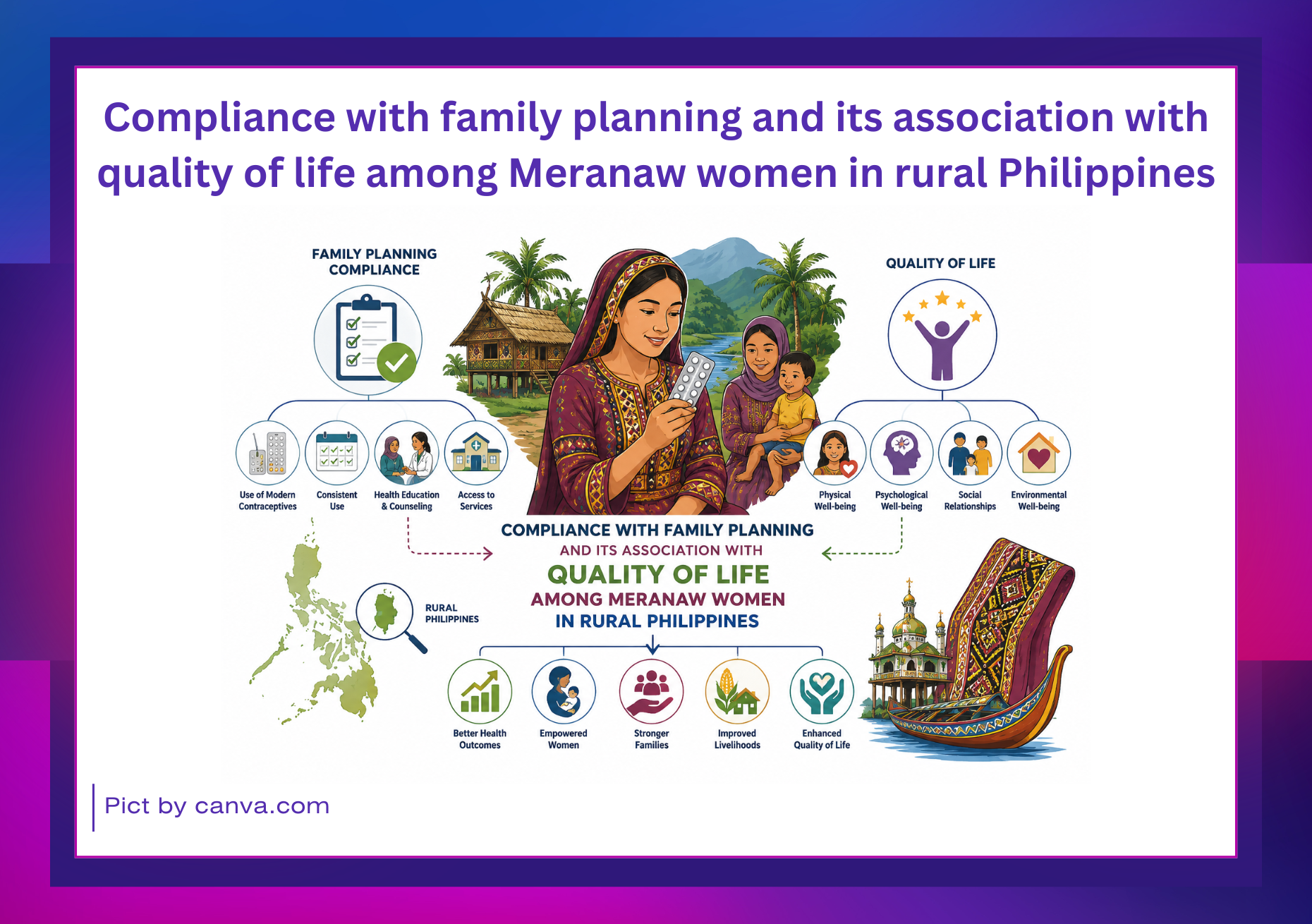
Compliance with family planning and its association with quality of life among Meranaw women in rural Philippines
Maslainie Aliola1, Hamdoni Pangandaman21. Mindanao State University - Marawi, Lanao Del Sur, 9700, Philippines , PH2. Mindanao State University, Marawi City , PH2026-05-24|page 1-13AbstractBackground: The COVID-19 pandemic disrupted access to essential health services, including family planning (FP), particularly in rural and underserved communities. These disruptions may influence women’s reproductive practices and overall quality of life (QoL).
Objectives: This study aimed to determine the level of family planning compliance and examine its influence on the quality of life among Meranaw women during the COVID-19 pandemic.
Methods: A descriptive cross-sectional design was employed among 378 Meranaw women who were family planning users in selected municipalities of Lanao del Sur, Philippines. Data were collected from January to October 2022. A stratified random sampling technique was used based on municipal distribution to ensure proportional representation of respondents. A validated researcher-developed questionnaire assessed attitude- and practice-related compliance (CVI = 0.81–0.92; α = 0.79), while QoL was measured using the WHOQOL-BREF. Data were analyzed using descriptive statistics and multiple linear regression.
Results: Respondents demonstrated high compliance in both attitude (mean = 3.61) and practice (mean = 3.41) domains. Overall QoL was rated very satisfactory (mean = 5.72), with the highest scores in the psychological (mean = 5.89) and relational (mean = 5.85) domains. Multiple regression analysis revealed that age (β = .319, p < .001), monthly income (β = –.097, p = .008), number of children (β = .395, p < .001), duration of FP use (β = .092, p = .034), and type of FP method (β = .129, p < .001) significantly predicted QoL. The model explained a substantial proportion of variance (R² = 0.974), indicating strong predictive capacity.
Conclusions: Meranaw women demonstrated high compliance with family planning practices despite pandemic-related constraints, thereby significantly improving the quality of life. Sustaining family planning services during public health crises is essential to maintaining women’s well-being, particularly in rural and culturally distinct populations.
APA Citation StyleAliola, M. , & Pangandaman, H. (2026). Compliance with family planning and its association with quality of life among Meranaw women in rural Philippines. Public Health and Occupational Safety Journal, 1-13. https://doi.org/10.56003/phosj.v2i1.698 -
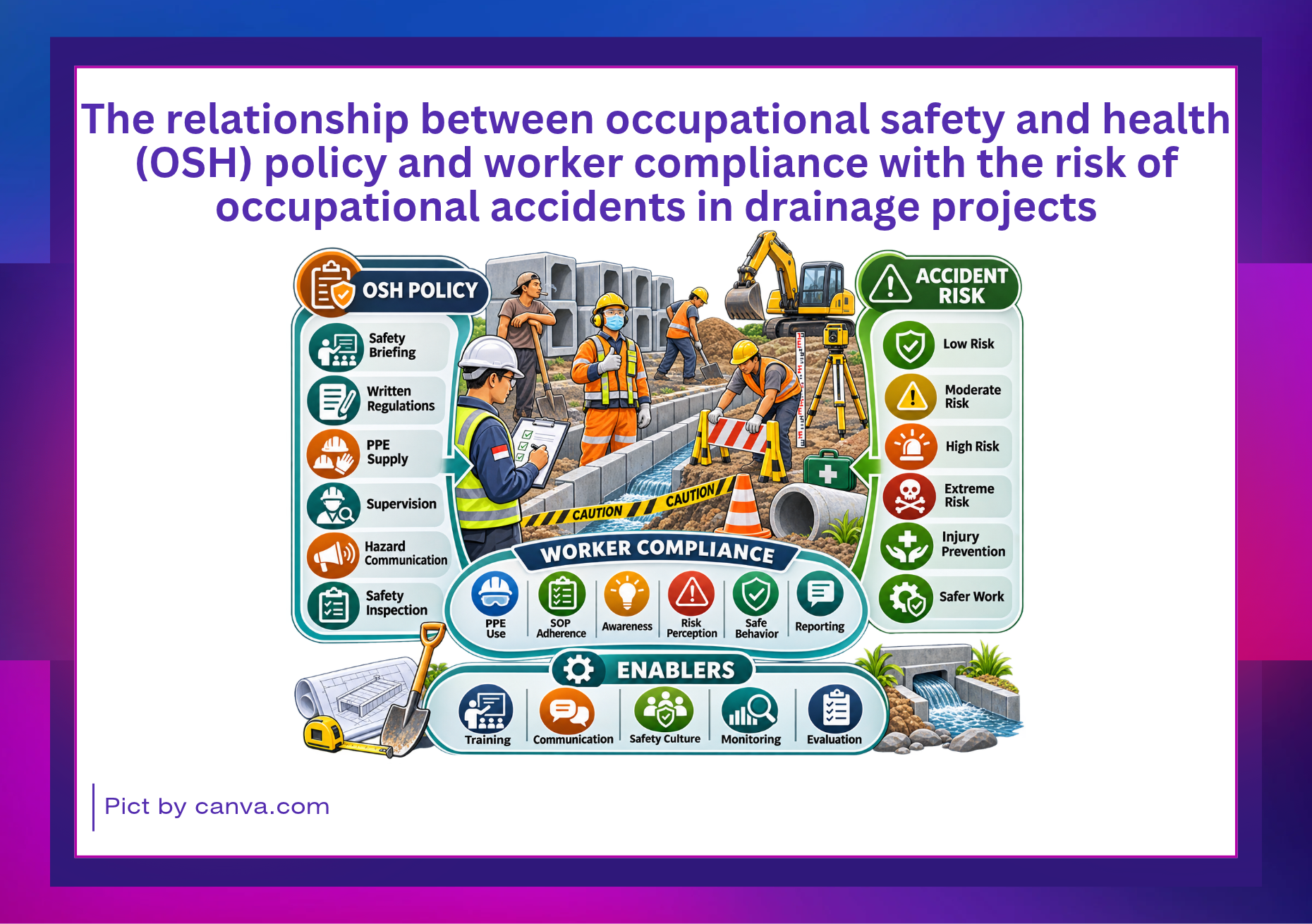
The relationship between occupational safety and health (OSH) policy and worker compliance with the risk of occupational accidents in drainage projects
Hasan Shirat1, Dwi Faqihatus Syarifah Has21. Universitas Muhammadiyah Gresik , ID2. Universitas Muhammadiyah Gresik , ID2026-11-19|page 87-98AbstractBackground: Construction workers, particularly those involved in drainage projects, are exposed to various occupational hazards that increase the risk of workplace accidents. Effective occupational safety and health (OSH) policies and worker compliance with safety procedures are essential for minimizing these risks.
Objectives: This study aimed to examine the associations of OSH policies and worker compliance with occupational accident risk among workers involved in a drainage project at PT Swadaya Cipta.
Methods: This quantitative analytical study employed a cross-sectional design. The study population comprised 65 drainage project workers at PT Swadaya Cipta, of whom 56 were selected through simple random sampling. The sample size was calculated using Slovin's formula with a 5% margin of error. Data were collected using questionnaires and the Hazard Identification, Risk Assessment, and Determining Control (HIRADC) worksheet. Associations between variables were analyzed using the chi-square test.
Results: OSH policy was significantly associated with occupational accident risk (p < .001; OR = 0.049). Worker compliance was also significantly associated with occupational accident risk (p = .002; OR = 0.138).
Conclusions: OSH policy and worker compliance were significantly associated with occupational accident risk among drainage project workers at PT Swadaya Cipta. These findings highlight the importance of effective OSH policy implementation and adherence to safety procedures in occupational accident prevention.APA Citation StyleShirat, H. , & Has, D. F. S. (2026). The relationship between occupational safety and health (OSH) policy and worker compliance with the risk of occupational accidents in drainage projects. Public Health and Occupational Safety Journal, 87-98. https://doi.org/10.56003/809

1 - 3 of 3 items