Search
Search Results
##search.searchResults.foundPlural##
-

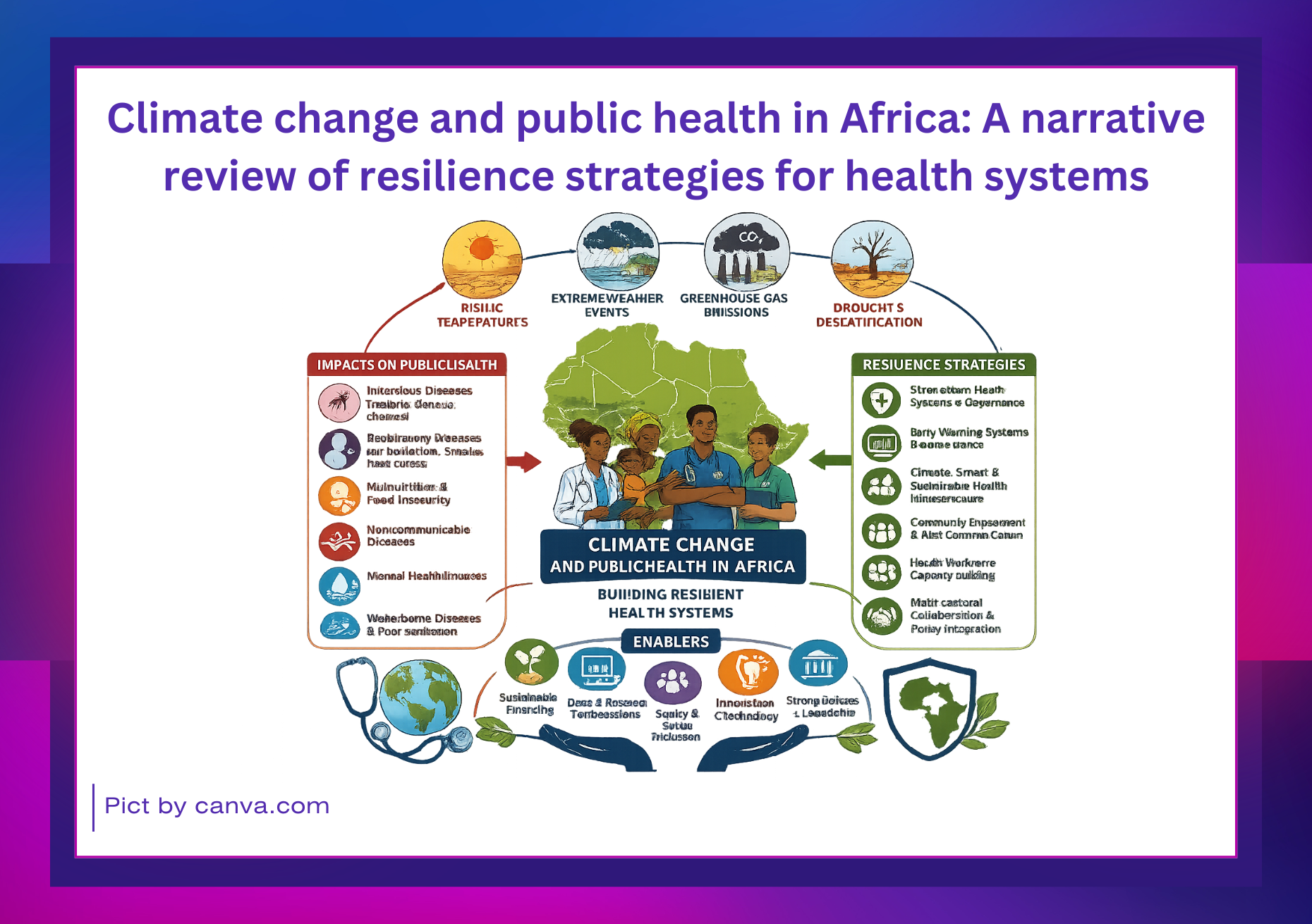
Climate change and public health in Africa: A narrative review of resilience strategies for health systems
Kabiru Gulma1, Sa’adatu M. Julde2, Isman Wais3, Emmanuel Morna4, Abubakar S. Danbatta5, Bakam Rodine6, Anastacia Katungo Maluki71. School of Global Health and Bioethics, Euclid University, Banjul , GM2. Faculty of Pharmaceutical Sciences, Bayero University, Kano , NG3. Euclid Caisse Nationale de Sécurité Sociale de Djibouti , DJ4. Doctoral Programme in Monitoring, Measurement and Evaluation, Euclid University, Bangui , CF5. Faculty of Pharmaceutical Sciences, Bayero University, Kano , NG6. Doctoral Programme in Global Energy Policy, Euclid University, Douala , CM7. Doctoral Programme in Epidemiology and Biostatistics, Euclid University, Banjul , GM2026-05-24|page 25-40AbstractBackground: Climate change poses an escalating threat to public health in Africa, a continent responsible for less than 10% of global greenhouse gas emissions yet disproportionately bearing the burden of its consequences. Existing health systems remain fragile, under-resourced, and ill-equipped to absorb climate-related shocks.
Objectives: To synthesize evidence on the health impacts of climate change in Africa and identify strategies for building climate-resilient health systems.
Methods: This study is a narrative literature review. A comprehensive search of peer-reviewed databases and gray literature was conducted. Sources were screened against predefined inclusion criteria and synthesized thematically across six domains: climate science, contextual vulnerabilities, health systems strengthening, governance, community engagement, and financing. A total of 22 studies and reports were included and analyzed using thematic synthesis following Thomas and Harden’s (2008) three-step approach.
Results: Climate change intensifies the burden of infectious and non-communicable diseases, disrupts health infrastructure, and deepens health inequities across African regions. Resilience-building requires strengthened governance, sustained domestic and international financing, multisectoral partnerships, community engagement, and climate-adaptive health information systems.
Conclusions: Concerted, context-sensitive action that integrates climate adaptation into health policy frameworks is urgently needed to protect the health and well-being of African populations from the accelerating impacts of climate change. Practical implications include strengthening health system governance, mobilizing climate finance, investing in climate-adaptive surveillance systems, and fostering community engagement and multisectoral collaboration to build durable climate resilience across African health systems.
APA Citation StyleGulma, K. , Julde, S. M. , Wais, I. , Morna, E. , Danbatta, A. S. , Rodine, B. , & Maluki, A. K. (2026). Climate change and public health in Africa: A narrative review of resilience strategies for health systems. Public Health and Occupational Safety Journal, 25-40. https://doi.org/10.56003/phosj.v2i1.719 -
Spatial mapping and correlation between healthy home coverage and tuberculosis incidence in Malang district
Fatma Lidya Zulfa1, Hartati Eko Wardani2, Tika Dwi Tama3, Anindya Hapsari4, Rara Warih Gayatri5, Erni Astutik61. State University of Malang , ID2. State University of Malang , ID3. State University of Malang , ID4. State University of Malang , ID5. State University of Malang , ID6. Airlangga University , ID2025-04-23|page 1-16AbstractBackground: According to the Ministry of Health, 91% of active tuberculosis (TB) cases in Indonesia occur in crowded and slum areas. The Healthy Homes Program under the Healthy Indonesia Indicators (2010) aims to improve housing conditions in such areas to meet health standards. Malang District, with the second-highest housing density in East Java, ranks fifth in TB cases, suggesting residential exposure as a contributing factor.
Objectives: This study aims to map trends and examine the correlation between healthy home coverage and TB incidence in the Malang District Health Center Working Area 2019-2021.
Methods: The study was conducted in January-April 2023 at the Malang District Health Office with a unit of analysis of 39 health centers. The variables of this study were the coverage of healthy homes and the incidence of BTA-positive pulmonary TB. The study used a mixed ecological study and Pearson correlation test with secondary data from the Malang District Health Office and BPS.
Results: TB incidence showed a decreasing trend alongside increasing healthy home coverage. Nine health centers remained in high-incidence zones, and five exhibited poor housing coverage. Correlation analysis revealed a weak, negative relationship (r = -0.084). High TB incidence was still found in areas meeting healthy home criteria.
Conclusions: The incidence rate of BTA-positive pulmonary TB in the working area of the Malang District Health Center showed a downward trend for 3 years. Future research using individual data and other specific risk factors that may influence TB incidence is recommended.
APA Citation StyleZulfa, F. L. , Wardani, H. E. , Tama, T. D. , Hapsari, A. , Gayatri, R. W. , & Astutik, E. (2025). Spatial mapping and correlation between healthy home coverage and tuberculosis incidence in Malang district. Public Health and Occupational Safety Journal, 1-16. https://doi.org/10.56003/phosj.v1i1.532

1 - 2 of 2 items