Search
Search Results
##search.searchResults.foundPlural##
-

Factors influencing desired family size among women of childbearing age in eastern Indonesia: Evidence from the Indonesian Demographic Health Survey
Cindy Ade Aulia1, Siti Nurrochmah2, Lucky Radita Alma3, Supriyadi Supriyadi41. State University of Malang , ID2. State University of Malang , ID3. State University of Malang , ID4. State University of Malang , ID2025-06-02|page 67-79AbstractBackground: Globally, Indonesia is the fourth most populous country. Based on the results of the Indonesian Central Bureau of Statistics census, it is known that the population of Indonesia in 2017 was around 261 million people, with an average number of children desired by women of childbearing age in East Nusa Tenggara Province of 2.9 or around three children per woman of childbearing age.
Objectives: This study aimed to determine the relationship between marital status, age at first marriage, employment status, and the number of children desired.
Methods: This quantitative study uses a cross-sectional design and an observational analytic survey method. This study took survey data from the 2017 Indonesian Demographic and Health Survey. The study sample was women aged 15-49 years who were recorded as a selected sample in East Nusa Tenggara Province, totaling 1,929 women. Data analysis used the Chi-square test.
Results: The analysis showed that the p-value of marital status was 0.000, the p-value of age at first marriage was 0.000, and the p-value of employment status was 0.000, which means that there is a significant relationship between marital status, age at first marriage, and employment status with the number of children desired by women of childbearing age.
Conclusions: This study found that marital status, age at first marriage, and employment status were significantly associated with the number of children desired by women of childbearing age. The findings suggest the need for employment-based interventions and marriage education to reduce fertility preferences in areas with high TFR.
APA Citation StyleAulia, C. A. , Nurrochmah, S. , Alma, L. R. , & Supriyadi, S. (2025). Factors influencing desired family size among women of childbearing age in eastern Indonesia: Evidence from the Indonesian Demographic Health Survey. Public Health and Occupational Safety Journal, 67-79. https://doi.org/10.56003/phosj.v1i1.533 -
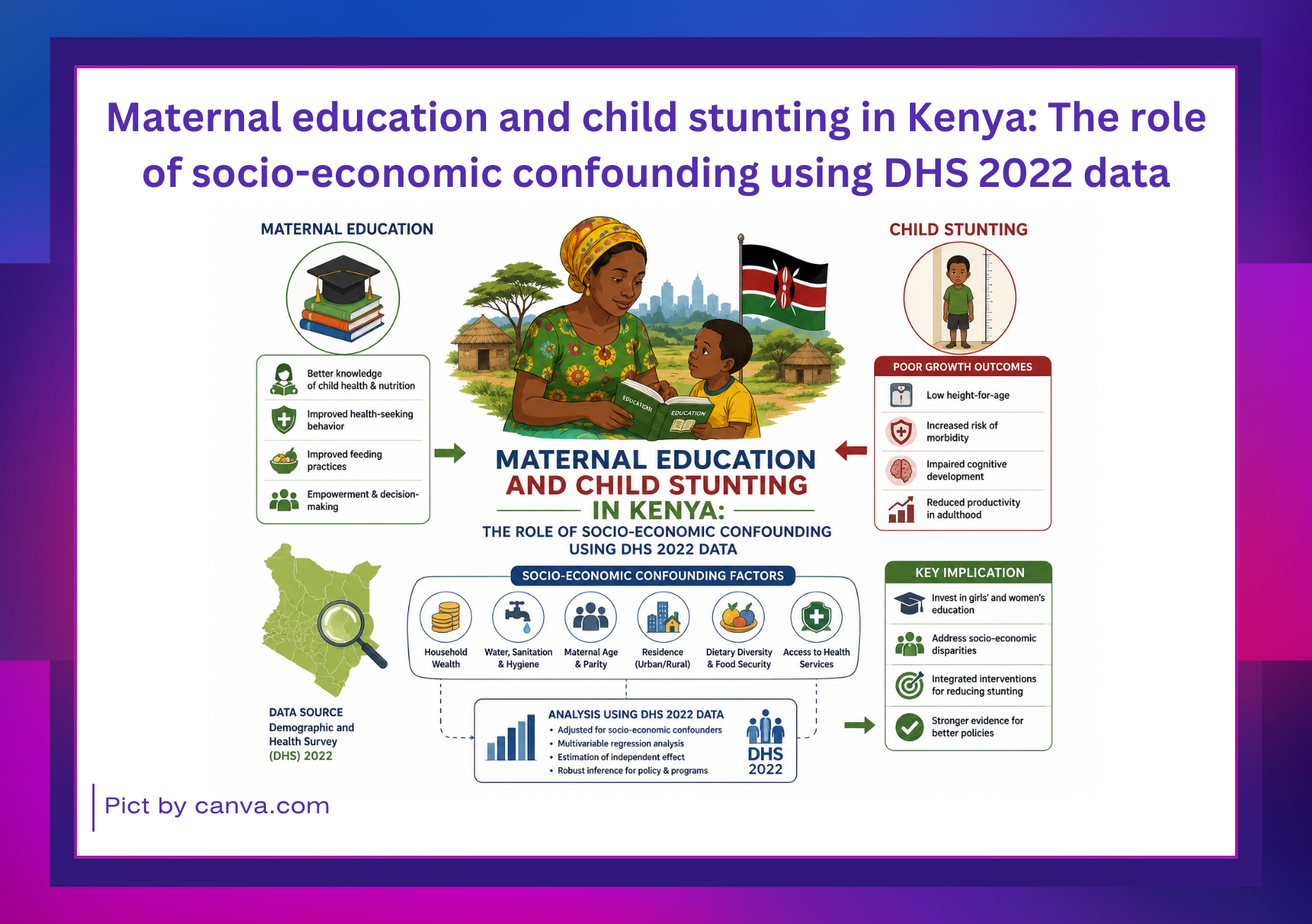
Maternal education and child stunting in Kenya: The role of socio-economic confounding using DHS 2022 data
Anastacia Katungo Maluki1, Zerai Hagos2, Kabiru Gulma3, Michael Musili Nzau41. Doctoral Programme in Epidemiology and Biostatistics, Euclid University, Banjul , GM2. Doctoral Programme in Epidemiology and Biostatistics, Euclid University, Banjul , GM3. School of Global Health and Bioethics, Euclid University, Bangui , CF4. United Nations Development Programme, New York , US2026-05-24|page 41-56AbstractBackground: Child stunting remains a major public health challenge in Kenya, reflecting long‑term nutritional deprivation and socioeconomic inequalities. Although maternal education is widely considered protective, its independent effect is often unclear due to confounding by structural factors.
Objectives: To examine the association between maternal education and child stunting among children under five in Kenya and to assess the extent of confounding and effect modification by key sociodemographic factors.
Methods: A cross‑sectional analytical study was conducted using data from the 2022 Kenya Demographic and Health Survey (KDHS). The sample included 19,530 children aged 0–59 months. Stunting was defined using height‑for‑age z-scores (<-2 SD). Descriptive, bivariate, stratified, and multivariable logistic regression analyses were performed, accounting for the complex survey design.
Results: Stunting prevalence was 18.2%. Stunting decreased with increasing maternal education, from 21.4–21.7% among children of mothers with no or primary education to 8.7% among those with higher education (χ² = 238, p < 0.001). However, the association was weak (Cramer’s V = 0.117) and attenuated after adjustment for socioeconomic factors. Household wealth was the strongest predictor, with children in the richest households having significantly lower odds of stunting than those in the poorest households (AOR = 0.268; 95% CI: 0.222–0.323; p < 0.001). Stunting risk increased with age, particularly among children aged 6–23 months, while females had lower odds than males (OR = 0.717; 95% CI: 0.662–0.776). Stratified analyses showed stronger protective effects of maternal education among older children. In contrast, variation across wealth groups should be interpreted cautiously, given inconsistent and non-significant findings in some strata. No meaningful effect modification by child sex was identified.
Conclusions: Child stunting in Kenya is primarily driven by structural socioeconomic factors. While maternal education is associated with reduced stunting, its effect is highly context dependent. Addressing poverty and inequality is essential for effective and equitable reductions in child stunting.
APA Citation StyleMaluki, A. K. , Hagos, Z. , Gulma, K. , & Nzau, M. M. (2026). Maternal education and child stunting in Kenya: The role of socio-economic confounding using DHS 2022 data. Public Health and Occupational Safety Journal, 41-56. https://doi.org/10.56003/phosj.v2i1.743 -

Role of inter-institutional partnerships in promoting holistic employee wellness programs: A convergent mixed-methods study across three public universities in Metro Manila, Philippines
Rosalie Dela Cruz11. University of Makati , PH2025-11-28|page 139-150AbstractBackground: Employee wellness has become an increasingly essential concern in higher education; yet, many public universities continue to struggle with implementing comprehensive and sustainable wellness initiatives. Inter-institutional partnerships offer opportunities to strengthen these efforts through shared resources and coordinated programming.
Objectives: This study examined how such partnerships support the development of holistic employee wellness programs across three public universities in Metro Manila.
Methods: Using a convergent mixed-methods design, quantitative data were collected from 150 employees through an 18-item validated survey and analyzed using descriptive statistics and chi-square tests to assess institutional differences in awareness, participation, and perceived effectiveness. Qualitative data from six key informants were analyzed using grounded theory techniques to identify themes related to institutional practices and collaborative mechanisms.
Results: Findings indicated significant variations among institutions in employee awareness, participation levels, and perceptions of program effectiveness. Despite the availability of wellness initiatives, participation remained limited, mainly due to workload demands, time constraints, and scheduling challenges. Qualitative themes highlighted four central factors influencing the implementation of wellness: institutional support, holistic wellness orientation, program personalization, and persistent participation barriers. These themes helped explain why engagement levels differed among institutions.
Conclusions: Overall, inter-institutional collaboration contributes positively to wellness program development, but its impact depends on strong institutional support, program relevance, and clear communication. Enhancing coordination and tailoring activities to employee needs may improve future wellness outcomes.
APA Citation StyleCruz, R. D. (2025). Role of inter-institutional partnerships in promoting holistic employee wellness programs: A convergent mixed-methods study across three public universities in Metro Manila, Philippines. Public Health and Occupational Safety Journal, 139-150. https://doi.org/10.56003/phosj.v1i2.610 -
Occupational safety and health hazards among artisanal and small-scale gold miners at Mazowe Jumbo Mine, Zimbabwe: A mixed-methods cross-sectional study
Bridget Nyamombe1, Vincent Itai Tanyanyiwa21. Zimbabwe Open University , ZW2. Zimbabwe Open University , ZW2025-11-28|page 151-162AbstractBackground: Artisanal and small-scale gold mining (ASGM) is associated with multiple occupational hazards that artisans are often unaware of.
Objectives: To identify the occupational hazards and risk factors among artisanal gold miners at Mazowe Jumbo mine, Zimbabwe.
Methods: The cross-sectional study employed Mixed-methods(Sep- Nov 2023). Purposive sampling of 34 miners from two sites (response rate was 100%). The interview was administered using questionnaires, structured interviews, field observations, and document review. Quantitative data were analyzed descriptively (frequencies and proportions), and qualitative data underwent thematic analysis.
Results: Heavy lifting was reported by 100% (34/34), manual handling by 91.2% (31/34), silica dust exposure by 91.2% (31/34), and contaminated water by 85.3% (29/34). Key risk factors included lack of PPE, financial pressure, and low OSH awareness. Field observations noted unsecured shafts, poor sanitation, and evidence of substance use on site.
Conclusions: ASG miners at Mazowe Jumbo Mine face multi-domain OSH hazards. We recommend targeted OSH training programmes, provision of PPE, improved sanitation, and monitoring/ formalization of ASGM activities.
APA Citation StyleNyamombe, B. , & Tanyanyiwa, V. I. (2025). Occupational safety and health hazards among artisanal and small-scale gold miners at Mazowe Jumbo Mine, Zimbabwe: A mixed-methods cross-sectional study. Public Health and Occupational Safety Journal, 151-162. https://doi.org/10.56003/phosj.v1i2.638

1 - 4 of 4 items