Search
Search Results
##search.searchResults.foundPlural##
-

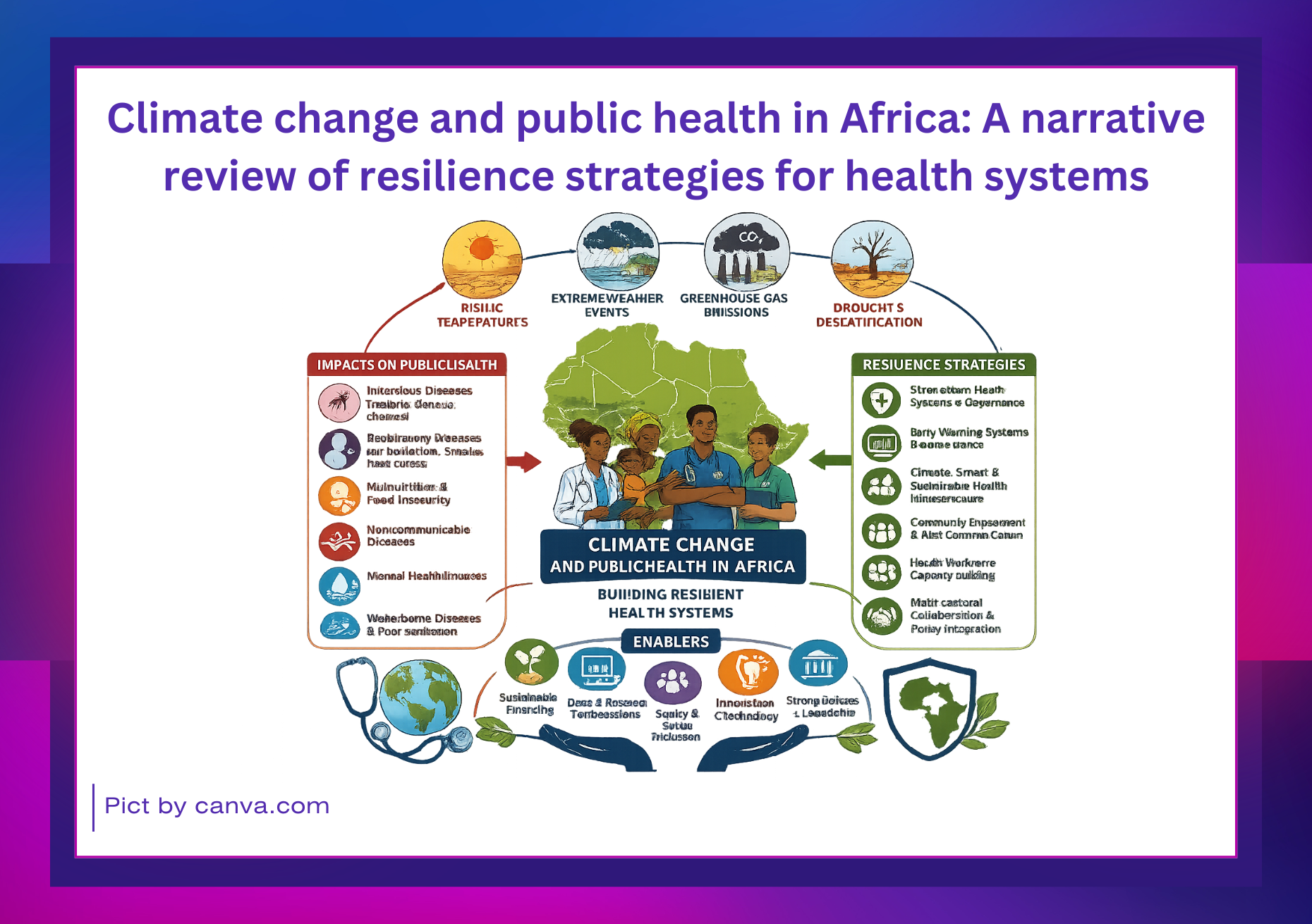
Climate change and public health in Africa: A narrative review of resilience strategies for health systems
Kabiru Gulma1, Sa’adatu M. Julde2, Isman Wais3, Emmanuel Morna4, Abubakar S. Danbatta5, Bakam Rodine6, Anastacia Katungo Maluki71. School of Global Health and Bioethics, Euclid University, Banjul , GM2. Faculty of Pharmaceutical Sciences, Bayero University, Kano , NG3. Euclid Caisse Nationale de Sécurité Sociale de Djibouti , DJ4. Doctoral Programme in Monitoring, Measurement and Evaluation, Euclid University, Bangui , CF5. Faculty of Pharmaceutical Sciences, Bayero University, Kano , NG6. Doctoral Programme in Global Energy Policy, Euclid University, Douala , CM7. Doctoral Programme in Epidemiology and Biostatistics, Euclid University, Banjul , GM2026-05-24|page 25-40AbstractBackground: Climate change poses an escalating threat to public health in Africa, a continent responsible for less than 10% of global greenhouse gas emissions yet disproportionately bearing the burden of its consequences. Existing health systems remain fragile, under-resourced, and ill-equipped to absorb climate-related shocks.
Objectives: To synthesize evidence on the health impacts of climate change in Africa and identify strategies for building climate-resilient health systems.
Methods: This study is a narrative literature review. A comprehensive search of peer-reviewed databases and gray literature was conducted. Sources were screened against predefined inclusion criteria and synthesized thematically across six domains: climate science, contextual vulnerabilities, health systems strengthening, governance, community engagement, and financing. A total of 22 studies and reports were included and analyzed using thematic synthesis following Thomas and Harden’s (2008) three-step approach.
Results: Climate change intensifies the burden of infectious and non-communicable diseases, disrupts health infrastructure, and deepens health inequities across African regions. Resilience-building requires strengthened governance, sustained domestic and international financing, multisectoral partnerships, community engagement, and climate-adaptive health information systems.
Conclusions: Concerted, context-sensitive action that integrates climate adaptation into health policy frameworks is urgently needed to protect the health and well-being of African populations from the accelerating impacts of climate change. Practical implications include strengthening health system governance, mobilizing climate finance, investing in climate-adaptive surveillance systems, and fostering community engagement and multisectoral collaboration to build durable climate resilience across African health systems.
APA Citation StyleGulma, K. , Julde, S. M. , Wais, I. , Morna, E. , Danbatta, A. S. , Rodine, B. , & Maluki, A. K. (2026). Climate change and public health in Africa: A narrative review of resilience strategies for health systems. Public Health and Occupational Safety Journal, 25-40. https://doi.org/10.56003/phosj.v2i1.719 -
Occupational safety and health hazards among artisanal and small-scale gold miners at Mazowe Jumbo Mine, Zimbabwe: A mixed-methods cross-sectional study
Bridget Nyamombe1, Vincent Itai Tanyanyiwa21. Zimbabwe Open University , ZW2. Zimbabwe Open University , ZW2025-11-28|page 151-162AbstractBackground: Artisanal and small-scale gold mining (ASGM) is associated with multiple occupational hazards that artisans are often unaware of.
Objectives: To identify the occupational hazards and risk factors among artisanal gold miners at Mazowe Jumbo mine, Zimbabwe.
Methods: The cross-sectional study employed Mixed-methods(Sep- Nov 2023). Purposive sampling of 34 miners from two sites (response rate was 100%). The interview was administered using questionnaires, structured interviews, field observations, and document review. Quantitative data were analyzed descriptively (frequencies and proportions), and qualitative data underwent thematic analysis.
Results: Heavy lifting was reported by 100% (34/34), manual handling by 91.2% (31/34), silica dust exposure by 91.2% (31/34), and contaminated water by 85.3% (29/34). Key risk factors included lack of PPE, financial pressure, and low OSH awareness. Field observations noted unsecured shafts, poor sanitation, and evidence of substance use on site.
Conclusions: ASG miners at Mazowe Jumbo Mine face multi-domain OSH hazards. We recommend targeted OSH training programmes, provision of PPE, improved sanitation, and monitoring/ formalization of ASGM activities.
APA Citation StyleNyamombe, B. , & Tanyanyiwa, V. I. (2025). Occupational safety and health hazards among artisanal and small-scale gold miners at Mazowe Jumbo Mine, Zimbabwe: A mixed-methods cross-sectional study. Public Health and Occupational Safety Journal, 151-162. https://doi.org/10.56003/phosj.v1i2.638

1 - 2 of 2 items