Search
Search Results
##search.searchResults.foundPlural##
-

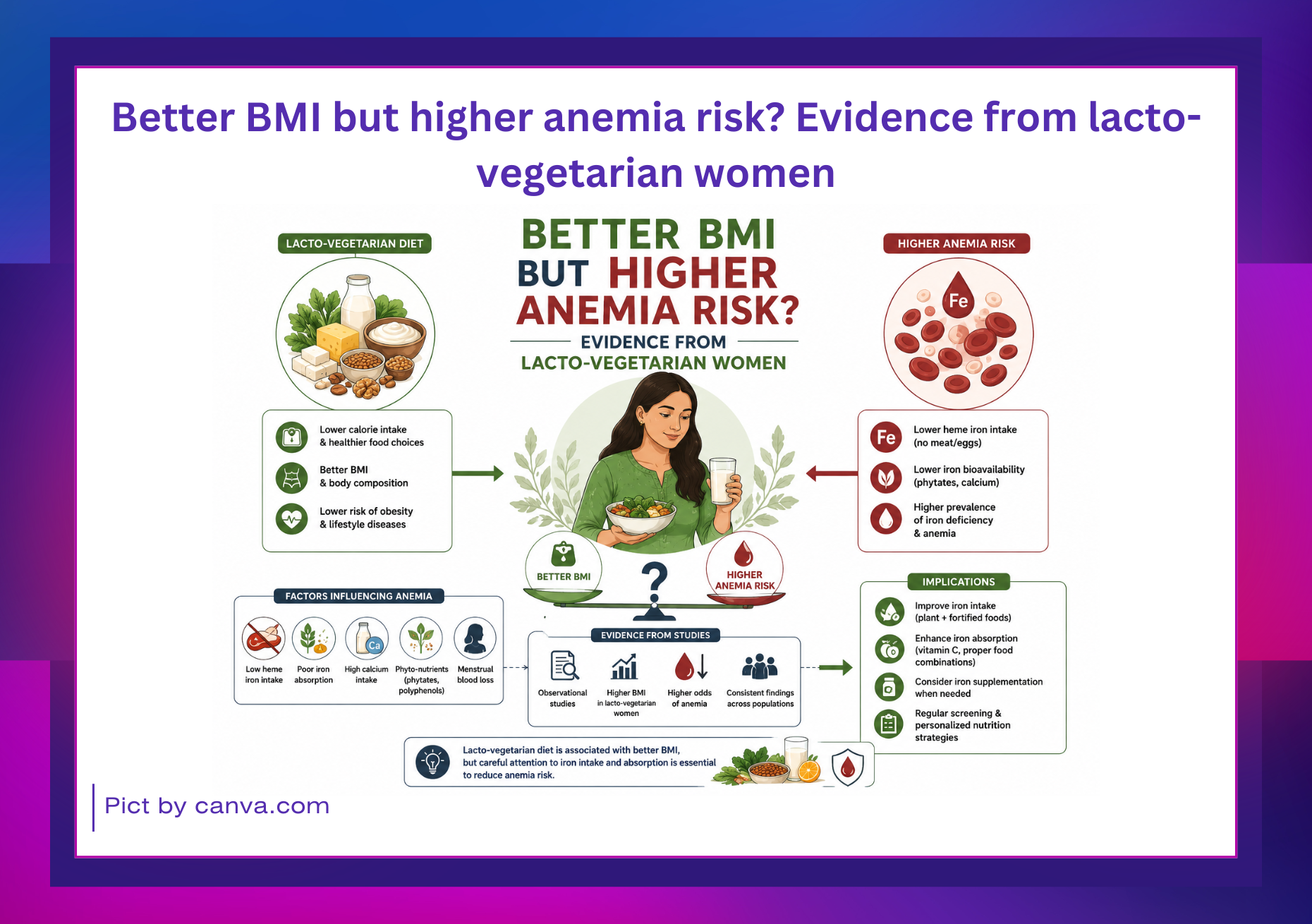
Better BMI but higher anemia risk? Evidence from lacto-vegetarian women
Hamid Nurrohman1, Ha Thi Thu Trang21. Department of Preventive and Restorative Dental Sciences, University of California , US2. Nursing Program, School of Medicine and Pharmacy, Vietnam National University, Hanoi , VN2026-05-24|page 14-24AbstractBackground: The increasing adoption of plant-based diets in the United States, particularly lacto-vegetarian patterns, has been driven by their perceived metabolic benefits. However, middle-aged women represent a nutritionally vulnerable group due to menopausal transitions and a high risk of anemia. In this context, the potential trade-off between improved body weight and micronutrient deficiencies remains insufficiently explored.
Objectives: This study examined the nutritional trade-offs between lacto-vegetarian and non-vegetarian diets, focusing on body mass index (BMI), anemia status, and lifestyle behaviors among middle-aged women in California, USA.
Methods: A cross-sectional study was conducted between June and September 2025 in California, USA, involving 40 women aged 40–65 years (20 lacto-vegetarians and 20 non-vegetarians), selected purposively. Socio-demographic characteristics and lifestyle behaviors were collected using a validated structured questionnaire. BMI, blood pressure, and hemoglobin levels were measured using standardized procedures. Data were analyzed using the Mann–Whitney U test and Spearman rank correlation, with results summarized using median and interquartile range (IQR) where appropriate. Statistical significance was set at p < 0.05.
Results: Lacto-vegetarian women showed a higher proportion of normal BMI compared to non-vegetarians (50% vs 30%, p=0.04). However, anemia prevalence was markedly higher among lacto-vegetarians (70% vs 10%, p=0.001). No significant differences were observed in physical activity, smoking, or blood pressure (p>0.05). These findings indicate a clear nutritional trade-off: improved weight status is associated with increased anemia risk.
Conclusions: Lacto-vegetarian diets were associated with more favorable BMI profiles but a significantly higher risk of anemia. These findings highlight the need for targeted nutritional strategies and public health interventions in the United States, particularly emphasizing iron and vitamin B12 adequacy among middle-aged women adopting plant-based diets.
APA Citation StyleNurrohman, H. , & Trang, H. T. T. (2026). Better BMI but higher anemia risk? Evidence from lacto-vegetarian women. Public Health and Occupational Safety Journal, 14-24. https://doi.org/10.56003/phosj.v2i1.714 -

Effectiveness of 3D poster in improving menstrual hygiene knowledge among adolescent girls: A quasi-experimental study
Rani Mustikawati1, Windi Chusniah Rachmawati2, Endang Sri Redjeki3, Nurnaningsih Herya Ulfah41. State University of Malang , ID2. State University of Malang , ID3. State University of Malang , ID4. State University of Malang , ID2025-04-23|page 40-52AbstractBackground: Personal hygiene during menstruation is important and must be applied during the menstrual cycle. Suppose personal hygiene during menstruation is not maintained correctly. In that case, adolescent girls have the potential to experience health problems such as vaginal discharge, irritation of the genital area, allergies, inflammation, and Urinary Tract Infection (UTI). As many as 75% of women in Indonesia have experienced vaginal discharge once, while 45% have experienced it more than 2 times.
Objectives: This study aimed to determine the effectiveness of 3D posters in increasing knowledge about personal hygiene during menstruation.
Methods: The research method used was Research and Development (R&D), which was conducted through a pre-experimental approach with one group pretest-posttest. Ninety-five adolescent girls in class VII of State Junior High School 13 Malang participated in the study obtained using a purposive sampling technique. The research instrument used a closed-type questionnaire with 10 items to measure knowledge.
Results: The 3D poster product obtained a percentage value of media feasibility of 95% for the media aspect and 92% for the material aspect, which means it is very feasible to use. After the intervention, it is known that there is an effect of providing health education using 3D posters on the knowledge of adolescent girls regarding personal hygiene during menstruation according to the p-value = 0.000 from the Wilcoxon test.
Conclusions: Personal hygiene education during menstruation should be done more often to improve the knowledge of adolescent girls. The findings support the use of 3D media in menstrual health promotion, especially in schools with limited resources.
APA Citation StyleMustikawati, R. , Rachmawati, W. C. , Redjeki, E. S. , & Ulfah, N. H. (2025). Effectiveness of 3D poster in improving menstrual hygiene knowledge among adolescent girls: A quasi-experimental study. Public Health and Occupational Safety Journal, 40-52. https://doi.org/10.56003/phosj.v1i1.531

1 - 2 of 2 items