Search
Search Results
##search.searchResults.foundPlural##
-

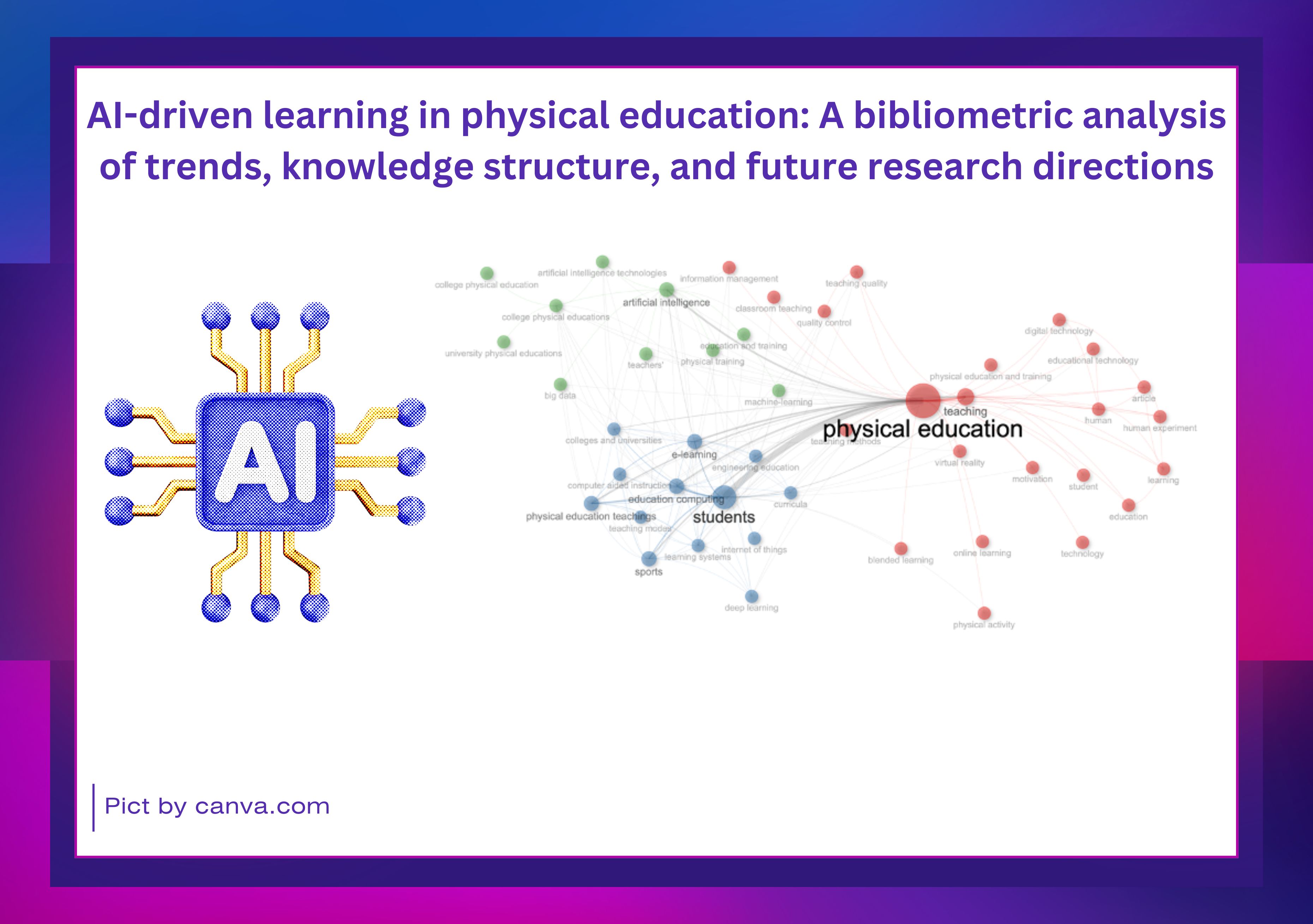
AI-driven learning in physical education: A bibliometric analysis of trends, knowledge structure, and future research directions
Amelia Larassary11. State Junior High School 1 Bunguran Tengah, Natuna Regency, Riau Islands , ID2026-04-06|page 102-118AbstractBackground: Although research on AI-driven learning in PE has expanded rapidly, existing studies remain fragmented across disciplines, journals, and methodological approaches, limiting a comprehensive understanding of the field's development and intellectual structure.
Objectives: This study aimed to systematically map the evolution, influential contributors, intellectual structure, dominant themes, and future research directions of AI-driven learning research in physical education from a bibliometric perspective.
Methods: A quantitative bibliometric analysis was conducted using data retrieved exclusively from the Scopus database. A total of 284 eligible documents published between 2020 and early 2026 were analyzed. Descriptive statistics were applied to examine publication trends, authorship, sources, institutions, and country contributions. Network and thematic analyses were performed using VOSviewer (version 1.6.20) and the Bibliometrix package in R to identify co-authorship patterns, keyword co-occurrence networks, and thematic clusters.
Results: The results indicate a sharp growth in AI-driven learning research in physical education after 2022, with publication output increasing more than fivefold from 2020 to 2025. China emerged as the leading contributing country, accounting for nearly half of the total publications, while institutional productivity was concentrated in several Russian universities. Keyword co-occurrence analysis revealed five major thematic clusters shaping the intellectual structure of the field, integrating pedagogical frameworks, computational intelligence, institutional contexts, and physical training models. Dominant research themes centered on pedagogical design, student engagement, adaptive learning systems, and the integration of educational technology. Emerging themes included virtual reality, advanced machine learning techniques, and immersive learning environments.
Conclusions: This study provides a structured and quantitative overview of AI-driven learning research in physical education, highlighting its interdisciplinary nature and rapid expansion.APA Citation StyleLarassary, A. (2026). AI-driven learning in physical education: A bibliometric analysis of trends, knowledge structure, and future research directions. Journal of Artificial Intelligence in Education & Learning Innovation, 102-118. https://doi.org/10.56003/jaieli.v1i2.673 -
Sports technology acceptance as a predictor of academic commitment among undergraduate physical education students in China
Yingxue Su11. Inner Normal Mongolia University , CN2026-09-08|page 72-84AbstractBackground: Sports analytics and digital learning technologies are increasingly incorporated into physical education and sport-related higher education. However, evidence regarding the relationship between students’ acceptance of sports-related technologies and their academic commitment remains limited, particularly among undergraduate Physical Education students in China.
Objectives: This study aimed to examine the association between Sports Technology Acceptance (STA) and Academic Commitment and to determine whether STA statistically predicts Academic Commitment within a cross-sectional structural model among undergraduate Physical Education students.
Methods: This quantitative study employed a cross-sectional correlational design involving 150 undergraduate students enrolled in the Bachelor of Physical Education program at Inner Mongolia Normal University, China, who were recruited using convenience sampling. Data were collected using the Higher Education Student Commitment Scale and an adapted Technology Use Tendency Scale in the Classroom to assess STA. Descriptive statistics, Pearson correlation analysis, and structural equation modeling (SEM) were performed using IBM SPSS Statistics 26 and IBM SPSS Amos 24.
Results: The mean Academic Commitment score was 3.68 (SD = 0.71), while the mean STA score was 4.01 (SD = 0.65). STA was moderately and positively correlated with Academic Commitment (r = .47, p < .01). The structural model showed a significant positive path from STA to Academic Commitment (β = .49, t = 6.81, p < .001), accounting for 24% of the variance in Academic Commitment (R² = .24). The reported model-fit indices indicated acceptable fit (CFI = .956, RMSEA = .057).
Conclusions: Sports Technology Acceptance was moderately and positively associated with Academic Commitment among undergraduate Physical Education students at one university in China. Within the cross-sectional structural model, STA accounted for 24% of the variance in Academic Commitment; therefore, the observed statistical prediction should not be interpreted as evidence of temporal or causal effects.
APA Citation StyleSu, Y. (2026). Sports technology acceptance as a predictor of academic commitment among undergraduate physical education students in China. Journal of Artificial Intelligence in Education & Learning Innovation, 72-84. https://doi.org/10.56003/jaieli.v2i1.748 -

Effects of Chat-GPT (Generative Pre-Trained Transformer) in the Writing Skills of Undergraduate Students: A Scoping Review
Hamdoni Pangandaman1, Mirella Veras2, Samiel Macalaba3, Abolbashar Mangontawar4, Sittie Ainah Mai-Alauya5, Saliha Janine Gubaten6, Maslainie Aliola7, Norhanie Lininding8, Paida Abdulmalik9, Sittie Hainieh Taratingan101. Mindanao State University, Marawi City , PH2. Department of Physical Therapy, College of Rehabilitation Sciences, Rady Faculty of Health Sciences, University of Manitoba , CA3. Mindanao State University, Main Campus, Marawi City , PH4. Mindanao State University, Marawi City , PH5. Mindanao State University, Marawi City , PH6. Mindanao State University, Marawi City , PH7. Mindanao State University, Marawi City , PH8. Mindanao State University, Marawi City , PH9. Mindanao State University, Marawi City , PH10. Mindanao State University, Marawi City , PH2026-07-02|page 14-31AbstractBackground: The integration of artificial intelligence (AI) in academic settings has gained increasing attention, particularly in improving students' writing skills. ChatGPT, a generative AI tool, has been explored as a potential aid in academic writing, providing instant feedback and enhancing students' ability to structure, revise, and refine their written work. However, there remains a need to systematically assess its effectiveness in undergraduate education
Objectives: This study aimed to evaluate the impact of ChatGPT on the writing skills of undergraduate students through a scoping review, analyzing its effectiveness in enhancing grammar, vocabulary, coherence, and overall writing proficiency.
Methods: A scoping review methodology was employed to identify relevant studies published between 2020 and 2024. A comprehensive search was conducted across seven academic databases: ScienceDirect, Scopus, ProQuest, EBSCOhost, Sage Journals, Taylor & Francis, and PubMed, using Boolean operators and predefined inclusion criteria. The studies were appraised using the Joanna Briggs Institute (JBI) Critical Appraisal Tool for quasi-experimental research and the ROBVIS checklist for randomized controlled trials (RCTs) to assess the risk of bias. The synthesis was conducted following the Synthesis Without Meta-Analysis (SWiM) guidelines, with PRISMA used for article selection and appraisal.
Results: A total of nine studies were included in the review, conducted in Saudi Arabia, China, Ecuador, Indonesia, Iran, Pakistan, and India, involving a total of 839 undergraduate students. The duration of interventions varied, with most lasting between 10 to 16 weeks. The overall risk of bias was low, indicating strong methodological reliability. The findings revealed that ChatGPT significantly improved students' writing proficiency, particularly in areas of grammatical accuracy, vocabulary use, organization, and argument structure. Also, students using ChatGPT exhibited increased engagement and motivation in writing tasks compared to traditional methods. However, some studies cautioned against over-reliance on AI-generated text and raised concerns about academic integrity and originality.
Conclusion: ChatGPT demonstrates promising potential as an AI-assisted writing tool, offering immediate feedback, structured learning support, and improved writing outcomes for undergraduate students. While its effectiveness is evident, further research is needed to establish best practices for integrating AI into academic writing instruction, ensuring that students develop critical thinking and independent writing skills while leveraging AI’s benefits responsibly.
APA Citation StylePangandaman, H. , Veras, M. , Macalaba, S. , Mangontawar, A. , Mai-Alauya, S. A. , Gubaten, S. J. , Aliola, M. , Lininding, N. , Abdulmalik, P. , & Taratingan, S. H. (2026). Effects of Chat-GPT (Generative Pre-Trained Transformer) in the Writing Skills of Undergraduate Students: A Scoping Review. Journal of Artificial Intelligence in Education & Learning Innovation, 14-31. https://doi.org/10.56003/jaieli.v2i1.712

1 - 3 of 3 items