Search
Search Results
##search.searchResults.foundPlural##
-

Sports technology acceptance as a predictor of academic commitment among undergraduate physical education students in China
Yingxue Su11. Inner Normal Mongolia University , CN2026-09-08|page 72-84AbstractBackground: Sports analytics and digital learning technologies are increasingly incorporated into physical education and sport-related higher education. However, evidence regarding the relationship between students’ acceptance of sports-related technologies and their academic commitment remains limited, particularly among undergraduate Physical Education students in China.
Objectives: This study aimed to examine the association between Sports Technology Acceptance (STA) and Academic Commitment and to determine whether STA statistically predicts Academic Commitment within a cross-sectional structural model among undergraduate Physical Education students.
Methods: This quantitative study employed a cross-sectional correlational design involving 150 undergraduate students enrolled in the Bachelor of Physical Education program at Inner Mongolia Normal University, China, who were recruited using convenience sampling. Data were collected using the Higher Education Student Commitment Scale and an adapted Technology Use Tendency Scale in the Classroom to assess STA. Descriptive statistics, Pearson correlation analysis, and structural equation modeling (SEM) were performed using IBM SPSS Statistics 26 and IBM SPSS Amos 24.
Results: The mean Academic Commitment score was 3.68 (SD = 0.71), while the mean STA score was 4.01 (SD = 0.65). STA was moderately and positively correlated with Academic Commitment (r = .47, p < .01). The structural model showed a significant positive path from STA to Academic Commitment (β = .49, t = 6.81, p < .001), accounting for 24% of the variance in Academic Commitment (R² = .24). The reported model-fit indices indicated acceptable fit (CFI = .956, RMSEA = .057).
Conclusions: Sports Technology Acceptance was moderately and positively associated with Academic Commitment among undergraduate Physical Education students at one university in China. Within the cross-sectional structural model, STA accounted for 24% of the variance in Academic Commitment; therefore, the observed statistical prediction should not be interpreted as evidence of temporal or causal effects.
APA Citation StyleSu, Y. (2026). Sports technology acceptance as a predictor of academic commitment among undergraduate physical education students in China. Journal of Artificial Intelligence in Education & Learning Innovation, 72-84. https://doi.org/10.56003/jaieli.v2i1.748 -
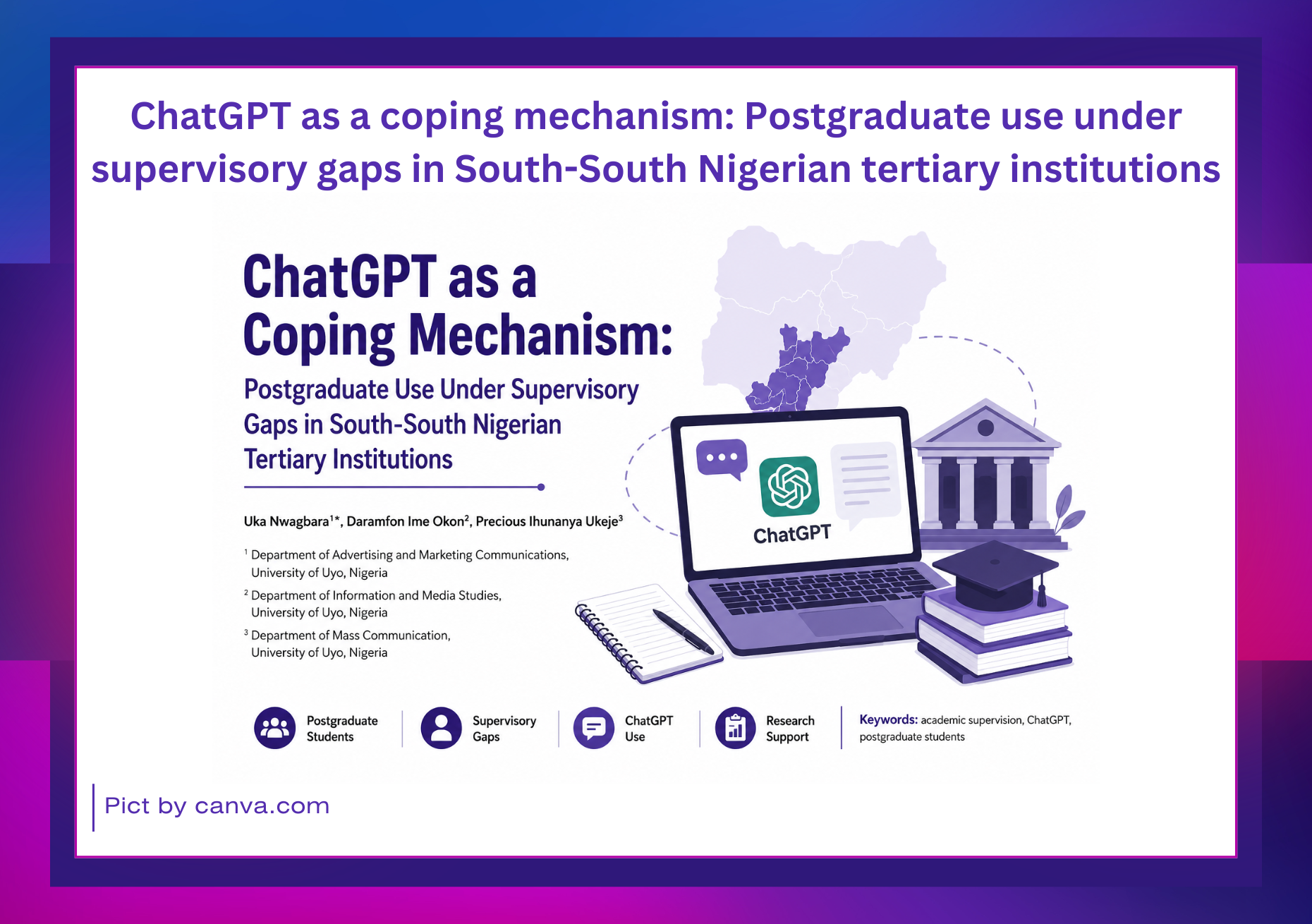
ChatGPT as a coping mechanism: Postgraduate use under supervisory gaps in South-South Nigerian tertiary institutions
Uka Nwagbara1, Daramfon Okon2, Precious Ukeje31. University of Uyo , NG2. University of Uyo , NG3. University of Uyo , NG2026-07-02|page 1-13AbstractBackground: Generative AI tools like ChatGPT are common in higher education, especially where students lack timely academic support. In many South-South Nigerian universities, gaps in postgraduate supervision may influence how students use such tools.
Objectives: This study examines how postgraduate students become aware of ChatGPT, how much they use it, and why they rely on it when supervision is limited.
Methods: A qualitative exploratory design was used. Twenty-one postgraduate students were purposively selected from universities in South-South Nigeria. Data were collected through online semi-structured interviews using a validated guide. Inductive thematic analysis, using Braun & Clarke’s framework, was applied to identify patterns in the data.
Results: Findings show that awareness of ChatGPT is mostly informal, driven by peers, social media, and personal trial and error. Many students use ChatGPT frequently, especially during proposal writing, data analysis, and thesis development. Its use is strongly linked to delays or gaps in supervision.
Conclusions: ChatGPT is widely used as a support tool and coping strategy, rather than merely a convenience. Its role reflects gaps in supervision and the need for clearer institutional guidance and training.
APA Citation StyleNwagbara, U. , Okon, D. , & Ukeje, P. (2026). ChatGPT as a coping mechanism: Postgraduate use under supervisory gaps in South-South Nigerian tertiary institutions. Journal of Artificial Intelligence in Education & Learning Innovation, 1-13. https://doi.org/10.56003/jaieli.v2i1.711 -

Development of KAREBU (cultural diversity card game) to enhance curiosity in fourth-grade elementary students
Etyka Rina Mahanani1, Erif Ahdhianto2, Yohannes Kurniawan Barus31. State University of Malang , ID2. State University of Malang , ID3. State University of Malang , ID2025-10-08|page 15-31AbstractBackground: Learning media is one of the important components of education.
Objectives: The purpose of this research and development was to develop the KAREBU (Cultural Diversity Card) learning media to strengthen the curiosity character of fourth-grade students in the subject of Natural and Social Sciences with local cultural diversity material that is valid, practical, and effective.
Methods: Using the ADDIE model (Analysis, Design, Development, Implementation, Evaluation), this study developed KAREBU cards integrated with augmented reality (AR) technology. This research instrument is in the form of interviews, observations, and questionnaires given to instrument experts, material experts, media experts, and users, including teachers and students. Data collection stages were carried out through observation, interviews, needs questionnaires, validation questionnaires, practicality questionnaires, and curiosity questionnaires before and after using the media.
Results: The results showed that the KAREBU learning media met the valid, practical, and effective criteria. KAREBU media received a validity score from material experts of 3.72 with a valid category, a score from media experts of 4.91 with a very valid category, and a score from users of 4.73 with a very valid category. The KAREBU learning media received a practicality score from teachers of 4.49 with a convenient category and a practicality score from students of 98.5% with a convenient category. The level of media effectiveness in strengthening students' curiosity was obtained from the results of the questionnaire before and after using the media, which was calculated using the N-Gain Score test with a value of 0.76 and high effectiveness criteria.
Conclusions: Therefore, it was concluded that the KAREBU learning media effectively strengthens students' curiosity. Further studies could explore the long-term impacts of KAREBU on cross-cultural empathy.
APA Citation StyleMahanani, E. R. , Ahdhianto, E. , & Barus, Y. K. (2025). Development of KAREBU (cultural diversity card game) to enhance curiosity in fourth-grade elementary students. Journal of Artificial Intelligence in Education & Learning Innovation, 15-31. https://doi.org/10.56003/jaieli.v1i1.526

1 - 3 of 3 items