Search
Search Results
##search.searchResults.foundPlural##
-

Academic goals and learning strategies of pre-service teachers during emergency online learning in the Philippines
Swen Joshryll Acebes1, Jaizel Malitante2, Nikki Tuble3, Rowena Bongolto41. Mindanao State University - General Santos , PH2. Mindanao State University - General Santos , PH3. Mindanao State University - General Santos , PH4. Mindanao State University - General Santos , PH2025-10-08|page 32-49AbstractBackground: The COVID-19 pandemic has lasted an extended period, during which many students have reported being adversely affected by the escalating global crisis.
Objectives: This study examined the academic goals, learning barriers, facilitative strategies, and ways forward of pre-service teachers during emergency online learning.
Methods: This qualitative case study employed content analysis to examine data gathered through focus group discussions. To explore the implications of survey findings and gain deeper insights into students' perspectives on remote learning, the researchers conducted Focus Group Discussions (FGDs) with twelve purposively selected pre-service teachers via Google Meet. The discussion transcripts were analyzed to construct a compelling narrative, supported by literature and prior research, to explain emerging themes.
Results: Among the twelve participants, ten reported experiencing psychosocial stress, eight cited recurring technical issues, and seven mentioned financial constraints as significant learning barriers. Despite these challenges, the participants remained motivated to complete their coursework, viewing academic achievement as a stepping stone toward improving their socio-economic conditions. They employed various strategies, including scheduling, note-taking, goal-setting, optimistic thinking, parental scaffolding, and systematic planning, to adapt to online learning. To ensure credibility, the researchers used member checking, peer debriefing, and FGD and survey data triangulation.
Conclusions: These findings highlight the resilience and adaptability of pre-service teachers in navigating the challenges of emergency online learning, underscoring the need for supportive institutional policies and resources. Future research may consider comparing student experiences in public and private institutions or examining the long-term impact of emergency remote learning on teaching efficacy. Pedagogical and academic implications are further discussed.
APA Citation StyleAcebes, S. J. , Malitante, J. , Tuble, N. , & Bongolto, R. (2025). Academic goals and learning strategies of pre-service teachers during emergency online learning in the Philippines. Journal of Artificial Intelligence in Education & Learning Innovation, 32-49. https://doi.org/10.56003/jaieli.v1i1.569 -
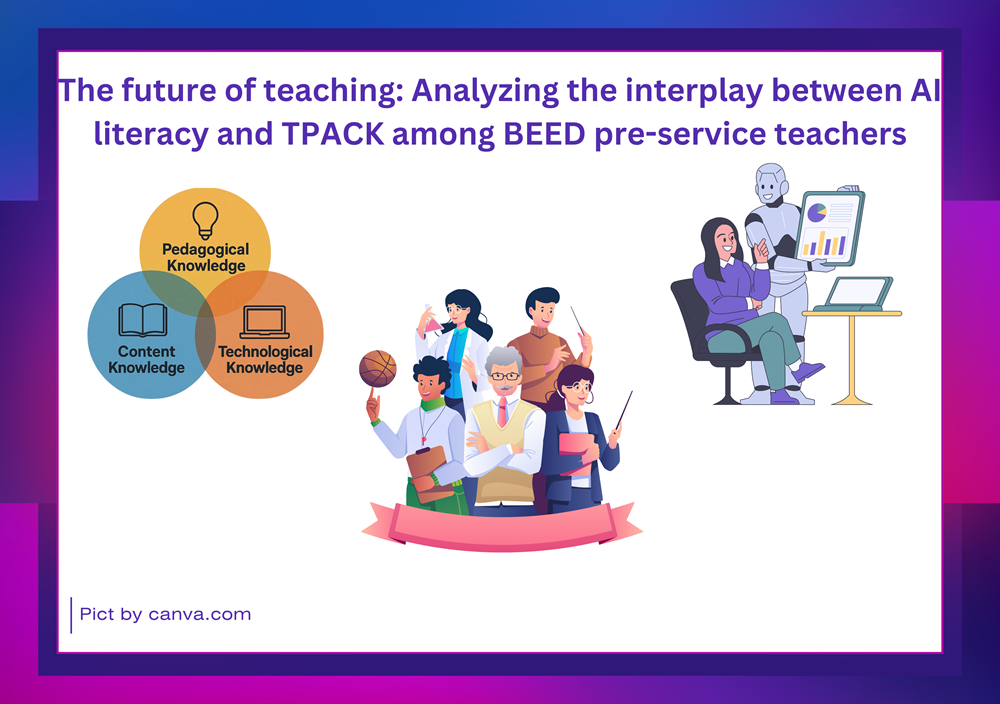
The future of teaching: Analyzing the interplay between AI literacy and TPACK among BEED pre-service teachers
Karl Alvin Aglibot1, Chelsea Lorraine Rito2, Larence Villalon3, Nelvin Gampal 41. Mindanao State University - General Santos , PH2. Mindanao State University – General Santos , PH3. Mindanao State University – General Santos , PH4. Mindanao State University – General Santos , PH2025-10-08|page 50-65AbstractBackground: As artificial intelligence (AI) continues transforming the educational landscape, pre-service teachers must develop theoretical understanding and practical skills in AI integration.
Objectives: This study explored the relationship between AI literacy and TPACK among 139 BEED pre-service teachers.
Methods: Using descriptive statistics, Spearman's correlation, and multiple linear regression analysis, the study investigated how components of AI literacy relate to TPACK.
Results: Results revealed that the pre-service teachers demonstrated high levels of AI literacy, particularly in ethical awareness and intrinsic motivation. Pre-service teachers expressed strong interest in AI's educational potential and a commitment to its responsible use. While their foundational AI knowledge was high, many reported moderate self-efficacy and lacked confidence in executing AI-related tasks. Gaps were also noted in applying AI concepts to real-world teaching scenarios and designing AI-driven solutions. Furthermore, the results showed high TPACK proficiency, with strength in pedagogical and technological knowledge, though weaknesses were observed in content areas like mathematics and technical troubleshooting. A moderate positive correlation (Spearman's ρ = 0.48, p < 0.05) between AI literacy and TPACK indicates a meaningful association. Regression analysis revealed that AI literacy components explained 25.5% of the variance in TPACK. Cognitive learning emerged as the only significant predictor.
Conclusions: The findings underscore the need for teacher education programs to provide hands-on, cognitive-focused AI training. Hence, enhancing pre-service teachers' cognitive and practical skills is essential to thoroughly preparing them for AI-enhanced teaching environments' demands.
APA Citation StyleAglibot, K. A. , Rito, C. L. , Villalon, L. , & Gampal , N. (2025). The future of teaching: Analyzing the interplay between AI literacy and TPACK among BEED pre-service teachers. Journal of Artificial Intelligence in Education & Learning Innovation, 50-65. https://doi.org/10.56003/jaieli.v1i1.570 -
Navigating the infodemic through social media: A qualitative case study of Filipino university students’ learning experiences during the COVID-19 polycrisis
Janel Talaman1, Mc Denver Necosia2, Larence Villalon3, Edrian Mark Tomines41. Mindanao State University – General Santos , PH2. Mindanao State University – General Santos , PH3. Mindanao State University – General Santos , PH4. Mindanao State University - General Santos , PH2026-04-06|page 119-134AbstractBackground: The COVID-19 pandemic has triggered a complex crisis in higher education that has not only disrupted formal learning but also given rise to an infodemic through the rapid spread of misinformation on digital platforms, making social media both a source of learning and a source of epistemic risk for students.
Objectives: This study aims to explore how Filipino university students navigated learning experiences through social media during the COVID-19 polycrisis, focusing on preferred platforms, perceived educational relevance, and strategies for evaluating information credibility amid an infodemic.
Methods: A qualitative case study design was employed. Six Filipino university students enrolled in a Bachelor of Elementary Education program participated in this study through purposive sampling. Data were collected via online semi-structured interviews, group chat discussions, document analysis of shared social media content, and follow-up interviews. Thematic analysis was conducted following Braun and Clarke's framework to identify recurring patterns across data sources.
Results: Findings reveal that social media—particularly Facebook—served as a supplementary learning space, enabling students to access real-time information, engage with societal issues, and sustain their learning during the suspension of formal instruction. Students demonstrated active information-seeking behaviors, including cross-checking sources and exercising caution in sharing content. However, persistent exposure to misinformation highlighted their vulnerability within infodemic environments, especially in the absence of structured institutional guidance.
Conclusions: Social media can support authentic and socially relevant learning during educational disruption, but its pedagogical value depends on students' critical and digital literacy capacities.APA Citation StyleTalaman, J. , Necosia, M. D. , Villalon, L. , & Tomines, E. M. (2026). Navigating the infodemic through social media: A qualitative case study of Filipino university students’ learning experiences during the COVID-19 polycrisis. Journal of Artificial Intelligence in Education & Learning Innovation, 119-134. https://doi.org/10.56003/jaieli.v1i2.571 -
Assessing academic integrity patterns among pre-service teachers using AI-based plagiarism detection
Irish Arroyo1, Sittie Nor Aisha Rusiana2, Daniere Maryje Tabada3, Kim Silva4, Carla Marie Rubio5, Esmeraldo Sarad6, Cathy Mae Toquero71. College of Education, Mindanao State University-General Santos , PH2. College of Education, Mindanao State University-General Santos , PH3. College of Education, Mindanao State University-General Santos , PH4. College of Education, Mindanao State University-General Santos , PH5. College of Education, Mindanao State University-General Santos , PH6. College of Education, Mindanao State University-General Santos , PH7. Faculty of Psychology, Malang State University , ID2026-04-06|page 148-163AbstractBackground: The advent of artificial intelligence has intensified concerns about academic dishonesty among students, particularly in written outputs. Plagiarism, a common form of misconduct, involves using others’ ideas without proper attribution.
Objectives: This study aimed to determine the degree and patterns of academic integrity in the pre-service teachers’ book reviews.
Methods: Employing a descriptive research design through document analysis, the study used purposive sampling to collect 40 book reviews, applying set inclusion and exclusion criteria. An AI-based plagiarism detection tool, Grammarly, was used to identify instances of plagiarism and assess the level of academic integrity reflected in the outputs. Descriptive statistical methods were applied to examine plagiarism levels across different sections of the book reviews.
Results: Results showed that the majority of pre-service teachers demonstrated a very high level of academic integrity in their book reviews, scoring 97% or interpreted as students committing 3% plagiarism. Furthermore, sectional analysis showed that the introduction and conclusion exhibited higher integrity, while the body contained the most instances of plagiarism. This suggests that students struggled more with sections requiring critical thinking, original insights, and proper citation. Most plagiarism cases were linked to failure to cite sources and unintentional misuse of references.
Conclusions: Teacher Education Institutions integrate AI-supported evaluation tools and plagiarism detection systems into instruction and assessment. Embedding academic integrity modules and discussions on AI ethics is also encouraged. Future research should involve larger and more diverse samples and utilize multiple AI detection tools to enhance the reliability and validity of findings through cross-verification.
APA Citation StyleArroyo, I. , Rusiana, S. N. A. , Tabada, D. M. , Silva, K. , Rubio, C. M. , Sarad, E. , & Toquero, C. M. (2026). Assessing academic integrity patterns among pre-service teachers using AI-based plagiarism detection. Journal of Artificial Intelligence in Education & Learning Innovation, 148-163. https://doi.org/10.56003/jaieli.v1i2.685

1 - 4 of 4 items