Search
Search Results
##search.searchResults.foundPlural##
-

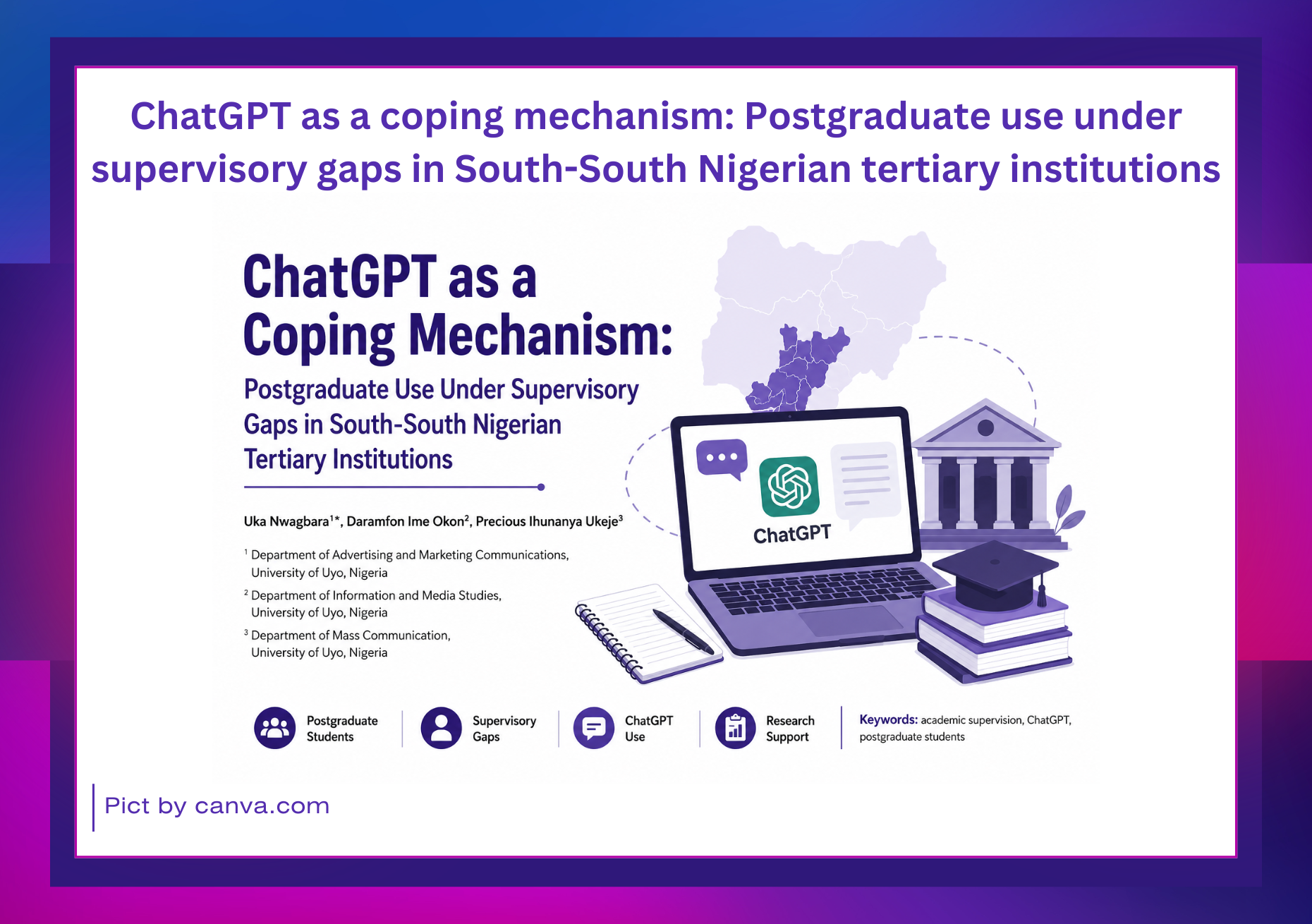
ChatGPT as a coping mechanism: Postgraduate use under supervisory gaps in South-South Nigerian tertiary institutions
Uka Nwagbara1, Daramfon Okon2, Precious Ukeje31. University of Uyo , NG2. University of Uyo , NG3. University of Uyo , NG2026-07-02|page 1-13AbstractBackground: Generative AI tools like ChatGPT are common in higher education, especially where students lack timely academic support. In many South-South Nigerian universities, gaps in postgraduate supervision may influence how students use such tools.
Objectives: This study examines how postgraduate students become aware of ChatGPT, how much they use it, and why they rely on it when supervision is limited.
Methods: A qualitative exploratory design was used. Twenty-one postgraduate students were purposively selected from universities in South-South Nigeria. Data were collected through online semi-structured interviews using a validated guide. Inductive thematic analysis, using Braun & Clarke’s framework, was applied to identify patterns in the data.
Results: Findings show that awareness of ChatGPT is mostly informal, driven by peers, social media, and personal trial and error. Many students use ChatGPT frequently, especially during proposal writing, data analysis, and thesis development. Its use is strongly linked to delays or gaps in supervision.
Conclusions: ChatGPT is widely used as a support tool and coping strategy, rather than merely a convenience. Its role reflects gaps in supervision and the need for clearer institutional guidance and training.
APA Citation StyleNwagbara, U. , Okon, D. , & Ukeje, P. (2026). ChatGPT as a coping mechanism: Postgraduate use under supervisory gaps in South-South Nigerian tertiary institutions. Journal of Artificial Intelligence in Education & Learning Innovation, 1-13. https://doi.org/10.56003/jaieli.v2i1.711 -
Academic goals and learning strategies of pre-service teachers during emergency online learning in the Philippines
Swen Joshryll Acebes1, Jaizel Malitante2, Nikki Tuble3, Rowena Bongolto41. Mindanao State University - General Santos , PH2. Mindanao State University - General Santos , PH3. Mindanao State University - General Santos , PH4. Mindanao State University - General Santos , PH2025-10-08|page 32-49AbstractBackground: The COVID-19 pandemic has lasted an extended period, during which many students have reported being adversely affected by the escalating global crisis.
Objectives: This study examined the academic goals, learning barriers, facilitative strategies, and ways forward of pre-service teachers during emergency online learning.
Methods: This qualitative case study employed content analysis to examine data gathered through focus group discussions. To explore the implications of survey findings and gain deeper insights into students' perspectives on remote learning, the researchers conducted Focus Group Discussions (FGDs) with twelve purposively selected pre-service teachers via Google Meet. The discussion transcripts were analyzed to construct a compelling narrative, supported by literature and prior research, to explain emerging themes.
Results: Among the twelve participants, ten reported experiencing psychosocial stress, eight cited recurring technical issues, and seven mentioned financial constraints as significant learning barriers. Despite these challenges, the participants remained motivated to complete their coursework, viewing academic achievement as a stepping stone toward improving their socio-economic conditions. They employed various strategies, including scheduling, note-taking, goal-setting, optimistic thinking, parental scaffolding, and systematic planning, to adapt to online learning. To ensure credibility, the researchers used member checking, peer debriefing, and FGD and survey data triangulation.
Conclusions: These findings highlight the resilience and adaptability of pre-service teachers in navigating the challenges of emergency online learning, underscoring the need for supportive institutional policies and resources. Future research may consider comparing student experiences in public and private institutions or examining the long-term impact of emergency remote learning on teaching efficacy. Pedagogical and academic implications are further discussed.
APA Citation StyleAcebes, S. J. , Malitante, J. , Tuble, N. , & Bongolto, R. (2025). Academic goals and learning strategies of pre-service teachers during emergency online learning in the Philippines. Journal of Artificial Intelligence in Education & Learning Innovation, 32-49. https://doi.org/10.56003/jaieli.v1i1.569 -
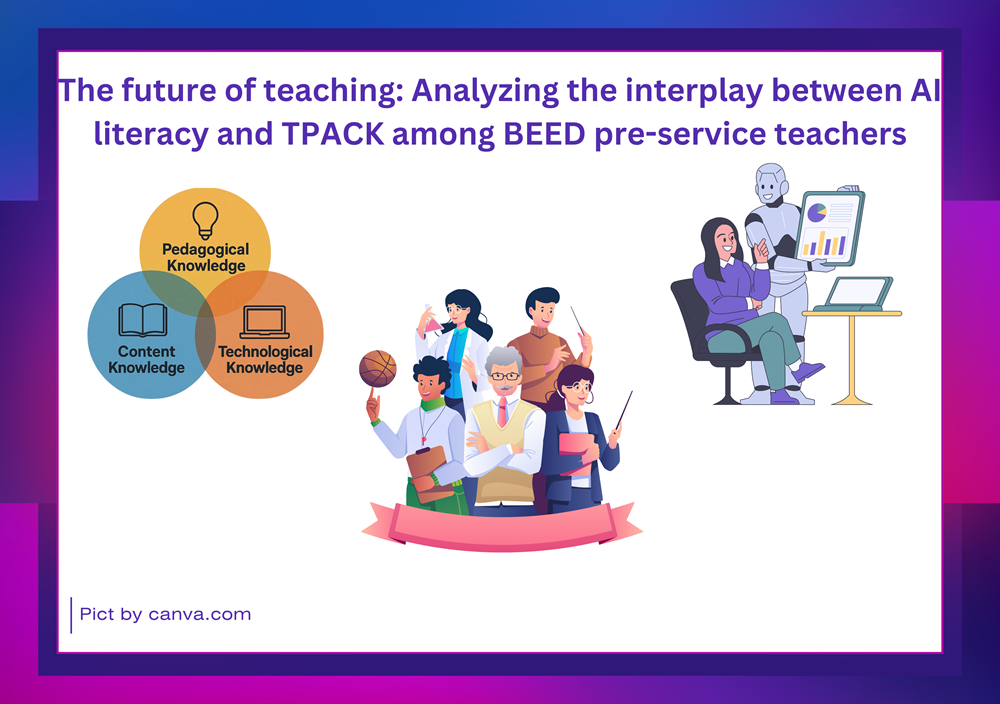
The future of teaching: Analyzing the interplay between AI literacy and TPACK among BEED pre-service teachers
Karl Alvin Aglibot1, Chelsea Lorraine Rito2, Larence Villalon3, Nelvin Gampal 41. Mindanao State University - General Santos , PH2. Mindanao State University – General Santos , PH3. Mindanao State University – General Santos , PH4. Mindanao State University – General Santos , PH2025-10-08|page 50-65AbstractBackground: As artificial intelligence (AI) continues transforming the educational landscape, pre-service teachers must develop theoretical understanding and practical skills in AI integration.
Objectives: This study explored the relationship between AI literacy and TPACK among 139 BEED pre-service teachers.
Methods: Using descriptive statistics, Spearman's correlation, and multiple linear regression analysis, the study investigated how components of AI literacy relate to TPACK.
Results: Results revealed that the pre-service teachers demonstrated high levels of AI literacy, particularly in ethical awareness and intrinsic motivation. Pre-service teachers expressed strong interest in AI's educational potential and a commitment to its responsible use. While their foundational AI knowledge was high, many reported moderate self-efficacy and lacked confidence in executing AI-related tasks. Gaps were also noted in applying AI concepts to real-world teaching scenarios and designing AI-driven solutions. Furthermore, the results showed high TPACK proficiency, with strength in pedagogical and technological knowledge, though weaknesses were observed in content areas like mathematics and technical troubleshooting. A moderate positive correlation (Spearman's ρ = 0.48, p < 0.05) between AI literacy and TPACK indicates a meaningful association. Regression analysis revealed that AI literacy components explained 25.5% of the variance in TPACK. Cognitive learning emerged as the only significant predictor.
Conclusions: The findings underscore the need for teacher education programs to provide hands-on, cognitive-focused AI training. Hence, enhancing pre-service teachers' cognitive and practical skills is essential to thoroughly preparing them for AI-enhanced teaching environments' demands.
APA Citation StyleAglibot, K. A. , Rito, C. L. , Villalon, L. , & Gampal , N. (2025). The future of teaching: Analyzing the interplay between AI literacy and TPACK among BEED pre-service teachers. Journal of Artificial Intelligence in Education & Learning Innovation, 50-65. https://doi.org/10.56003/jaieli.v1i1.570 -
Factors influencing teachers’ attrition in public basic schools in Techiman Municipality, Ghana: An embedded mixed methods study
Joseph Kyeremeh1, Dickson Adom2, Michael Ato Essuman3, Lim Seon Pek41. Kwame Nkrumah University of Science and Technology , GH2. Kwame Nkrumah University of Science and Technology , GH3. Kwame Nkrumah University of Science and Technology , GH4. INTI International University , MY2025-10-08|page 66-88AbstractBackground: The high teacher attrition rate in public primary schools in Techiman, Ghana, has become a serious problem that directly impacts the quality of education and the achievement of national education development goals.
Objectives: The study investigated factors that influence teachers' attrition in the Techiman Municipality.
Methods: One hundred ninety-seven teachers were sampled for the study using convenience and simple random sampling techniques. This study utilized the embedded mixed methods design with descriptive survey and phenomenology as research methods to collect quantitative and qualitative datasets using questionnaires and interviews as data collection tools. The qualitative data were analyzed using thematic analysis, while the quantitative data were analyzed using descriptive and inferential statistics using the SPSS software.
Results: It was found that teachers perceived salary as the major employer-related factor in teachers' attrition (relative importance index (RII) = 0.85). team member-related factors, such as the willingness of teachers to pursue another career outside education, were perceived as the primary factor of attrition (RII = 0.78). In contrast, an external-related factor, such as better opportunities in some other occupations, was ranked the first major contributor to teachers' attrition (RII = 0.88). The overall assessment of the factors of attrition based on the relative importance index revealed that Employer-related factors are the major contributor to teachers' attrition (RII = 0.70).
Conclusions: The study recommends that the Ghana government find innovative ways of increasing teachers' salaries as a source of motivation and offer them other incentive packages to aid in retaining them in the service.
APA Citation StyleKyeremeh, J. , Adom, D. , Essuman, M. A. , & Pek, L. S. (2025). Factors influencing teachers’ attrition in public basic schools in Techiman Municipality, Ghana: An embedded mixed methods study. Journal of Artificial Intelligence in Education & Learning Innovation, 66-88. https://doi.org/10.56003/jaieli.v1i1.578 -
Artificial intelligence-supported motor skill performance in physical education and sport: A systematic review and meta-analysis informed by motor learning theory
Yulingga Nanda Hanief1, Vera Septi Sistiasih2, Ferdinando Cereda3, Spyridon Plakias41. Department of Sport Education, Faculty of Sports Science, Universitas Negeri Semarang , ID2. Department of Sport Education, Faculty of Sports Science, Universitas Negeri Semarang , ID3. Department of Education, The Catholic University of the Sacred Heart in Milan, Italy , IT4. Department of Physical Education and Sport Science, University of Thessaly , GR2026-08-30|page 44-71AbstractBackground: Artificial Intelligence (AI) has increasingly been integrated into physical education (PE) to support motor learning through technologies such as computer vision, motion tracking, intelligent tutoring systems, virtual reality, and generative AI. However, evidence regarding its effectiveness remains fragmented across different intervention types and learning contexts.
Objectives: This study aimed to evaluate the effects of AI-supported interventions on motor skill performance in physical education and sport settings and to synthesize complementary learning-related outcomes.
Methods: A systematic review and meta-analysis were conducted in accordance with PRISMA 2020. Scopus, PubMed, and ProQuest were searched through 22 June 2026. Eligible studies evaluated AI-supported, adaptive, or intelligent interventions in physical education, sport, or motor skill-learning contexts and reported learner-level motor performance; complementary learning-related outcomes were synthesized narratively. Risk of bias was assessed using RoB 2 and ROBINS-I, and standardized mean differences (SMDs) with 95% confidence intervals (CIs) were synthesized using a random-effects model.
Results: Fifteen studies were included in the qualitative synthesis; six contributed to the meta-analysis and nine were synthesized narratively. The pooled estimate favored the designated AI-supported experimental conditions over their comparators (SMD = 3.15, 95% CI 1.86–4.44; p < .001; I² = 98%). Given the small evidence base, very high heterogeneity, and variable risk of bias, the magnitude of this pooled effect is uncertain. Qualitative findings concerned short-term motor skill performance and complementary outcomes such as engagement, motivation, learning interest, and self-directed learning.
Conclusions: AI-supported interventions may improve short-term motor skill performance in some physical education and sport contexts and may support complementary learning-related outcomes. However, the evidence is preliminary and highly heterogeneous, and immediate post-intervention performance should not be interpreted as definitive evidence of durable motor learning, retention, or transfer. AI should be considered a complementary pedagogical tool rather than a replacement for teacher or coach expertise.
APA Citation StyleHanief, Y. N. , Sistiasih, V. S. , Cereda, F. , & Plakias, S. (2026). Artificial intelligence-supported motor skill performance in physical education and sport: A systematic review and meta-analysis informed by motor learning theory. Journal of Artificial Intelligence in Education & Learning Innovation, 44-71. https://doi.org/10.56003/jaieli.v2i1.753

1 - 5 of 5 items