Search
Search Results
##search.searchResults.foundPlural##
-

Effects of theory-based education versus simulation-based training on knowledge and skills in managing shortness of breath among university health volunteers
Agus Nur Wahyuda1, Marji Marji2, Nurnaningsih Herya Ulfah3, Anita Sulistyorini41. State University of Malang , ID2. State University of Malang , ID3. State University of Malang , ID4. State University of Malang , ID2026-01-14|page 163-173AbstractBackground: First aid skills for respiratory emergencies, particularly shortness of breath, are crucial for university health volunteers who often serve as the first responders. However, theory-based learning alone is not always adequate for developing practical competencies.
Objectives: This study aims to evaluate the effectiveness of theoretical education compared to the combination of theory and simulation in enhancing the knowledge and skills of university health volunteers in managing cases of shortness of breath.
Methods: A quasi-experimental pre-posttest design was conducted among 40 student volunteers of the Indonesian Red Cross Volunteer Corps (KSR-PMI), aged 18-20 years, who were equally assigned to a theory-only group or a theory-plus-simulation group. The intervention consisted of two 45-minute sessions. Knowledge and skills were assessed before and after the intervention. Data were analyzed using the Wilcoxon Signed Rank Test and the Mann–Whitney U Test with a significance level of α = 0.05.
Results: Knowledge significantly improved in both groups (p < 0.05), with no significant difference between them (p = 0.204). Skill performance improved markedly in the simulation group, increasing from 0% to 100%, compared with only 20% in the theory-only group (p < 0.001).
Conclusions: While theoretical education effectively enhances knowledge, it is insufficient for developing practical skills. Integrating simulation-based training significantly improves psychomotor competence and better prepares university health volunteers to manage respiratory emergencies.
APA Citation StyleWahyuda, A. N. , Marji, M. , Ulfah, N. H. , & Sulistyorini, A. (2026). Effects of theory-based education versus simulation-based training on knowledge and skills in managing shortness of breath among university health volunteers. Public Health and Occupational Safety Journal, 163-173. https://doi.org/10.56003/phosj.v1i2.671 -
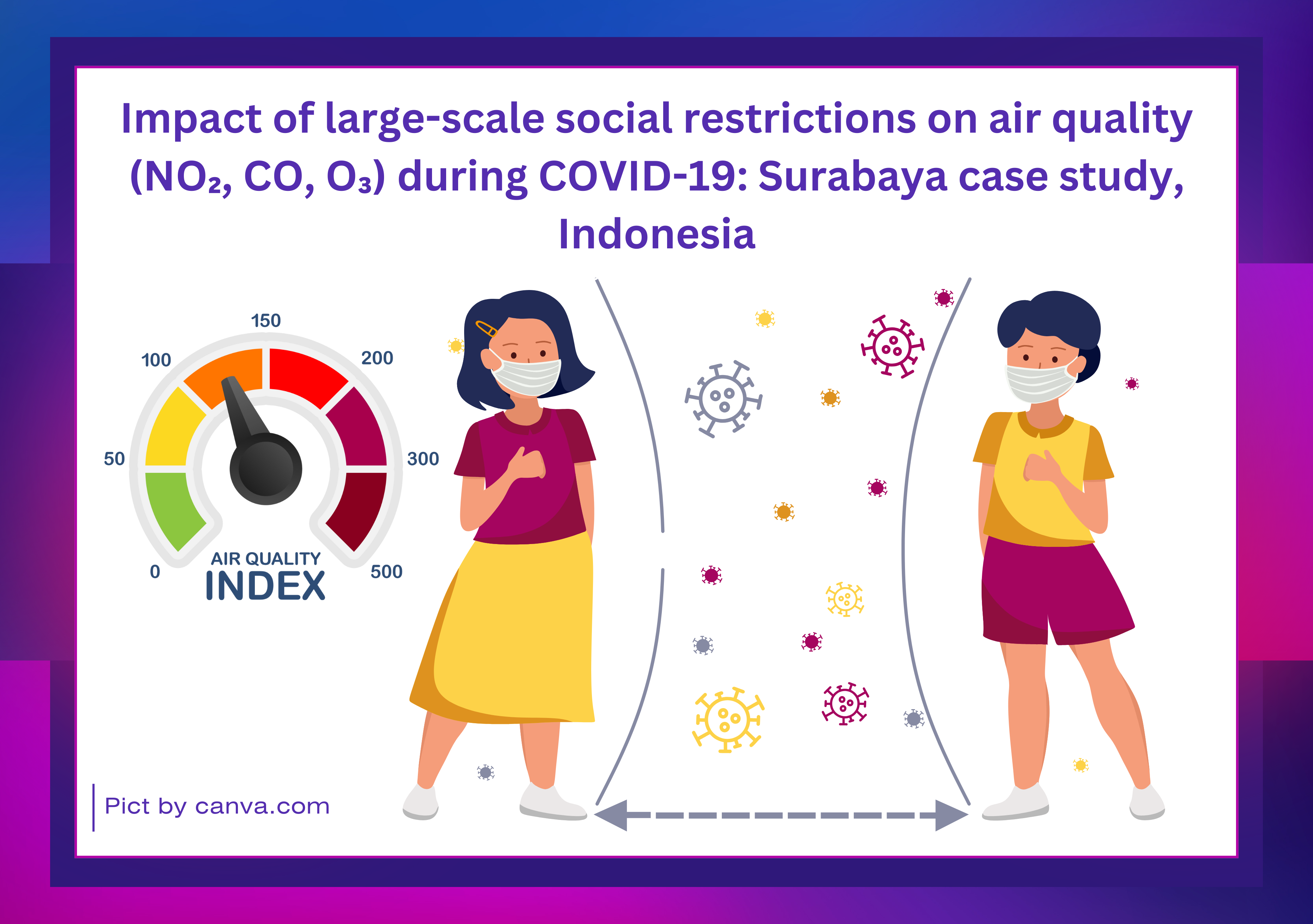
Impact of large-scale social restrictions on air quality (NO₂, CO, O₃) during COVID-19: Surabaya case study, Indonesia
Asmaul Nur Fitria1, Supriyadi Supriyadi2, Muhammad Al-Irsyad3, Anindya Hapsari41. State University of Malang , ID2. State University of Malang , ID3. State University of Malang , ID4. State University of Malang , ID2025-04-23|page 27-39AbstractBackground: The COVID-19 pandemic galvanized the world at the end of 2019. It was identified as an attack on humans and spread very quickly almost all over the world. As the person in charge of protecting the community, the government makes a policy that can suppress the spread of the COVID-19 virus.
Objectives: This study aims to determine whether implementing large-scale social restrictions (PSBB) in the COVID-19 period (2020 to 2021) impacts air quality in Surabaya City, East Java.
Methods: This quantitative research uses an Analysis of Secondary Data (ADS) approach by utilizing secondary data as the primary source. This research was conducted at the Surabaya City Environmental Service, East Java Province, in July - August 2021, with the total population being all the results of NO2, O3, and CO air quality measurements in 2020-2021 during the COVID-19 pandemic in January 2020 to December 2021 at monitoring stations in Surabaya City. This study uses Wilcoxon test analysis.
Results: The results showed that implementing the first phase of large-scale social restrictions had no significant impact on NO₂ air quality in Surabaya City (p = 0.068). Implementing the transitional PSBB (second stage) had no significant impact on NO₂ air quality in Surabaya City (p = 0.068). Implementing the first and second phases of the PSBB has no significant impact on NO₂ air quality in Surabaya City (p = 0.173).
Conclusions: The implementation of PSBB Phase One and PSBB Phase Two (transition period) did not significantly impact the air quality of NO2, CO, or O3 gases in Surabaya City. This finding challenges the common assumption that lockdowns automatically improve air quality and emphasizes the need for more comprehensive environmental policies.
APA Citation StyleFitria, A. N. , Supriyadi, S. , Al-Irsyad, M. , & Hapsari, A. (2025). Impact of large-scale social restrictions on air quality (NO₂, CO, O₃) during COVID-19: Surabaya case study, Indonesia. Public Health and Occupational Safety Journal, 27-39. https://doi.org/10.56003/phosj.v1i1.528

1 - 2 of 2 items