Search
Search Results
##search.searchResults.foundPlural##
-

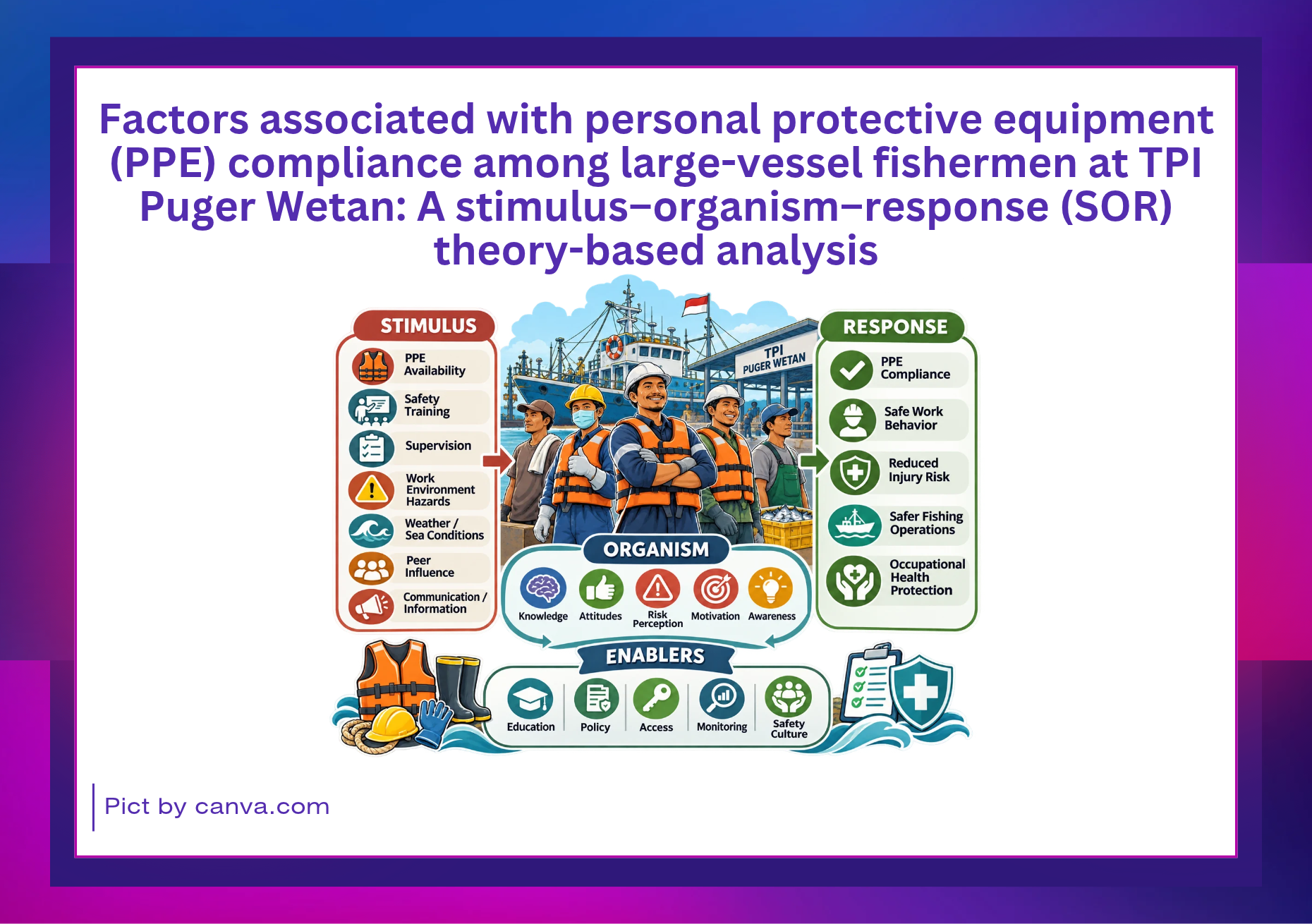
Factors associated with personal protective equipment (PPE) compliance among large-vessel fishermen at TPI Puger Wetan: A stimulus–organism–response (SOR) theory-based analysis
Putri Alifah Salsabila1, Nesya Nesya2, Fazilatu Afza3, Alisya Puspita Sari4, Kamiliyatul Yanani5, Rachel Mutiara Jasmine6, Bunga Tri Cantika7, Nazwa Ajeng Vania Putri8, Davina Zahra Fernanda9, Farida Wahyu Ningtyias10, Sri Rahayu Pudjiati11, Yunus Ariyanto12, Taufan Asrisyah Ode131. Universitas Jember , ID2. Universitas Jember , ID3. Universitas Jember , ID4. Universitas Jember , ID5. Universitas Jember , ID6. Universitas Jember , ID7. Universitas Jember , ID8. Universitas Jember , ID9. Universitas Jember , ID10. Universitas Jember , ID11. Universitas Jember , ID12. Universitas Jember , ID13. Universitas Jember , ID2026-11-19|page 70-86AbstractBackground: Large-vessel fishermen face substantial occupational hazards, yet compliance with personal protective equipment (PPE) requirements remains low. The stimulus–organism–response (SOR) theory provides a framework for exam-ining factors associated with PPE compliance.
Objectives: To identify factors associated with PPE compliance among large-vessel fishermen at the Puger Wetan Fish Landing Site (TPI Puger Wetan).
Methods: This analytical cross-sectional study included 52 fishermen selected through simple random sampling. Data were collected through structured ques-tionnaire-based interviews. Associations were examined using the Fisher–Freeman–Halton exact test (α = 0.05) because the chi-square test assumptions were not met. Cramér's V was used to assess association strength.
Results: Most respondents (63.5%) were noncompliant with PPE requirements. Significant associations were found for educational attainment (p = 0.004), knowledge (p < 0.001), PPE training (p = 0.005), regulations (p = 0.012), and reward-and-punishment systems (p < 0.001), with Cramér's V values ranging from 0.41 to 0.62. Age, length of service, working hours, attitude, PPE availability, and supervision showed no significant associations.
Conclusions: Educational attainment, knowledge, training, regulations, and re-ward-and-punishment systems were significantly associated with PPE compliance. Strengthening occupational safety education, training, and policy implementation may improve compliance. However, the cross-sectional design and unadjusted analyses preclude causal inferences.APA Citation StyleSalsabila, P. A. , Nesya, N. , Afza, F. , Sari, A. P. , Yanani, K. , Jasmine, R. M. , Cantika, B. T. , Putri, N. A. V. , Fernanda, D. Z. , Ningtyias, F. W. , Pudjiati, S. R. , Ariyanto, Y. , & Ode, T. A. (2026). Factors associated with personal protective equipment (PPE) compliance among large-vessel fishermen at TPI Puger Wetan: A stimulus–organism–response (SOR) theory-based analysis. Public Health and Occupational Safety Journal, 70-86. https://doi.org/10.56003/phosj.v2i2.780 -
Occupational safety and health hazards among artisanal and small-scale gold miners at Mazowe Jumbo Mine, Zimbabwe: A mixed-methods cross-sectional study
Bridget Nyamombe1, Vincent Itai Tanyanyiwa21. Zimbabwe Open University , ZW2. Zimbabwe Open University , ZW2025-11-28|page 151-162AbstractBackground: Artisanal and small-scale gold mining (ASGM) is associated with multiple occupational hazards that artisans are often unaware of.
Objectives: To identify the occupational hazards and risk factors among artisanal gold miners at Mazowe Jumbo mine, Zimbabwe.
Methods: The cross-sectional study employed Mixed-methods(Sep- Nov 2023). Purposive sampling of 34 miners from two sites (response rate was 100%). The interview was administered using questionnaires, structured interviews, field observations, and document review. Quantitative data were analyzed descriptively (frequencies and proportions), and qualitative data underwent thematic analysis.
Results: Heavy lifting was reported by 100% (34/34), manual handling by 91.2% (31/34), silica dust exposure by 91.2% (31/34), and contaminated water by 85.3% (29/34). Key risk factors included lack of PPE, financial pressure, and low OSH awareness. Field observations noted unsecured shafts, poor sanitation, and evidence of substance use on site.
Conclusions: ASG miners at Mazowe Jumbo Mine face multi-domain OSH hazards. We recommend targeted OSH training programmes, provision of PPE, improved sanitation, and monitoring/ formalization of ASGM activities.
APA Citation StyleNyamombe, B. , & Tanyanyiwa, V. I. (2025). Occupational safety and health hazards among artisanal and small-scale gold miners at Mazowe Jumbo Mine, Zimbabwe: A mixed-methods cross-sectional study. Public Health and Occupational Safety Journal, 151-162. https://doi.org/10.56003/phosj.v1i2.638

1 - 2 of 2 items