Search
Search Results
##search.searchResults.foundPlural##
-


Enhancing basketball technique learning using I-spring application: A study in high school physical education
Hadi Saputro1, Rama Kurniawan2, Surya Adi Saputra3, Usman Wahyudi41. State University of Malang , ID2. State University of Malang , ID3. State University of Malang , ID4. State University of Malang , ID2025-10-08|page 1-14AbstractBackground: High school students feel less able to master the subject of Physical Education, Sports, and Health (PJOK) Basketball material in a relatively short meeting, so it needs innovative learning.
Objectives: This research was conducted to develop learning media for basketball game material based on the I-Spring application to facilitate students' learning.
Methods: This research uses the Research and Development (R&D) method using the ADDIE model, which refers to Lee and Owens. Data collection was done through direct observation and questionnaire distribution. The research subjects were the students of Senior High School 1 Gondanglegi, Malang Regency, Indonesia, which amounted to 866 students. The data analysis method used is descriptive qualitative using Likert scale calculation.
Results: The observation results showed that 95.5% of students had participated in basketball learning in class or on the field, 71.2% of students had difficulty learning the basic techniques of basketball games, and 92.4 students needed application-based learning media to understand more deeply and be able to practice basic basketball techniques. Small group trials on 10 students obtained results of 85.2% and 86.4% for large group trials with 30 students.
Conclusions: The developed product is feasible for PJOK learning, especially basketball material at State Senior High School 1 Gondanglegi. Future studies are encouraged to expand the material coverage and evaluate long-term learning outcomes using the developed application.
APA Citation StyleSaputro, H. , Kurniawan, R. , Saputra, S. A. , & Wahyudi, U. (2025). Enhancing basketball technique learning using I-spring application: A study in high school physical education. Journal of Artificial Intelligence in Education & Learning Innovation, 1-14. https://doi.org/10.56003/jaieli.v1i1.522 -
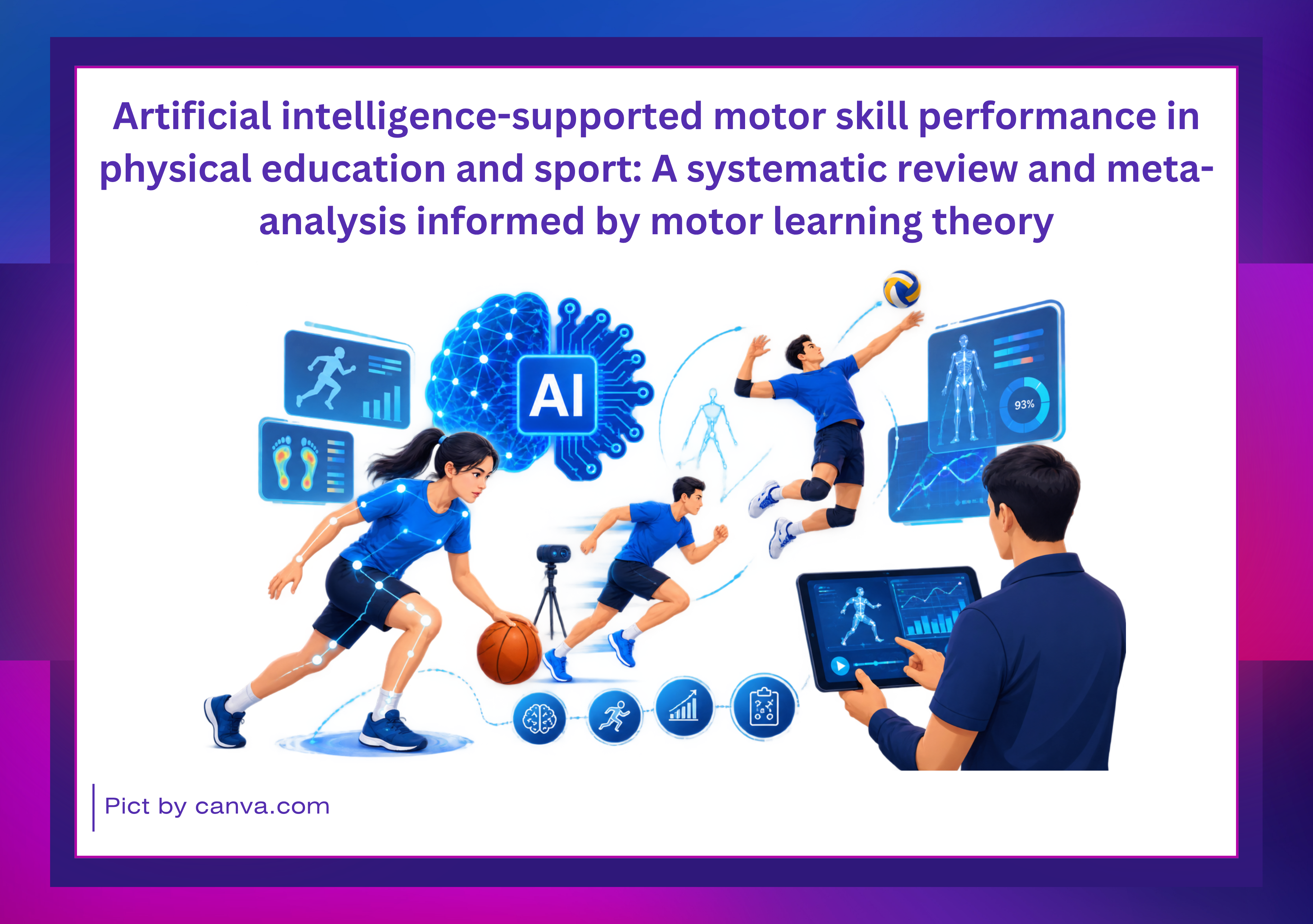
Artificial intelligence-supported motor skill performance in physical education and sport: A systematic review and meta-analysis informed by motor learning theory
Yulingga Nanda Hanief1, Vera Septi Sistiasih2, Ferdinando Cereda3, Spyridon Plakias41. Department of Sport Education, Faculty of Sports Science, Universitas Negeri Semarang , ID2. Department of Sport Education, Faculty of Sports Science, Universitas Negeri Semarang , ID3. Department of Education, The Catholic University of the Sacred Heart in Milan, Italy , IT4. Department of Physical Education and Sport Science, University of Thessaly , GR2026-08-30|page 44-71AbstractBackground: Artificial Intelligence (AI) has increasingly been integrated into physical education (PE) to support motor learning through technologies such as computer vision, motion tracking, intelligent tutoring systems, virtual reality, and generative AI. However, evidence regarding its effectiveness remains fragmented across different intervention types and learning contexts.
Objectives: This study aimed to evaluate the effects of AI-supported interventions on motor skill performance in physical education and sport settings and to synthesize complementary learning-related outcomes.
Methods: A systematic review and meta-analysis were conducted in accordance with PRISMA 2020. Scopus, PubMed, and ProQuest were searched through 22 June 2026. Eligible studies evaluated AI-supported, adaptive, or intelligent interventions in physical education, sport, or motor skill-learning contexts and reported learner-level motor performance; complementary learning-related outcomes were synthesized narratively. Risk of bias was assessed using RoB 2 and ROBINS-I, and standardized mean differences (SMDs) with 95% confidence intervals (CIs) were synthesized using a random-effects model.
Results: Fifteen studies were included in the qualitative synthesis; six contributed to the meta-analysis and nine were synthesized narratively. The pooled estimate favored the designated AI-supported experimental conditions over their comparators (SMD = 3.15, 95% CI 1.86–4.44; p < .001; I² = 98%). Given the small evidence base, very high heterogeneity, and variable risk of bias, the magnitude of this pooled effect is uncertain. Qualitative findings concerned short-term motor skill performance and complementary outcomes such as engagement, motivation, learning interest, and self-directed learning.
Conclusions: AI-supported interventions may improve short-term motor skill performance in some physical education and sport contexts and may support complementary learning-related outcomes. However, the evidence is preliminary and highly heterogeneous, and immediate post-intervention performance should not be interpreted as definitive evidence of durable motor learning, retention, or transfer. AI should be considered a complementary pedagogical tool rather than a replacement for teacher or coach expertise.
APA Citation StyleHanief, Y. N. , Sistiasih, V. S. , Cereda, F. , & Plakias, S. (2026). Artificial intelligence-supported motor skill performance in physical education and sport: A systematic review and meta-analysis informed by motor learning theory. Journal of Artificial Intelligence in Education & Learning Innovation, 44-71. https://doi.org/10.56003/jaieli.v2i1.753

1 - 2 of 2 items