Search
Search Results
##search.searchResults.foundPlural##
-

Injury pattern and risk factors in grassroots football: A study of 10-year-old athletes
Leo Ferdinand1, Yulingga Nanda Hanief2, Randy M. Manimtim31. State University of Malang , ID2. State University of Malang , ID3. Batangas State University TNEU , PH2025-06-17|page 27-39AbstractBackground: Young football players, especially in grassroots competitions, are highly susceptible to injury due to physical contact, fatigue, and underdeveloped motor skills, making injury prevention a critical aspect of early childhood sports.
Objectives: This study aims to analyze the types, causes, and needs for injury prevention in 10-year-old football players.
Methods: A descriptive quantitative design was used with the survey method. Data was collected through a structured questionnaire distributed to players injured during the competition. A purposive sampling technique was applied with inclusion criteria: (1) players injured during the match and (2) willing to participate. The final sample consisted of 25 athletes.
Results: A total of 25 injury incidents were recorded. The most common type of injury was contusion, reaching 13 cases (52%), followed by muscle cramps (20%) and sprains (8%). Most injuries (64%) occurred in the lower extremities, especially the knee and thigh. Injuries predominantly occurred in the second half of matches (60%), with 88% caused by physical contact with an opponent. In the absence of medical personnel, coaches often found themselves in the role of first responders, a challenging position that requires adequate training and support. Many players continued to play despite their injuries, indicating a need for improved injury management.
Conclusions: The study concluded that football injuries in children generally occur in the lower extremities, with bruising being the most dominant type. Player-to-player collisions caused most injuries, and many players could continue the match. This shows the importance of prevention, education, and follow-up for developing the sport of football.
APA Citation StyleFerdinand, L. , Hanief, Y. N. , & Manimtim, R. M. (2025). Injury pattern and risk factors in grassroots football: A study of 10-year-old athletes. Sport, Exercise, and Injury, 27-39. https://doi.org/10.56003/sei.v1i1.512 -
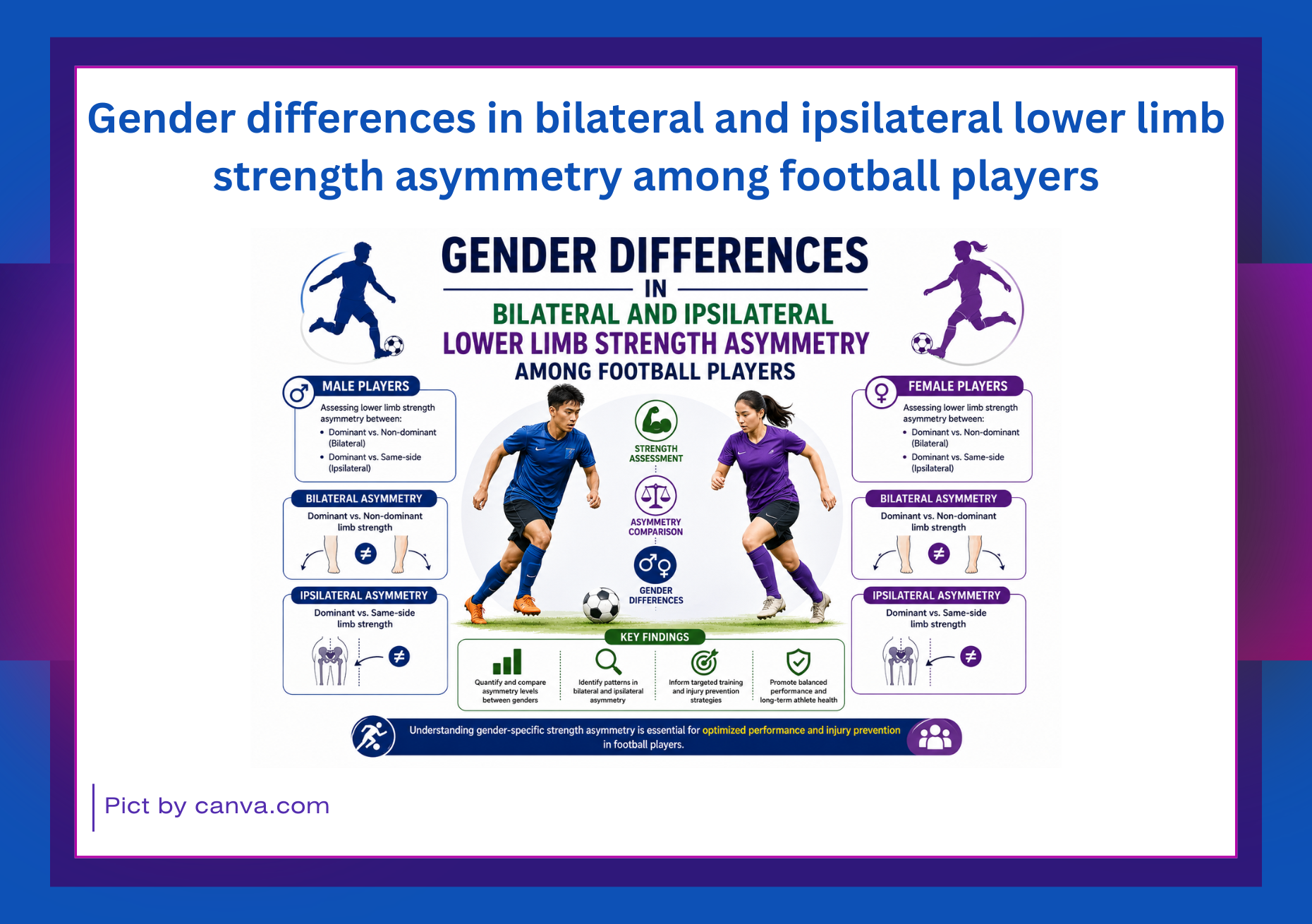
Gender differences in bilateral and ipsilateral lower limb strength asymmetry among football players
Randy R. Manimtim1, Eissel Ronquillo21. Office of Sports Development Program, Batangas State University The National Engineering University Lipa Campus , PH2. Department of Physical Education, School of Education, Holy Angel University , PH2026-06-02|page 1-10AbstractBackground: Lower limb muscle strength asymmetry is a significant factor that can impact playing ability and increase the risk of injury in soccer players. Differences in leg use and the specific movement requirements of a sport can lead to strength imbalances, either on both sides of the body or on the same side. Lower limb muscle strength asymmetry, particularly bilateral and ipsilateral strength asymmetry, is a significant factor influencing performance and increasing injury risk in football players. Differences in limb dominance and sport-specific movement demands can lead to strength imbalances.
Objectives: This study aimed to compare bilateral and ipsilateral lower limb strength asymmetry between male and female football players.
Methods: A cross-sectional study was conducted involving 50 amateur football players (26 males and 24 females; aged 18–21 years). Isokinetic strength testing of knee extensors and flexors was performed at 60°/s. Bilateral asymmetry was calculated based on peak torque differences between limbs, while ipsilateral asymmetry was assessed using the hamstring-to-quadriceps (H/Q) ratio. Statistical analyses included the Mann–Whitney U test and independent t-test (p < 0.05).
Results: Significant sex differences were found in bilateral strength asymmetry for both quadriceps (7.21 ± 4.04% vs 5.04 ± 3.13%, p = 0.02) and hamstrings (9.13 ± 5.15% vs 5.06 ± 4.04%, p = 0.01), with males showing greater asymmetry. Female athletes demonstrated values closer to the recommended asymmetry threshold (≤10–15%). No significant differences were observed in ipsilateral strength asymmetry (H/Q ratio) between groups (p > 0.05).
Conclusions: Bilateral strength asymmetry differs by sex, with male athletes exhibiting higher imbalance, while ipsilateral strength balance is comparable between groups. These findings highlight the importance of monitoring individual strength asymmetry to inform targeted training strategies, reduce injury risk, and optimize performance in football players.
APA Citation StyleManimtim, R. R. , & Ronquillo, E. (2026). Gender differences in bilateral and ipsilateral lower limb strength asymmetry among football players. Sport, Exercise, and Injury, 1-10. https://doi.org/10.56003/sei.v2i1.681

1 - 2 of 2 items